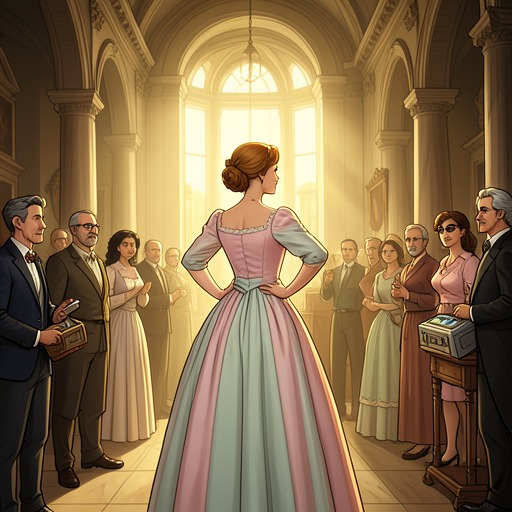
Peter Walsh
Mrs DallowayPeter Walsh is Clarissa Dalloway’s former suitor, a returning traveler whose visit brings their unresolved history into the present. Newly back in London after five years in India, he moves between hope, embarrassment, and self-reproach: he can imagine telling Clarissa that he loves her, yet repeatedly finds himself unable to make feeling simple or speak it plainly. His restless inward life also connects the novel’s private memories to the city’s public movement and to its wider concern with how little one person can fully know another.
Identity and Return
Peter arrives at Clarissa’s house on the morning she is preparing to give a party. He has been away in India for five years, and he expects that she will receive him. Clarissa has not read his letter; when he appears, she is surprised and glad, but takes a moment to recall his name. Their meeting begins in the awkward intimacy of recognition: Peter trembles, takes both her hands, and kisses them, while noticing that she has grown older and deciding not to mention it.
The return is also part of a larger remembered history. At a lunch with Clarissa, Richard Dalloway, and Hugh Whitbread, Lady Millicent Bruton brings up Peter as an old friend. Those present recall that he had passionately loved Clarissa, been rejected, gone to India, and made a mess of things. Richard is genuinely glad that Peter is back and retains great affection for him. Peter’s past is thus known beyond the former couple, but the emotional meaning of that past remains especially unsettled for Peter himself.
The Visit and Its Aftermath
In the house, Clarissa asks what has happened to him. Peter tries to assemble an account of his life, including his Oxford career, his marriage, and his work. The effort stirs him; he raises his hands to his forehead as he struggles to give shape to the many things he might tell her. Their conversation is more than an exchange of news: each is measuring the person before them against memories that neither can wholly share.
After leaving, Peter thinks that Clarissa has refused him. The thought empties him, and the narration briefly makes the city’s passing cloud and the cessation of effort echo his inward stillness. He stands with the conviction that she rejected him, even though his return has brought them together again. His response shows how strongly the old decision continues to organize his sense of himself, despite the life he has lived since.
On another walk, Peter follows a woman through London, imagining himself as a reckless adventurer who has cast off respectability. Other pedestrians repeatedly obstruct his view; the woman eventually enters a house and disappears. Clarissa’s reminder of her party continues to sound in his thoughts. The episode turns urban movement into a rehearsal of Peter’s pursuit and loss: he can follow, imagine, and invest a stranger with significance, but the encounter ends at a closed threshold rather than in a relationship.
Clarissa, Intimacy, and What Remains Unsaid
Peter’s attachment to Clarissa persists alongside his judgment of her. He thinks her hard and somewhat sentimental, and remembers what he sees as her timidity becoming conventionality. He is also ashamed that he has been emotional and told her everything, as he feels he has done before. The oscillation between accusation, affection, and embarrassment makes his recollections less a settled account of the past than a continuing argument with it.
A memory of their earlier conversations gives that argument a broader subject: the difficulty of knowing other people. Peter recalls exploring London with Clarissa, including rides on top of an omnibus and visits to the Caledonian Market. They had wondered how people could meet daily and then go months or years without meeting, and how little they consequently knew of one another. Clarissa’s theory was that a person might be felt everywhere rather than located only in one place; to know someone, she suggested, one had to seek the people and places that completed them. Peter remembers this as one of their shared theories, but their later separation gives the idea a painful limit: intimacy can be real without making either person fully knowable to the other.
At the evening party, Peter is still thinking about Clarissa. He tells Sally Seton that he does not know what he feels. He describes his relations with Clarissa as difficult and says that the relationship spoiled his life; he also insists that he cannot be in love twice. Sally recognizes that his attention remains fixed on Clarissa and that he wants her to come and speak with them. Peter’s declaration of uncertainty does not cancel his attachment; it exposes the gap between the force of his feeling and his ability to define it.
London, Memory, and the Ending
Peter’s movements through London repeatedly bring private thought into contact with the public city. The streets, shops, and crowds are not merely scenery: their interruptions redirect his attention, while the city’s clocks mark time passing even as he returns mentally to the moment Clarissa refused him. His walk after leaving her house and his later recollection of their journeys together give London two simultaneous meanings—as the place where people cross paths and as a map of remembered closeness that cannot restore the past.
By the end, Peter remains capable of imagining a future meeting: he invites Sally and her husband to have him stay with them in Manchester once he has finished what he has to do in London. Yet this prospective connection does not resolve his feelings about Clarissa. The novel leaves him among the guests at her party, troubled and moved, still fidgeting with his knife and still longing for her attention. His arc offers no decisive reconciliation or clean release; instead, it brings the old attachment into renewed social life and leaves its meaning open, caught between remembered intimacy and the knowledge that feeling alone cannot make another person fully known.