Rest cure
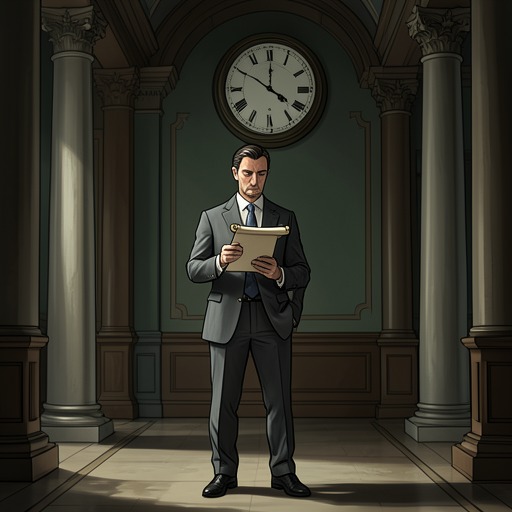
Mrs DallowayThe Rest cure is the enforced regimen Sir William Bradshaw proposes for Septimus Warren Smith: prolonged bed rest in a country home, apart from his wife, with solitude and silence treated as necessities. Presented as a response to a reported suicide threat, it becomes more than a treatment plan. Its language of proportion and order shows how medical authority can replace a patient’s account of his distress with an imposed definition of what counts as normal.
Diagnosis and prescription
When Bradshaw speaks with Lucrezia Warren Smith, he calls Septimus very seriously ill and asks whether he has threatened to kill himself. Rezia confirms that he has, but says he did not mean it and insists that he has done nothing wrong. Bradshaw answers that the issue is rest: a long period in bed at a country home where Septimus will be looked after. Rezia asks whether this means he will be away from her. Bradshaw says that, unfortunately, it does, adding that the people most cared for may not be good for a person when ill.
The exchange gives Rezia’s testimony a place in the consultation, but does not let it determine the decision. She distinguishes a threat from an intention and contests the implication that her husband is mad. Bradshaw avoids the word madness, describing the problem instead as a lack of a sense of proportion. He presents the proposed separation as unavoidable, telling her that there is no alternative. The treatment thus follows not from an account developed with Septimus, but from the doctor’s authoritative reading of his condition and risk.
What the regimen requires
Bradshaw describes a country home, capable nurses, and weekly visits from himself. He assures Rezia that he does not hurry his patients and asks whether she has further questions before returning to Septimus. The plan’s reassuring details—the setting, the nursing, the regular medical visit—sit beside its central cost: Septimus is to be removed from his wife and placed under a system she cannot refuse. Rezia has nothing more to ask, but her silence does not resolve her concerns.
The novel broadens this individual prescription into a rule of treatment. In its account of Bradshaw’s practice, a patient who is judged deluded, has a message, or threatens suicide is met with proportion and ordered rest: solitude, silence, and a long period without friends, books, or messages. The regimen is described as lasting six months, with a stark before-and-after measure of weight: a man entering at seven stone six may leave weighing twelve. These details make the cure legible as a structured program of isolation rather than a brief interval of recuperation.
Proportion as medical authority
Bradshaw’s appeal to proportion supplies the rationale for the Rest cure and reveals its governing value. In the novel’s critical account, he treats proportion as a power to classify and contain: people whose perceptions or claims exceed his standard are to be secluded until they share his sense of proportion. The treatment’s silence and separation are therefore not neutral surroundings. They enact a judgment about which forms of speech, feeling, and interpretation are acceptable.
That judgment conflicts with Septimus’s attempt to communicate what he believes he has learned. His thoughts move among universal love, the absence of crime, beauty, and the meaning of human life; Rezia sees him writing about war, Shakespeare, and the claim that there is no death. She also sees how difficult it is to follow these writings, which stop, change direction, and gather new material. The Rest cure’s ban on messages and company would remove precisely the channels through which he tries to express an experience that the medical language of proportion cannot accommodate.
Rezia, Septimus, and the consequences
The decision is mediated through Rezia, who is both Septimus’s wife and his immediate advocate. When Septimus speaks to himself, she is alarmed and sends for Dr. Holmes; later she asks Bradshaw whether the proposed cure will take her husband away. Her concern is not an abstract objection to treatment: separation threatens the companionship through which she has tried to care for him. Bradshaw’s explanation that loved ones may hinder recovery turns that bond into a reason for removing her from the process.
The narrative places this prescription within a wider pattern of failed communication between Septimus and the people claiming to help him. Rezia reports his condition, doctors interpret it, and decisions are made about his future; Septimus’s own meanings remain at odds with the clinical description. Against that imbalance, the Rest cure stands as the practical expression of Bradshaw’s authority: care is offered through control of place, company, and speech. Its significance lies in the contrast between a treatment presented as order and the isolation it demands from a patient whose distress has not been met by understanding.