Sir William Bradshaw
Mrs DallowaySir William Bradshaw is a prominent physician whose professional standing rests on the authority to diagnose and manage mental illness. In his treatment of Septimus Warren Smith, that authority becomes more than medical expertise: his language of proportion and his insistence on rest and separation turn a clinical judgment into control over a patient’s life. The contrast between his reputation for sympathy and the distress of Septimus and Lucrezia Warren Smith makes him a central figure in the novel’s examination of who gets to define illness, and what happens when institutional certainty displaces the voices of the people being treated.
Identity and Professional Standing
The narrative presents Sir William as an older, accomplished doctor who has worked hard and risen from the son of a shopkeeper to a position of distinction. He loves his profession, speaks effectively at ceremonies, and is considered skilled in diagnosis. The continuous stream of patients and the responsibilities attached to his status have given him a weary appearance, but that weariness also contributes to the imposing presence through which he commands confidence. His reputation extends beyond technical ability: he is thought to possess sympathy, tact, and an understanding of the human soul.
That public standing is supported by a settled domestic and social success. His wife, Lady Bradshaw, has a son who is doing well at Eton; she takes part in child welfare and the after-care of epileptic patients, and pursues photography with considerable competence. Her life includes social and charitable duties, while her husband’s work continues to expand. These details place the Bradshaws within a world of professional achievement and established respectability, against which the experience of a distressed patient can appear to them as a problem to be classified and contained.
Diagnosis and Treatment of Septimus
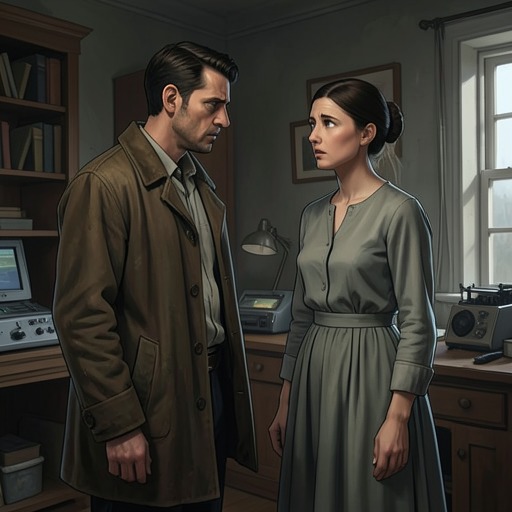
When the Warren Smiths consult him, Sir William says that he can recognize the case almost immediately. He judges Septimus to be in an advanced state of complete physical and nervous breakdown, and he records answers to his questions on a pink card. His confidence is explicit: he believes his experience and instinct enable him to identify the condition in only a few minutes. The clinical scene gives him the power to name what is happening, while Septimus’s own attempts to speak about his experience are treated as signs to be assessed.
Sir William asks whether Septimus has threatened to kill himself. Lucrezia confirms that he has, but says that she does not believe he meant it. The doctor responds that the case is a question of rest and prescribes a long period in bed at a country home, where Septimus will be looked after. He says that the couple must be separated because the people one cares for most are not good for one when one is ill. Lucrezia asks whether her husband is mad; Sir William avoids that word, instead describing his condition as a lack of a sense of proportion. He presents the treatment as necessary, not as a matter open to negotiation, and tells her that there is no alternative.
His plan is concrete and restrictive: Septimus is to stay in a country house, with nurses caring for him, and Sir William will visit once a week. The doctor gives Lucrezia an opportunity to ask questions, but the exchange does not give her meaningful influence over the decision. She is told that the arrangement is a question of law, and that the proposed separation will go ahead despite her concern about being sent away from her husband. When they return to Septimus, he is sitting under a skylight and muttering about beauty, still absorbed in an experience that the doctor’s plan has not addressed.
Proportion as a Social Principle
Sir William’s treatment reflects a broader commitment to what the narrative calls proportion. The ideal is not simply a feature of his diagnosis: it is a principle by which he judges people and organizes social life. The text associates its acquisition with his professional career, his recreation, and his household, then shows him using it to classify those who do not conform. Under this system, difference becomes evidence of disorder, and the doctor’s preferred standard is treated as a necessary form of health.
The consequences extend beyond Septimus. The narrative describes Sir William as helping to make England prosper while also secluding people called lunatics, penalizing despair, and preventing those considered unfit from spreading their views. Patients who imagine catastrophe or spiritual revelation are directed toward bed and milk. The doctor’s colleagues respect him, his subordinates fear him, and the friends and relations of patients are grateful for his decisiveness. That gratitude exposes an important divide: relatives may welcome the apparent certainty of his interventions even when the patient’s own perspective is silenced.
The account of his authority turns on a contradiction between humane manner and coercive effect. Sir William’s combination of decision and humanity makes him appealing to those who want someone to take charge; the same combination can obscure how thoroughly his will overrides that of the people under his care. His confidence that he is defending society, family affection, honour, and courage leaves little room for a patient whose experience challenges his measures of normality. Proportion thus appears as both a medical ideal and an instrument for enforcing social conformity.
Relations with Septimus and Lucrezia
Septimus experiences the doctor’s approach not as reassurance but as a threat. He recalls Sir William’s view that the people closest to a patient may be harmful and that the patient must be taught to rest. In Septimus’s mind, the instruction to rest and the impending separation join Dr. Holmes and Sir William into a single force of human nature that will pursue and constrain him. The novel sets this fear against Sir William’s calm, professional confidence: the doctor understands his plan as care, while Septimus experiences it as an assault on his freedom.
Lucrezia’s position is also divided. She seeks medical help because her husband is suffering and behaving in ways she cannot understand, yet she defends him when Sir William suggests the severity of his condition. She tells the doctor that Septimus has done nothing wrong and tries to distinguish his threats from an intention to act on them. Although she is the person closest to him and the principal witness to his changes, her account does not prevent the doctor from deciding on separation. After leaving the consultation, she says she does not like Sir William. Her reaction gives the clinical decision a consequence beyond diagnosis: it damages the confidence of the person who has brought Septimus for help.
That conflict continues in the household. When Sir William’s order is repeated to Septimus, he objects to the doctor’s authority to tell him what he must do. Lucrezia explains that the order follows from his talk of suicide, while also trying to protect him when Dr. Holmes later comes to the house. She refuses to let Holmes see her husband and positions herself between the doctor and the upstairs room. The two doctors therefore frame the crisis as a matter for professional intervention, while Lucrezia tries to preserve a private space in which Septimus is not simply at their disposal.
Narrative Significance
Sir William is drawn through the distance between the medical language of care and its effects on those subjected to it. He has credentials, experience, social respect, and a reputation for sympathy; the narrative does not erase those qualities. Instead, it shows how they can coexist with a system that reduces a patient’s account to symptoms and treats a contested judgment as settled fact. The pink card, the proposed country home, and the weekly visit give that system practical form: it assesses, relocates, and supervises.
His ideal of proportion also provides a counterpoint to Septimus’s fragmentary and intensely personal attempts to communicate. Septimus’s visions and declarations cannot be accepted at face value as a stable account of reality, but the narrative makes visible what the doctor’s classification leaves out: the patient’s terror, his longing to communicate, and the meaning he gives to beauty and to his dead friend Evans. Sir William’s diagnosis can name an illness without conveying the lived experience that has brought Septimus to this point. In that gap, professional certainty becomes part of the conflict rather than its resolution.
The character’s significance lies finally in the reach of ordinary authority. Sir William does not need to be portrayed as consciously cruel for his methods to become harmful: the force of his social standing, diagnostic confidence, and prescription is enough to make disagreement difficult to sustain. By placing his language of proportion beside Septimus’s resistance and Lucrezia’s alarm, the novel asks readers to notice not only what a doctor believes a patient needs, but who is heard when that belief determines the patient’s future.