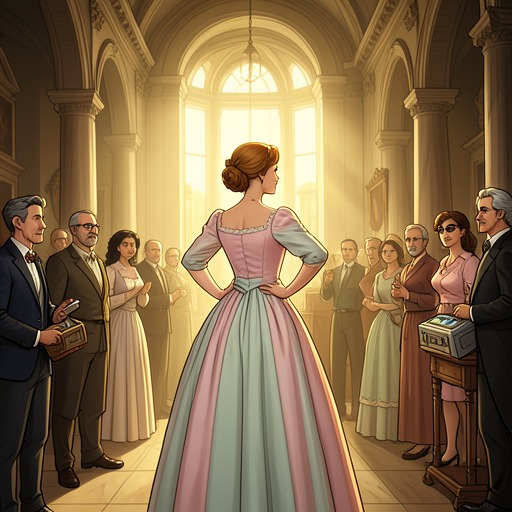
The party as an offering
Mrs DallowayClarissa Dalloway’s party is not merely a social performance but an offering: her chosen means of gathering lives that would otherwise remain separate. She knows that others may mistake her motive for vanity or a taste for famous company, yet understands the party as a gift made for life’s sake—an effort to connect people and affirm the value of ordinary days in the face of death.
The Meaning of the Offering
Clarissa arrives at this understanding while resting on a sofa and reconsidering the judgments Peter Walsh and Richard Dalloway have made of her parties. Peter, she thinks, takes her to enjoy imposing herself and gathering important people around her; Richard regards her excitement as foolish, especially because of her heart. She rejects both accounts. What she likes, she recognizes, is life, and the party is what she does for it. Her defense does not depend on convincing either man: she suspects that neither would understand what she means, because each would interpret the gathering through a different account of importance.
The party’s purpose becomes clearer as Clarissa imagines people scattered across London: one in South Kensington, another in Bayswater, another in Mayfair. She feels their separate existence and the waste of their remaining apart. Bringing them together is both an act of creation and an offering, though she cannot identify a recipient. It may be an offering simply for the sake of offering. That uncertainty is part of the idea: the gift need not secure a return or answer to a single person in order to matter.
Making the Gift in Daily Life
The offering takes practical form in work around the house. At the beginning of the day, Clarissa says she will buy the flowers herself, while the preparations require Lucy’s labor and the removal of doors for the arrival of Rumpelmayer’s men. Later, Clarissa takes a torn green evening dress from the cupboard, carries it to the window, and decides to mend it herself because the maids already have too much to do. She gathers her scissors, silks, and thimble, intending to sew while also writing and seeing that the house is in order. The party is an ideal, but it is also a schedule of concrete tasks and shared work.
The house registers this labor in sounds and movements: a map swishes, someone taps and knocks, the front door opens, a message is repeated below, and clean silver is carried upstairs. Clarissa understands the activity as being for the party. She praises the silver to Lucy, and when Lucy offers to help mend the dress, Clarissa thanks her repeatedly. Her gratitude is not only for the offer of assistance; she recognizes her servants’ help as part of the work that lets her become the gentle, generous person she wants to be. The gathering thus depends on a household effort that Clarissa notices even as she occupies the role of hostess.
Flowers, Invitations, and Encounter
Objects given or arranged for the party carry feeling between people. Richard, after leaving Hugh Whitbread, wants to visit Clarissa with something in his hands. He chooses flowers because he does not trust his taste in gold. He brings red and white roses, but cannot bring himself to say directly that he loves her. Clarissa understands the feeling without his saying it, takes the flowers, and puts them in vases on the mantelpiece. The gesture shows how an offering can communicate where explicit speech fails; it also places their private affection among the preparations for the gathering.
The party’s invitation extends beyond Clarissa’s closest circle. She considers whether to ask Ellie Henderson, whom Mrs. Marsham has said wants to come, even as she wonders why she should invite all the dull women in London. This uncertainty makes the hostess’s work more complicated than simple sociability: choosing whom to include is part of the effort to bring separate lives together, but the impulse toward inclusion coexists with judgments about who will interest her guests. At the party, Clarissa greets each arrival with the same welcoming formula. Peter Walsh, who knows few people there, hears the greeting as effusive and insincere and regrets having come. The disparity between her purpose and his judgment shows that the offering cannot guarantee that it will be understood or welcomed.
When Sally Seton appears after many years, their first awkward words tumble together as she explains that she is passing through London and has come without an invitation. They kiss by the drawing-room door. Clarissa takes Sally’s hand and turns back toward rooms filled with people, voices, candlesticks, moving curtains, and Richard’s roses. The reunion does not stand outside the party’s work of connection: it enters the gathering as a personal history renewed among its guests and objects.
Life, Time, and Mortality
For Clarissa, the party gives shape to a life measured in ordinary returns: Wednesday, Thursday, Friday, Saturday; waking in the morning, seeing the sky, walking in the park, meeting Hugh, and then having Peter suddenly come in, with Richard’s roses following. These recurring days and unexpected encounters are not trivial to her. Their continuation is enough, and it makes death harder to accept: the life she loves, instant by instant, must end, while the world may never know how fully she valued it.
The party’s significance lies in this tension. It is temporary, assembled from invitations, household labor, flowers, and brief meetings, yet it answers isolation by making a shared occasion. Clarissa’s offering cannot abolish death, settle every private distance, or persuade every guest of its value. It can, however, create a meeting point for lives that would otherwise remain apart. In treating that act of gathering as her gift, she gives domestic sociability a purpose that is personal, imperfect, and inseparable from her attachment to life.