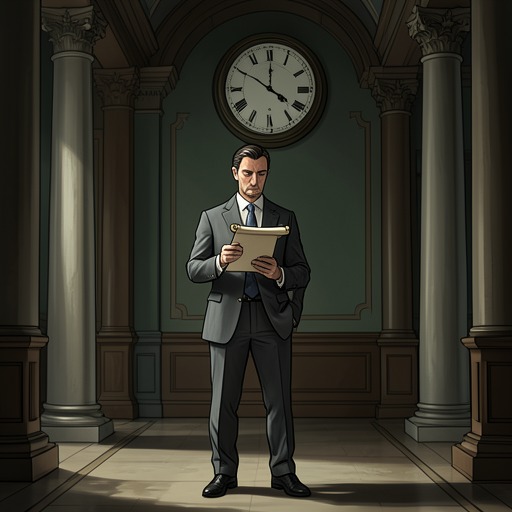
The principle of proportion
Mrs DallowayThe principle of proportion is Sir William Bradshaw’s rule for defining health and responding to distress. In his practice, health depends on proportion: patients whose speech or conduct departs from his standard are to be placed under a regimen of rest and isolation. The doctrine sounds like clinical order, but its force in Septimus Warren Smith’s case is also social and coercive: it displaces the patient’s own account, discounts his wife’s testimony, and determines where he will go and with whom he may remain.
Proportion as Medical Doctrine
Sir William treats proportion as the foundation of medical judgment. He allows each patient three-quarters of an hour and maintains that a doctor fails if he loses his sense of proportion. The nervous system and human brain, he acknowledges, are matters about which people know little; nonetheless, he makes proportion the practical standard by which illness is judged and managed. Health, in this account, is not simply the absence of distress but a state of order defined by the physician.
The treatment prescribed for a patient who threatens suicide is rest in bed, solitude, silence, and separation from friends, books, and messages. Sir William describes a six-month rest and invokes the measurable change in a patient’s weight as evidence of recovery. This concrete regimen gives proportion institutional power: a disputed interpretation of someone’s condition can lead to a sustained alteration of that person’s daily life and relationships.
The Smiths’ Crisis and Conflicting Accounts
The doctrine comes into focus through Septimus and Lucrezia Warren Smith’s encounter with Sir William. Septimus has threatened to kill himself. Lucrezia tells the doctor that he has done nothing wrong and insists that he did not mean the threat; Sir William nevertheless says there is no alternative to rest. He calls Septimus seriously ill, while avoiding the word madness and describing the problem instead as a lack of proportion. His terminology softens the diagnosis without changing the authority of the decision.
Sir William speaks with Lucrezia separately and tells her that the proposed country home will care for her husband. When she asks whether Septimus will be away from her, the doctor confirms that he will: people closest to a patient are, in his view, not good for the patient during illness. He presents the separation as a matter of law and emphasizes that the nurses are admirable and that he will visit once a week. Lucrezia has no further questions to ask him, but the plan has already been set out in terms that leave little room for her judgment or Septimus’s wishes.
The contrast between the clinical account and the couple’s experience is sharp. While Sir William explains the arrangement, Septimus sits in an armchair beneath a skylight, looking at a photograph of Lady Bradshaw in court dress and muttering about beauty. The doctor’s conversation classifies and organizes the crisis; Septimus’s speech belongs to a different register, one that the treatment plan does not recognize as a source of knowledge about what he is undergoing.
Authority, Resistance, and Consequences
For Septimus, medical authority is not neutral reassurance. He thinks that once someone falls, human nature is upon him, naming Dr. Holmes and Sir William as agents who pursue and constrain him. His perception turns the language of help into the language of capture. The narrative places this fear alongside the doctors’ confidence in proportion, exposing the distance between their orderly account of care and Septimus’s sense that he is being controlled.
The conflict also shapes Lucrezia’s position. She is required to answer for Septimus’s threat and to hear the case for removing him, even as she defends him and questions whether he is mad. Sir William’s decision privileges his professional interpretation over both her assurance that Septimus has done nothing wrong and the couple’s wish to remain together. Proportion thus operates not only as an idea about health but as a rule governing whose account is believed and who has authority to decide a patient’s future.
The doctrine’s broader reach is suggested by the narrative’s depiction of Sir William’s influence: he isolates people designated as mentally unwell and seeks to make those who fall outside his standard share his sense of proportion. Against this expansive authority, Septimus’s interrupted messages and Lucrezia’s effort to protect him reveal the human relationships the regimen risks excluding. The principle’s significance lies in that contradiction: it promises order and health, yet in practice can turn a contested judgment into enforced solitude and separation.