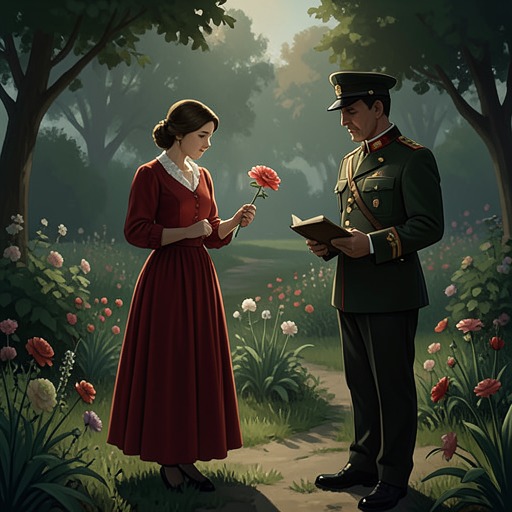
What a lark! What a plunge!
Mrs Dalloway“What a lark! What a plunge!” is Clarissa Dalloway’s remembered exclamation for the exhilaration of stepping through the French windows at Bourton into the open air. Recalled during her morning in London, the phrase makes a youthful bodily sensation recur within an ordinary day of errands, domestic work, and party preparations; its brightness carries both the promise of renewed experience and the awareness of what time, illness, and loss have changed.
The remembered plunge
The phrase first belongs to Clarissa at eighteen, standing at an open window in the early morning and then bursting through the French windows into the air. She remembers the day as fresh and calm, the air like a wave’s flap and kiss, chill and sharp. Yet the scene is not simply carefree: she had felt that something awful was about to happen as she looked at flowers and trees, while smoke wound above them and rooks rose and fell. The exclamation holds exhilaration and foreboding together from its first appearance.
Peter Walsh’s teasing remark about her musing among vegetables also attaches the memory to a particular social world. Clarissa is unsure of its exact wording, but recalls Peter’s sayings, eyes, pocket-knife, smile, and grumpiness even as many other things have vanished. The remembered plunge therefore evokes not only physical freedom but the vivid, fragmentary persistence of a relationship and a past that cannot be recovered intact.
A morning in the present
The memory surfaces as Clarissa goes out into London to buy flowers herself, with the practical preparations for the party already under way at home. The present-day morning has its own freshness, but the contrast with Bourton is marked: Clarissa is now over fifty and has grown very white since her illness. The young woman’s leap survives in language, while the body and circumstances from which it came have altered.
That contrast does not make the phrase a simple emblem of lost youth. Clarissa continues to meet the day through movement and attention, crossing the street, returning to the house, and taking part in its preparations. The remembered cry gives an ordinary act a sudden charge: a morning errand can open onto a past sensation without making the present identical to it.
Domestic work and the party
The energy of the phrase finds a quieter counterpart in Clarissa’s work at home. She retrieves a green evening dress torn at the Embassy party, notices that its color has faded in the sun, and decides to mend it herself because the maids already have too much to do. Sitting with scissors, silks, and needle, she thanks Lucy repeatedly for offering help, grateful to her servants for helping her become the gentle, generous-hearted person she wants to be. The leap through an open window and the careful repair of a dress are different kinds of action, but both make identity visible through what Clarissa does.
The preparations also show the social labor gathered around the evening. Clarissa senses the temper of the house through sounds rising on the stairs: tapping and knocking, a message repeated in the basement, and clean silver arriving on a tray. Her dresses and the servants’ work serve the party, while her own mending keeps her involved in its material details. The remembered phrase thus resonates within a day when vitality is expressed not only as an impulse to plunge outward but as sustained attention to people and tasks.
Recurrence and significance
Clarissa thinks of her party as an offering: an attempt to bring people together and create a meeting point for lives otherwise dispersed across London. That purpose gives the phrase’s image of a plunge a social echo. The youthful leap enters a novel in which connections are made through fleeting meetings, remembered gestures, and shared rooms, even though Clarissa recognizes how difficult it is to solve the separation between one person and another.
The phrase’s force lies in its unresolved double note. Its exuberance recalls a body entering the open air, but the memory is accompanied by an expectation of something awful, and its speaker now carries age and the effects of illness. Rather than erase that distance, the recurring exclamation makes past and present touch: a moment of youthful possibility remains alive in Clarissa’s language while the day’s practical obligations give that vitality a present form.