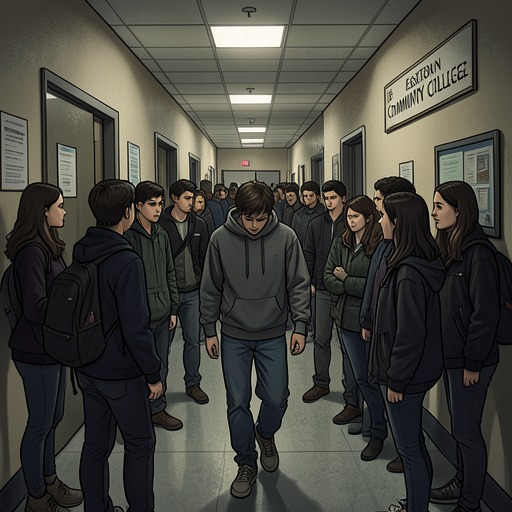
Eastern Community College
Mrs. FletcherEastern Community College is the setting for Eve Fletcher’s return to student life and Julian Spitzer’s reluctant start in higher education. Its evening classes give Eve a route out of an increasingly empty home, while one seminar offers Julian a rare intellectual counterweight to his disappointment with community college. The institution matters less as a prestigious destination than as a place where different generations, personal histories, and ideas about gender meet.
Setting and Access
Eve first considers Eastern Community College while in her kitchen, where she has retreated after an awkward interruption at Brendan’s bedroom door. As tea steeps, she looks through the college catalogue and circles classes that might fit her schedule. Brendan is leaving home, and the prospect of having more time to herself prompts her to seek activities that could take her outside the house and put her in contact with new people. The catalogue turns that need into a practical possibility: she can choose a class, make a schedule, and begin building a life not organized around someone else’s company.
When Eve later arrives for class, she walks through the Humanities Building looking for Room 213. The corridors hold other nontraditional students, including some older than she is, and their presence eases her sense of being out of place. Inside, the chairs are arranged in a circle. A crude message carved into a desk briefly disrupts the promise of a fresh start; Eve covers it with her new notebook and opens to a clean page. The classroom’s circle, the notebook, and the blank paper make the college feel like a modest but tangible space for beginning again.
Eve’s Return to Study
Eve already has a master’s degree in social work, earned through four years of night classes when Brendan was in elementary school. That earlier education had been one source of strain in her marriage to Ted: he resented her absences and the added parenting responsibilities, and he did not take her work seriously. In retrospect, his dismissiveness seems especially ironic because he now raises an autistic child and depends on specialists in the caring professions. Eve’s decision to enroll again is not a career move or an effort to add another credential. She wants to read, think, and reconnect with a version of herself she remembers as more open, fluid, and hopeful.
She selects Gender and Society: A Critical Perspective, a writing-intensive seminar meeting on Tuesday and Thursday evenings from 7:30 to 9:00. It is her third choice: the courses she preferred, one about the ethics of sustainable eating and another about Jane Austen and country-house fiction, are already full. The subject is not the main attraction. Being present, trying something unfamiliar, meeting people, and enlarging her world matter more than the course title. The twice-weekly schedule also gives her a reason to leave the house without needing to persuade anyone to come with her.
The seminar’s instructor, Margo Fairchild, introduces herself as an adjunct professor and makes clear that the position is poorly paid. Her classroom presence is confident and theatrical, but the course also draws attention to the gap between abstract ideas and lived experience. For Eve, the class is at once an intellectual activity and a social opening: she later speaks enthusiastically about its diverse students and challenging reading. Brendan, hearing this, is irritated by her excitement and compares her single course with the heavier demands of his own college schedule. Their different reactions show how the same institution can signify discovery to one person and obligation to another.
Julian’s Uneven Start
Julian attends Eastern Community College after a difficult senior year of high school leaves him too depressed to complete applications on time. His medication is adjusted repeatedly before he begins to feel better, but the improvement comes too late for the application cycle. His parents and psychiatrist encourage him to take classes at ECC, build confidence, and potentially transfer to a four-year school if he does well. In his mind, the college is a temporary substitute for a more selective institution he believes he could have entered.
That disappointment shapes his early view of the coursework. He finds math easier than high school and earns high marks in biology despite dozing in class. Gender and Society is the exception: a night seminar with adult students and Margo, whose experience of transitioning after being assigned male at birth gives her teaching a personal dimension. The material introduces Julian to terms concerning gender and to everyday rules he had rarely thought to question, from expectations about clothing and temperament to assumptions about who looks and who is looked at. He recognizes that such rules are taught and enforced by people across ordinary life, not only by formal authorities. The class therefore challenges him in a way his other courses do not, even as he continues to imagine ECC as a stepping-stone rather than his final destination.
A Meeting Place in the Wider Story
Eve’s seminar also connects her to Julian, a former high-school acquaintance of Brendan. She learns from a classmate that Julian attended school with her son and mentions the name to Brendan. His pause and guarded response expose a past connection that he does not want to discuss freely. The college thus becomes a meeting point not just for students but for separate strands of the family’s life: Eve’s effort to make new connections leads directly to a name associated with Brendan’s history.
The institution’s significance rests in these contrasting uses. Eve comes seeking renewed independence and intellectual company; Julian arrives after depression and a missed opportunity, expecting little and finding one course that makes him reconsider ordinary assumptions. Their shared seminar does not erase the differences in their ages, motives, or circumstances. Instead, Eastern Community College gives those differences a common room and schedule, allowing private transitions to intersect through study. Its promise is deliberately modest: not a guaranteed transformation, but a place to begin, return, or think differently.