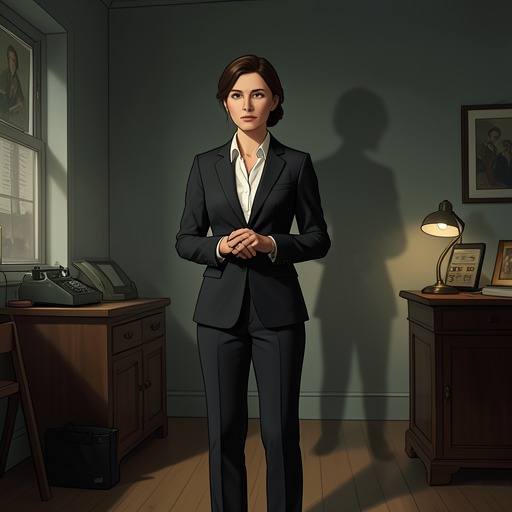
Eve, Amanda, and Julian’s encounter
Mrs. FletcherEve Fletcher, Amanda Olney, and Julian Spitzer’s encounter begins when Eve opens a bedroom door to investigate a sound and ends with Eve joining Amanda and Julian. The scene reverses Eve’s earlier restraint toward Amanda: a kiss that had once ended in uncertainty is now welcomed, but Eve later understands her choice not as care for Julian or a considered step toward intimacy, but as an impulsive response to loneliness.
From Caution to Invitation
Before the encounter, Eve had wanted to pursue Amanda but held back. New friends were rare, she believed, and more valuable than a fleeting sexual adventure that might leave both women hurt or confused. Amanda had seemed disappointed when Eve did not go further, and Eve thought they could talk about what had passed between them another time, when they were sober and not spending the night under the same roof. That restraint establishes the choice she makes later as a reversal, not a continuation of an agreed plan.
In the dark, Eve hears a distressed groan from what she recognizes as Brendan Fletcher’s room. The sound recalls the familiar routine of checking on her son and listening for steady breathing, but this time she hears no reassurance. Unlike the previous occasion, when she retreated in horror, she opens the door a crack and looks inside. Amanda is on top of Julian, her polka-dot dress undone to the waist. She turns toward Eve without visible embarrassment and apologizes for waking her; Eve replies that it is not their fault, since she is a light sleeper.
Eve steps farther into the room as Amanda continues rocking gently. The movement feels beautiful to watch and strangely familiar to Eve, like something recalled from a dream or seen in a video. Julian asks whether Eve is comfortable with what is happening, and Amanda answers that she is. Eve’s foot lands on a roll of condoms on the floor, an unexpected physical detail that reassures her the pair are being safe. Then Amanda reaches for Eve’s hand and calls her Ursula. Eve bends down and kisses Amanda. This time, the kiss brings no confusion or rejection: it is slow and welcoming, and continues until Julian tentatively places a hand on Eve’s breast and asks again whether she is comfortable with it.
Loneliness, Impulse, and Responsibility
The scene’s consent checks do not settle the question Eve later has to face: why she entered the room. In the moment, Julian asks whether she is comfortable, and Eve has time to think before answering; afterward, she does not treat that exchange as proof that her decision was wise. She distinguishes her own position from Amanda’s and Julian’s. They had been drinking and, in Eve’s view, were young and free to make their own choices. Eve, by contrast, was the homeowner, host, boss, and adult present. Those roles make her feel responsible for recognizing the imbalance and for exercising better judgment, not simply for responding to what she wanted.
Eve initially frames her entry as concern for Julian, whose room she had heard from the hallway. In retrospect, she acknowledges that concern may have been present at first, but it was no longer her real reason by the time she opened the door. She had already understood what was happening and did not want to be excluded. The admission changes the meaning of her movement down the hall: what began with the familiar vigilance of a mother checking on her son became a choice to step into another pair’s private encounter.
The force behind that choice, Eve concludes, was loneliness. Retreating to her bedroom meant returning to the feeling of being stranded alone in bed, a state of self-pity she believed she had already spent too much time inhabiting. Rather than endure that isolation while Amanda and Julian were together, she invited herself into their moment without considering what might follow. Eve calls the decision selfish and childish, and recognizes that it could have caused greater harm. The encounter therefore turns on a contrast between immediate welcome and later responsibility: Eve’s participation was not an extension of the careful restraint she had shown toward Amanda earlier, but an impulsive bid not to be left alone.
Discovery and Immediate Aftermath
The encounter’s private aftermath changes abruptly when Brendan Fletcher arrives without warning, letting himself into the house with the spare key hidden in a fake rock beneath the azalea bush. By then, Amanda has gone home, too embarrassed to stay overnight, and Eve has returned to her bedroom to process what happened. Brendan therefore encounters neither the beginning of the encounter nor its participants together, but its physical residue: Julian Spitzer, a young man he vaguely knows from high school, asleep naked amid tangled sheets and blankets, a roll of condoms on the floor, and two torn, empty wrappers. The objects make the intimacy visible before Eve appears to explain anything.
Brendan seems more confused than angry. He turns on the light and calls for his mother repeatedly, while Julian pulls on his jeans and tries to reassure him in a calm but frightened voice that everything is fine. Eve emerges from her room clutching the lapels of her fuzzy pink robe. The contrast between Julian’s attempted reassurance and the scene Brendan has walked into leaves the assurance unconvincing; the encounter that had felt welcoming to Eve now has an immediate family consequence, witnessed in the disarray of her home.
Eve feels terrible about sending Julian away on his skateboard in the middle of the night, but decides that getting him out of the house quickly is best for everyone. That hurried departure closes the episode without resolving its discomfort. Amanda has already withdrawn, Brendan has arrived to a scene he cannot readily make sense of, and Eve’s own later judgment of her actions is sharpened by the fact that what she had treated as an escape from loneliness has also placed others in an awkward, exposed position.
The Encounter’s Unresolved Meaning
The scene separates consent in the moment from responsibility understood afterward. Julian’s questions and Amanda’s welcome establish that Eve is not simply imposing herself against an expressed refusal; they do not answer whether entering the encounter was a sound choice within the household and relationships involved. Eve’s later account keeps those questions distinct. She does not make Amanda or Julian responsible for her decision, but judges herself by the authority and maturity she believes her role required. The encounter’s significance lies partly in that gap between being welcomed and having acted wisely.
Nor does the episode settle into a new arrangement among the three. Amanda leaves rather than stay the night, Julian is sent away, and Eve is left to reckon with a choice she had made to escape isolation. The movement from tentative intimacy to hurried separation leaves the earlier connection between Eve and Amanda unresolved: Eve had imagined discussing it later, but the encounter makes that conversation more difficult, not less necessary. Its ending offers no easy vindication or catastrophe, only the consequences of a moment whose apparent welcome cannot erase the loneliness and poor judgment Eve recognizes behind it.