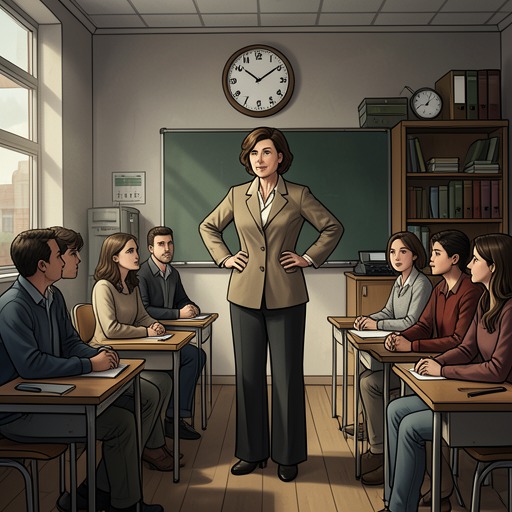
Margo Fairchild
Mrs. FletcherMargo Fairchild is a transgender adjunct professor whose life and teaching make gender both an academic subject and a public test of how other people see and classify her. A former professional athlete who once lived as a heterosexual man, she came to identify herself as a woman after a suicide attempt and a coma. As an instructor, she asks students to approach gender as complex rather than natural or self-evident; as a speaker, she must also contend with an audience that can reduce a personal history to a question about which restroom she uses. Her arc connects the work of explaining gender to the cost of being made an object of public scrutiny.
Identity and Background
Margo teaches as an adjunct professor, a position she introduces with humor about its poor pay. She arrives at Eve Fletcher’s evening seminar in a black pencil skirt and heels, presenting herself with a self-possession that immediately shapes the room’s attention. Her professional presence is athletic and striking, but the narrative also makes clear that being looked at is not simply a source of confidence: Margo is still getting used to the way people inspect her appearance as if judging a contestant.
Her history reaches back to a life lived as a man. She was a professional athlete, had a wife and child, and struggled emotionally while using alcohol and prescription drugs to cope. During a business trip she attempted suicide by overdose and came close to dying. After emerging from a coma, she said that she was a woman and had been one all her life. The account presents this declaration as a recognition of an identity already lived inwardly, rather than a sudden invention prompted by the crisis. She had been living as a woman for only a few years when Eve described her to Amanda, making her transition comparatively recent in the novel’s present.
Teaching Gender
Eve enrolls in Margo’s writing-intensive Gender and Society seminar for reasons that are personal rather than career-driven. She already has a master’s degree in social work and does not need another credential; returning to class offers intellectual life, new company, and a way to widen her world while Brendan Fletcher is away at college. Margo’s class therefore becomes one of the settings in which Eve tries to recover a more open and hopeful version of herself.
Margo’s teaching style is direct, theatrical, and alert to the assumptions hidden inside a question. When Dumell asks whether there were women on Margo’s former team, she considers how to answer and instead explains that the players ranged across the gender spectrum. She accepts that the subject is complicated, arguing in class that gender is not simple or natural and that people have to navigate its ideological hazards. The exchange turns a question about a roster into an introduction to the course’s larger concern: the categories people use are not neutral, and speaking about them has consequences for others.
That lesson becomes harder for Eve when Barry reveals that Margo used to be a man, using a derogatory term. The disclosure reaches Eve through a classmate rather than through Margo, and the moment exposes the gap between studying gender in a seminar and encountering the hostility attached to a person’s identity. Margo’s presence in the classroom is itself a challenge to the students’ assumptions, but the novel does not make her responsible for smoothing away their discomfort.
Margo and Eve
Eve and Margo’s connection grows through teaching and study. Eve regards Margo as an attractive and compelling professor, while also noticing how the middle-aged straight men in the class respond uncertainly to her. Their relationship is not only one of admiration: Margo’s life gives the questions in the seminar an immediate human context, and Eve’s participation allows her to engage with those questions as a student rather than only as a parent or professional.
At the end of the semester, Eve earns a solid A for a paper about the fraught relationship between radical feminism and the transgender movement. Margo writes enthusiastic praise on the back of the essay. Eve takes encouragement from the evaluation, while also noticing that she associates the professor’s cursive with masculinity and recognizing that reaction as a faulty reflex shaped by residual transphobia. The small moment shows Eve applying the course’s scrutiny to her own habits of perception. Margo’s approval matters academically, but it also becomes part of Eve’s continuing effort to identify assumptions she might otherwise leave unexamined.
When Eve stops attending classes in the spring to give Brendan room to rebuild his academic confidence, the choice costs her more than she expects. She had completed the first semester successfully, and the class had supplied intellectual focus and a community; without it, her social and intellectual life loses momentum. Margo is not responsible for that withdrawal, but her seminar marks a period in which Eve has begun to enlarge her life. The novel’s later discussion of Margo and Eve’s friendship points toward a reciprocal bond, though the available scenes establish its foundations chiefly through teaching, encouragement, and the questions they make possible for one another.
Public Story and the Audience’s Gaze
At a Senior Center lecture, Margo tells her story to a crowd larger than she expected, with women making up at least two-thirds of those present. Before speaking, she steps out from behind the podium and gives the audience time to look at her. She even turns so they can see her from behind, describing the gesture inwardly through the logic of a beauty pageant. The act is deliberate, but it does not mean she welcomes the scrutiny. She knows that gender and fairness rarely meet on equal terms, and the performance makes visible the demand that women present themselves for judgment.
The audience’s response steadily undercuts the talk. Some listeners whisper or make comments that draw snickers; the applause after the main presentation is barely more than polite. When the lights come up for questions, Margo sees blank, cold, disgusted, or confused expressions. After a heavy silence, a woman asks which restroom she uses. Margo answers that she uses the women’s room and adds that entering the men’s room would cause a stir. The question’s loud approval from other listeners makes plain that the crowd has seized on a practical challenge to her belonging rather than the wider account she has just given.
The strained reception has consequences beyond the room. Some seniors find Margo’s presentation disturbing, inappropriate, or appalling, and their complaints reach the Town Council. The lecture series comes under scrutiny, placing pressure on Eve to protect the program and its funding. By the following March, Eve is working to restore the series’ reputation with an uncontroversial talk about maple syrup. That institutional retreat contrasts with the course Margo taught: the public response shows how quickly a community can treat the disruption of its expectations as a problem to contain.
Narrative Significance
Margo’s story complicates the idea that gender can be understood through a simple distinction or settled by a person’s appearance. In the classroom, she gives students language for complexity; in public, the audience’s attention repeatedly tries to turn that complexity into a test of classification. Her decision to speak openly about her past does not guarantee that listeners will hear her on her own terms. Instead, the lecture dramatizes the distance between being invited to tell one’s story and being granted the audience’s understanding.
Her role also changes the scale of Eve’s return to education. Margo’s seminar is not merely a course Eve takes before withdrawing from college; it gives her a place to think, a demanding subject for her final paper, and a professor whose praise helps confirm that her intellectual life remains active. Through Margo, the novel links personal transformation to public language and institutional power, while refusing to treat a successful lesson as proof that prejudice has disappeared. The class can sharpen Eve’s awareness, but the hostile lecture audience demonstrates how much remains beyond the classroom.