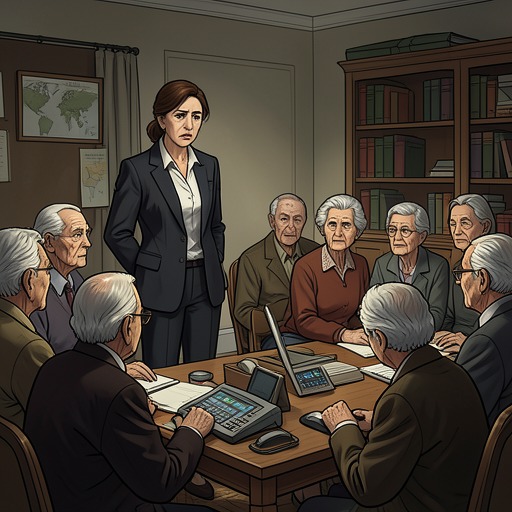
Roy Rafferty's expulsion from the Senior Center
Mrs. FletcherRoy Rafferty's expulsion from the Senior Center is a painful act of institutional boundary-setting: Eve Fletcher must exclude a longtime member whose dementia has made his behavior unsafe and distressing to others, even as she recognizes the man and community they are losing. The scene turns an administrative decision into a conflict between care for Roy, responsibility to the other people at the center, and the limits of what the center can provide.
The Meeting and Its Immediate Cause
Eve summons Roy’s son, George Rafferty, to the center and begins by thanking him for coming on short notice. George arrives in work clothes marked by grease and grime, apparently interrupted in the middle of a plumbing job. His wariness has precedent: the last time the center called him in, Roy had urinated out of an Elderbus window on the way home from the supermarket. When Eve asks Roy to explain what happened after lunch, his attention snaps to the word lunch; he cannot recall the incident or even orient himself to the time of day.
Roy has entered the women’s room again. George reminds him that they have already talked about staying out of it, and Roy hangs his head like a chastened schoolboy. Eve knows that this familiar, friendly regular has changed quickly. He had been healthy and lucid until roughly six months earlier, when his wife died of a stroke; since then, his decline has been rapid and alarming. The meeting is not about a deliberate breach that Roy can understand and correct. His inability to remember what happened is part of the circumstance Eve must address.
The incident is more serious than entering the wrong restroom. Roy exposed himself and touched himself, and he made an inappropriate overture to Evelyn Gerardi, an older member who uses an oxygen tank. Eve initially tells George only that his father exposed himself. She avoids specifying the sexual behavior and the invitation directed at Evelyn, whom Roy had called sweetheart. When George insists that his father cannot remember, Eve lets that recognition stand before explaining that several women were upset. She later makes the omitted details explicit: one witness wanted to call the police and file charges, and Eve had managed to calm the situation and handle it through the center rather than have it escalate that way.
The Decision and Its Limits
Eve addresses Roy directly before delivering the decision. She tells him that staff have enjoyed his company, recalls his kindness and consideration, and says that he will not be able to come back. The courteous acknowledgment matters: the person being excluded is not reduced to the latest incident. But warmth cannot undo the practical boundary. Eve says that she has no choice and that Roy needs a nursing home rather than a community center.
George is shocked that the center is kicking his father out and asks for one more chance. Eve answers that they have already given him one, and tells George that the situation will not improve. The exchange makes the decision both specific and constrained: Roy’s repeated restroom behavior and the exposure incident have harmed other members, while the possibility of further decline makes another informal exception inadequate. The center can offer programs and companionship, but Eve does not present it as a substitute for the nursing care Roy now needs.
George’s plea also reveals the strain beyond the center’s doors. Roy loves the place, George says, and it is all his father has left. George cannot watch him all day, and his wife is seriously ill and receiving chemotherapy. Eve’s decision therefore does not resolve the family’s care problem; it identifies a limit while leaving George to face responsibilities he cannot easily meet. His grief and exasperation are visible together: he knows his father cannot remember, yet he must hear the consequences described and absorb the loss of a place that matters to them both.
The Human Cost of Exclusion
After the decision, George reaches for his father’s hand. Roy does not seem to notice, a small physical detail that sharpens the distance between George’s effort to connect and Roy’s diminished awareness. George says that he hates seeing his father this way. Eve responds first by referring to Roy as a good man in the third person, then corrects herself and speaks to him directly, telling him that they will miss him. Roy looks at her and nods as though he understands the kindness. His final turn back to lunch is gentle and disorienting: he receives the moment of farewell, or appears to, then returns to a basic question he has already asked.
The consequences become clearer when Roy dies soon afterward. At his wake, Eve is deeply upset that his death comes so soon after she expelled him. She does not decide that the expulsion was wrong; as an administrator, she believes she had no choice. What changes is the emotional weight of the decision in retrospect. She had not known that Roy had only a month to live, and the episode now looks to her like the humiliation of a sick old man shortly before his death. The packed wake, attended by people whose lives Roy had touched through his ties to Haddington and his long career as a plumbing contractor, recalls the sociable man who existed before dementia altered his behavior. Eve’s professional detachment cannot keep that earlier Roy separate from the person she had to exclude.
Care, Age, and Institutional Responsibility
The scene makes the Senior Center both a source of belonging and an institution with limits. Roy’s history there is not interchangeable with his disruptive behavior: he had been a friendly, much-liked regular, and George’s fear that the center is all his father has left gives the exclusion a genuine social cost. At the same time, the women disturbed by the incident are members of the same community, and Eve cannot treat their safety or distress as secondary to Roy’s attachment to the place. Her decision holds these responsibilities in tension rather than resolving them cleanly.
That tension echoes a later dispute over who deserves to be heard in a senior setting. Margo Fairchild initially resists speaking to older people because she believes many of them will not reconsider their views about transgender people. Eve challenges that dismissal as ageist, arguing that seniors are vulnerable and stigmatized too and should not be written off. The parallel does not make Roy’s expulsion equivalent to Margo’s decision about whom to address: one concerns a specific behavior that harms other members, while the other concerns a generation being presumed incapable of change. Together, however, the episodes resist treating older people as a single problem to manage. Roy is at once a person deserving tenderness, a member whose behavior has become harmful, and someone whose needs exceed what the center can safely provide. His expulsion is necessary in the scene, but the later wake shows why necessity does not make it painless.