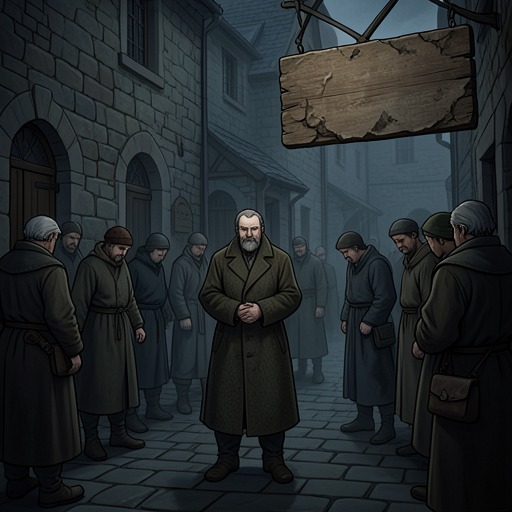
Antonio
Much Ado About NothingAntonio, Leonato’s brother, is a guardian of family order whose presence becomes most consequential when private suspicion turns into public shame. He helps define the household in Messina as a place where music, marriage, inheritance, reputation, and violence are inseparable. Although his role is not that of the principal lover or accuser, his interventions repeatedly expose how quickly family loyalty can become both protection and confrontation.
Identity and Introduction
Antonio first appears in Leonato’s house, meeting Leonato as a brother and reporting that strange news is at hand. His entrance establishes him as an informed member of the household rather than an outsider: he is close enough to know what is being arranged and authoritative enough to bring information directly to Leonato. When Leonato asks about his son’s preparations for the music, Antonio confirms that the young man is busy with them before turning the conversation toward the unexpected report. The exchange places Antonio within the domestic network that surrounds Hero’s marriage and the entertainments of the house.
His identity is also tested through the play’s culture of disguise. During the masked revels, Ursula recognizes him as Signior Antonio, while Antonio denies that identification. The moment is comic, but it is not insignificant. The mask disrupts ordinary social recognition, and Antonio participates in that disruption by refusing the name assigned to him. His brief denial shows how easily status and identity can become performative in the household’s festive world, where people speak through masks, infer motives from appearances, and treat recognition itself as a contest.
Family Authority and the Marriage Plot
Antonio belongs to the family structure that makes Hero’s marriage possible. Claudio’s inquiry about whether Leonato has a son is answered by Don Pedro with the information that Hero is Leonato’s only child and heir. Against that background, Antonio’s relationship to Leonato carries practical significance: the marriage is not merely a private attachment but an arrangement involving inheritance, paternal consent, and the continuity of the household. Don Pedro later announces that he has wooed Hero in Claudio’s name, obtained her father’s goodwill, and secured the match. Leonato accepts the union by giving his daughter and his fortunes, so the marriage is framed as an exchange of affection, authority, and family resources.
Antonio’s importance becomes sharper after the wedding is destroyed by accusation. When Claudio and Don Pedro declare that Hero has been seen with a man at her window between twelve and one, Leonato is forced to hear a charge that attacks both his daughter’s virtue and his own standing as a father. Hero denies speaking with any man at that hour, but Don Pedro concludes that her denial proves she is no maiden. Leonato responds not with detached judgment but with a cry for a dagger, and Hero swoons. Antonio is part of the family circle in which this public accusation becomes a catastrophe: the alleged fact is treated as decisive before it has been examined, while the family’s honor is made to depend on male testimony and visible ritual.
Conflict, Protection, and Violence
Antonio’s most forceful intervention comes in the confrontation before Leonato’s house. Leonato, consumed by the loss of his child and the stain placed upon her name, threatens Claudio. When he says that Claudio has killed his child and warns that killing him would kill a man, Antonio intensifies the threat by declaring that Claudio would kill two men, and men indeed, though the immediate priority is to let him kill one first. The exchange transforms grief into a contest of masculine honor. Antonio does not merely console Leonato; he joins him in imagining retaliation and presents the family’s injury as a demand for action.
This scene reveals the double edge of Antonio’s loyalty. His solidarity with Leonato gives the father’s suffering a public voice, yet it also shows how the honor system can propel injured men toward further violence. The accusation against Hero has not been established through reliable inquiry, but its social consequences are already treated as grounds for bloodshed. Antonio’s language therefore belongs to the same moral atmosphere that first allowed the charge to prevail: reputation is experienced as a material wound, and restoring it appears to require an equally visible response.
The play later places such responses beside a more formal process of examination. Dogberry’s watch brings Borachio and Conrade before authority, but the Sexton corrects Dogberry’s faulty method and insists that the watchmen who accuse them must be called forward. The correction matters because it distinguishes assertion from testimony. Borachio then confesses that Don John incited him to slander Hero and that the night scene in the orchard was staged with Margaret wearing Hero’s garments. Antonio’s earlier readiness to answer shame with violence is thus set against the delayed discovery that the original evidence was manufactured. The family’s crisis is resolved not by the first public judgment, but by a later account of who saw what, who arranged the deception, and who can be held responsible.
The Final Restoration
After Borachio’s confession, Leonato tells Claudio that he cannot simply command his dead daughter to live, because such a command would be impossible. Antonio shares in the aftermath of this irreparable loss and the demand for a remedy that cannot literally restore what has been taken. Yet the household moves toward symbolic restoration through a renewed marriage arrangement. Leonato’s brother is assigned a specific office: he must act as father to his brother’s daughter and give her to young Claudio. The instruction turns Antonio’s familial position into a ceremonial responsibility.
Antonio’s function in the ending is therefore neither passive mourning nor independent judgment. He helps carry the family from the language of death and revenge into the language of substitution, recognition, and marriage. The arranged ceremony cannot erase the false accusation or undo the public humiliation, but it provides a social form through which Claudio may be returned to Leonato’s family. Antonio’s role as the brother who gives the daughter to Claudio makes him an agent of that transfer and a participant in the reconstruction of family bonds.
Narrative Role and Significance
Antonio occupies the space between domestic intimacy and public authority. He begins as a brother exchanging household news, appears as a masked figure whose identity can be denied, becomes an ally in Leonato’s violent grief, and ends as a family representative entrusted with the marriage’s formal repair. His trajectory follows the play’s movement from celebration to suspicion, from accusation to threatened retaliation, and from confused spectacle to confession and restitution.
His significance lies especially in the contrast between what the family believes it has seen and what later testimony reveals. The tragedy surrounding Hero is produced by misrecognized appearances, male authority, and an honor culture that treats accusation as knowledge. Antonio’s anger registers the real force of that culture: once the family’s name has been publicly damaged, emotional and physical retaliation seem immediately intelligible. Yet the final proceedings show that justice depends on disciplined questioning and the recovery of suppressed facts. Antonio consequently embodies both sides of the play’s family ethic—unyielding loyalty to the injured household and participation in the difficult, imperfect work of restoring its social order.