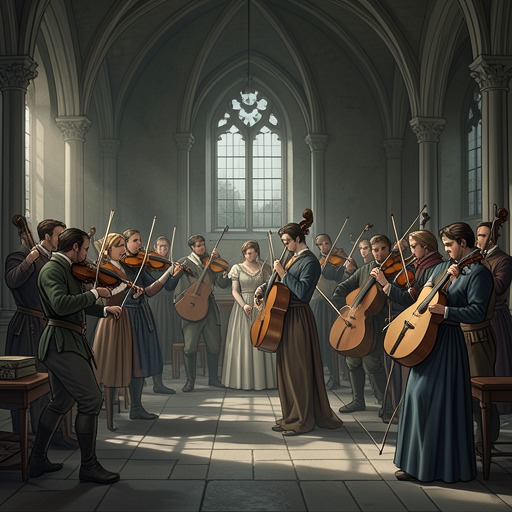
Balthasar
Much Ado About NothingBalthasar is the musician within Don Pedro’s company, a character whose importance exceeds his limited stage time. He appears among the prince’s companions and revellers, but his most memorable function is auditory: through his singing and the music he supplies, the play converts private feeling into a public and highly organized performance. His presence helps connect disguise, courtship, comic judgment, and mourning across the changing emotional register of the action.
Identity and Introduction
Balthasar is first introduced as one of the men accompanying Don Pedro, Don John, Claudio, and Benedick. He belongs to the same mobile courtly circle as these figures and is present when Don Pedro approaches Leonato. His inclusion in that group establishes him as a trusted associate rather than an isolated entertainer. Later, when the revellers enter in masks, Balthasar is again part of the collective spectacle, appearing among Don Pedro, Claudio, Benedick, Don John, Borachio, Margaret, Ursula, and the other masked participants.
The masked gathering makes Balthasar’s social position especially revealing. The mask conceals individual identity while music organizes movement and interaction. In that setting, he is both participant and facilitator: he joins the revels, yet his particular skill also gives the gathering its rhythm and expressive medium. The play’s social world is therefore not simply spoken into existence; it is danced, heard, and arranged through figures such as Balthasar.
Music and Courtship
Balthasar becomes most active after the masked exchanges, when Don Pedro calls for music. He is summoned with music and asked to repeat his song, a request that places his voice at the center of the scene. His role is not merely to provide background sound. The song creates a reflective counterpoint to the flirtation and verbal combat surrounding it, giving the revelry a form in which desire, disappointment, and social performance can be heard together.
His song begins, “Sigh no more, ladies, sigh no more,” and immediately addresses women who have been made vulnerable by romantic expectation. Its recurring assertion that men are deceivers ever turns a general proverb about male inconstancy into a public performance. The song does not resolve the uncertainty of courtship; instead, it gives that uncertainty a graceful, memorable shape. Its musical fluency makes skepticism socially acceptable, even pleasurable, allowing the company to hear a warning while continuing to enjoy the rituals of wooing.
The song also complicates the relation between what characters hear and what they know. Around Balthasar, music becomes a vehicle for meanings that direct declarations might make too dangerous or too earnest. The audience can register the irony of a song about deceptive men while male characters continue to pursue romantic designs through disguise, overhearing, and staged appearances. Balthasar’s performance therefore accompanies the comedy while quietly exposing the instability beneath its celebrations.
Performance, Masks, and Social Arrangement
Balthasar’s music belongs to the same theatrical system as the masks. At the revels, identity is deliberately obscured, and speech becomes a means of testing or manipulating recognition. Music adds another layer of mediation: it gathers the company, directs attention, and creates a shared emotional atmosphere without identifying a single private truth. Balthasar’s contribution is consequently collective rather than confessional. He does not claim the scene as his own story; he gives the group a form in which its contradictory attitudes can coexist.
The contrast between Balthasar’s song and Beatrice’s verbal wit is particularly instructive. Beatrice treats conversation as a contest, imagining that Benedick’s comparisons may leave him melancholic if no one laughs at them. Music, by contrast, does not defeat an opponent in argument. It circulates through the assembled company, accompanying movement and enabling the revellers to follow their leaders. Balthasar occupies this complementary position: where Beatrice sharpens social interaction through language, he regulates it through sound.
His practical reliability is also part of the characterization available in the evidence. When Don Pedro asks him to obtain excellent music for the following night at Hero’s chamber-window, Balthasar promises to do the best he can. The request places him inside the machinery of courtship, where music is used to approach a beloved indirectly and to stage affection beneath a window. He is thus connected not only with entertainment but with the deliberate production of romantic atmosphere.
From Revelry to Mourning
Balthasar’s musical function gains further significance when the play’s emotional world darkens. The evidence places solemn music at the tomb, where the action calls for a hymn after Hero’s apparent death. Balthasar is not explicitly named as the performer in that later moment, so his individual action there cannot be claimed. Nevertheless, the recurrence of music establishes a structural contrast between his earlier song and the later sound of mourning. Music first accompanies masks, dancing, and the comic circulation of desire; later it marks grief, ritual, and the attempt to honor the dead.
That transition clarifies the range of what music can do in the play. Balthasar’s song turns emotional danger into a repeatable social form, while the hymn at the tomb gives communal shape to loss that ordinary conversation cannot contain. The movement from a song warning that men deceive to solemn music for Hero’s memory traces the play’s passage from playful uncertainty through public disgrace toward recognition and repair. Balthasar’s earlier presence helps prepare the audience to understand music as an instrument capable of carrying both comedy and lament.
Narrative Role and Significance
Balthasar is not a principal agent of the deception, the accusation, or the later exposure of Don John’s scheme. His significance lies instead in the way he supplies the play with a listening dimension. He is associated with a song requested, repeated, judged, and carried forward into the social life of the company. Through him, the drama presents music as a mode of indirect speech: it can voice a cultural judgment about love, soften a warning into entertainment, and bind a crowd into coordinated action.
His appearances also expose a productive irony. The courtly company can laugh, dance, and listen to a song about male deception while its own relationships are being shaped by disguises and false appearances. Balthasar does not explain that irony; the performance allows it to be heard. His role is therefore modest in plot terms but substantial in theatrical terms. He helps make the play’s social world audible, and his song remains a recurrent tonal reference against which the later violence, shame, and mourning can be measured.