Borachio
Much Ado About NothingBorachio is the practical architect of Don John’s assault on Hero’s reputation. He moves between private intelligence and public consequence, turning a contrived scene at a chamber window into apparent proof of sexual disloyalty. His importance lies in this mastery of mediated information: he does not merely participate in the deception, but designs the evidence by which Claudio and Don Pedro are made to condemn an innocent woman. When the Watch overhears his confession, however, the same chain of information reverses direction, and Borachio’s own account brings the concealed crime into the open.
Identity and Introduction
Borachio first appears as a subordinate of Don John, entering with news from the great supper at which Don Pedro is being entertained by Leonato. He reports that an intended marriage is developing, identifying the match between Count Claudio and Hero before the plot against it has fully taken shape. Don John immediately asks whether this marriage can provide a model on which to build mischief, and Borachio becomes the man capable of supplying the necessary method.
His usefulness comes from access. Borachio has been present where important conversations occur, and he knows how private arrangements can be made to look public and verifiable. Earlier, Antonio reports that Don Pedro and Claudio were overheard in Leonato’s orchard discussing the plan to woo Hero for Claudio: Don Pedro would present himself as the suitor, obtain Hero’s agreement, and then speak with Leonato on Claudio’s behalf. Borachio’s later account supplies the hostile version of this same kind of hidden knowledge. In both cases, overhearing becomes a force that can redirect the lives of people who believe themselves to be acting freely.
Intelligence and the Construction of Deception
Borachio tells Don John that he had once explained how strongly he was favored by Margaret, Hero’s waiting gentlewoman. That relationship gives him a route into the private space surrounding Hero. He proposes that Don John arrange for Don Pedro and Claudio to be alone, then tell them that Hero loves Borachio. The accusation is to be presented not as malice but as protective zeal: Don John will claim concern for his brother’s honor and for Claudio’s reputation, supposedly endangered by the appearance of an innocent maid.
The plan depends on graduated verification. Borachio knows that a bare report will not be enough, so he instructs Don John to offer examples that seem impossible to dismiss. The prince and Claudio must see Borachio at Hero’s chamber-window, hear him call Margaret by Hero’s name, and hear Margaret address him as Claudio. He also intends to ensure that Hero is absent on the night of the staging, making the false scene appear to occupy the place where Hero should have been. The deception therefore imitates the structure of proof: a witness is given a report, then a scene, then sounds and visual details that appear to confirm one another.
The intended wedding is placed at the center of this operation. Borachio specifically chooses the night before the marriage, when suspicion can still overthrow the preparations and when Claudio’s emotional investment will make the evidence particularly destructive. Don John accepts the scheme and promises Borachio a fee of a thousand ducats, giving the plot a precise material incentive as well as its larger motive of damaging Don Pedro’s party. Borachio’s role is thus both conspiratorial and technical: he supplies the mechanism by which jealousy can be made to resemble certainty.
The Window Scene and Its Consequences
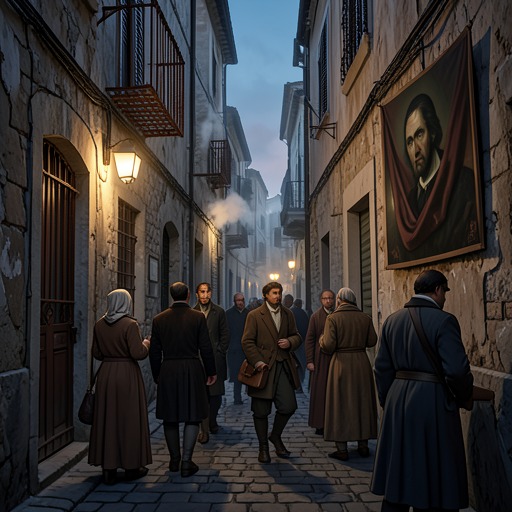
Borachio carries out the performance with Margaret, wooing her by the name of Hero while she appears at her mistress’s chamber-window and bids him good night repeatedly. From the orchard, Don Pedro, Claudio, and Don John watch the encounter. Borachio later recalls that Don John had placed them where they could see it from afar, so that the distance itself would help preserve the illusion. They think Margaret is Hero; the spectators’ mistaken identity becomes the central fact on which the accusation rests.
The scene produces consequences far beyond the lovers’ private understanding. Claudio accepts the staged appearance as evidence that Hero is disloyal and disgraces her when he should have married her. The false spectacle changes the social meaning of the wedding: what had been an arranged and publicly approved match becomes an occasion for denunciation. Borachio’s device works because it joins intimacy to surveillance. A lover’s conversation at a window is made to look like a witnessed confession, while the actual identities of the people involved remain hidden by darkness, distance, and costume.
Borachio’s scheme also exposes the fragility of authority when authority relies on incomplete information. Don Pedro and Claudio possess status, proximity, and apparent eyewitness knowledge, yet they see only what Borachio has prepared for them to see. Their judgment is not corrected by their direct observation because the observation has already been engineered. The tragedy that follows is therefore driven less by physical force than by an information network in which rumor receives the appearance of firsthand proof and is then carried into the family and the wedding ceremony.
Discovery, Confession, and Punishment
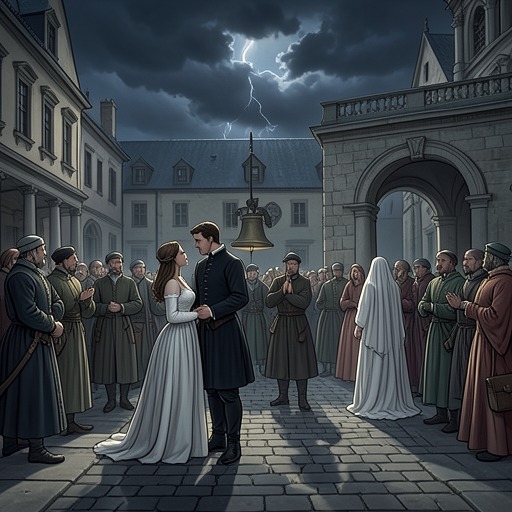
After the deception has done its damage, Borachio is brought before Don Pedro in the prison with Conrade, the Watch, Dogberry, Verges, and the Sexton. The discovery comes through an unexpected channel: the Watch overhears Borachio confessing to Conrade how Don John incited him to slander Hero. The low-ranking watchmen, whom the conspirators may have regarded as foolish or insignificant, preserve the facts that more powerful observers failed to establish.
Borachio’s confession reconstructs the entire mechanism of the crime. He admits that Don John provoked him to slander Hero, that Don Pedro and Claudio were brought into the orchard, and that they saw him court Margaret in Hero’s garments. He accepts responsibility for the deception and acknowledges that Hero was disgraced when she should have been married. His statement also identifies the fatal consequence: Hero has been reported dead after being accused and refused because of the false charge.
In addressing Don Pedro, Borachio asks that Claudio kill him rather than allow him to continue speaking. He says that he deceived even the prince’s eyes and that matters the wisdom of the powerful could not discover were brought to light by the shallow fools of the Watch. This is both confession and moral reversal. The same visual evidence that once seemed authoritative is exposed as a deliberate construction, while the supposedly inferior investigators become the agents of truth. Borachio’s willingness to receive death presents his guilt as something he would rather seal with punishment than repeat to his own shame, although his full explanation is necessary to restore the chain of causation.
The Sexton confirms the scale of the revelation: Don John has secretly fled; Hero was accused and refused in the manner Borachio describes; and she died, according to the information then available, from the grief caused by the event. The prisoners are ordered to be bound and taken to Leonato’s house. Borachio’s capture therefore turns a hidden conspiracy into a legal and familial crisis, transferring the matter from private suspicion to public examination.
Relationships and Narrative Role
Borachio’s closest operative relationship is with Don John, whose hostility supplies the political direction of the plot while Borachio supplies its working design. Don John promises payment and commands the broad objective, but Borachio determines how the accusation will be made credible. Their alliance demonstrates the difference between motive and method: Don John wants to cross the prince and undo his glory, whereas Borachio knows how to convert that desire into a scene that Claudio will misread.
His relationship with Margaret is also structurally important. Borachio’s favor with her enables the substitution of names and garments that makes the window scene persuasive. Margaret is not presented to the watchers under her own identity; Borachio’s performance depends on making her appear to be Hero and on making himself sound like Claudio. The intimacy he stages with Margaret is consequently transformed into counterfeit evidence against another woman.
Borachio’s relation to Claudio and Don Pedro is founded on asymmetrical knowledge. He knows who stands at the window, who is being named, and what the watchers have been positioned to infer. They know only the image he gives them. Later, the asymmetry is overturned: the Watch knows what Borachio has confessed, while the authorities must ask him to explain the offense. His narrative position changes from hidden producer of evidence to exposed witness against the conspiracy.
Change and Significance
Borachio begins as a confident conspirator who treats a marriage as an opportunity for calculated mischief and accepts a thousand ducats for the work. He ends as a bound prisoner who openly names Don John’s incitement, details his own villainy, and submits to death or punishment. The change does not erase his responsibility; rather, it makes responsibility legible. His confession supplies the missing interpretation that turns an apparently witnessed betrayal into a staged deception.
His trajectory gives the plot a sharp irony. Borachio first weaponizes visibility: the distant view from the orchard is made to overpower truth. He is later defeated by audibility, when the Watch hears his confession. The story’s decisive correction does not come from a superior spectacle but from speech that names the identities, motives, and arrangements hidden inside the spectacle. Borachio is therefore central to the play’s investigation of slander and deception. He shows how easily reputation can be manufactured from fragments of sight and sound, and how unexpectedly the same circulation of information can expose the lie.