Deception
Much Ado About NothingDeception is the play’s central technology of appearances. It operates through disguise, false identity, staged evidence, and controlled overhearing, repeatedly making characters mistake performance for fact. The same mechanism can serve courtship and comedy, as when Claudio’s friend assumes his part in disguise, or destruction, as when Don John engineers a false scene that makes Hero appear disloyal. Deception therefore changes not only what characters know but also what they are willing to do: it turns love into suspicion, honour into public shame, and grievance into a demand for bodily punishment.
Deception as Disguise and Courtship
Claudio’s first use of deception is comparatively benign. He announces that there will be revelry and proposes to assume Benedick’s part in some disguise, using the borrowed identity to tell Hero that he is Claudio. The plan depends on concealment, but its purpose is access: disguise allows a hesitant lover to approach the woman he desires without confronting the risks of direct speech. Identity becomes something that can be put on temporarily, and the difference between sincere feeling and theatrical performance remains deliberately unstable.
The masquerade also creates a world in which recognition is partial and socially managed. Don John suspects that his brother is enamoured of Hero and observes that only one visor remains; Borachio identifies the concealed Claudio by his bearing. The disguise hides the face but not entirely the body’s signs, so deception is never absolute. It shifts the burden of interpretation onto gestures, posture, and circumstance, allowing observers to believe that they possess knowledge even when they possess only an inference.
The contrast between this courtly deception and the later plot against Hero establishes the concept’s moral range. Claudio’s concealed approach seeks mutual love, whereas Don John’s concealment seeks to manufacture betrayal. Both depend on a gap between what is performed and what is true, but one uses that gap to overcome embarrassment while the other uses it to produce certainty from false appearances.
The Fabrication of False Evidence
Don John’s scheme is a deliberate construction rather than a spontaneous lie. Borachio is instructed to bring Don Pedro and Claudio to a carefully selected hour and place, tell them that Hero loves Borachio, and present the accusation as an act of loyalty to the prince and concern for Claudio’s reputation. The plot is designed to look reluctant and protective, giving deception the moral costume of public service. Its persuasive force will come not from a bare assertion but from multiple apparent instances: Borachio at Hero’s chamber window, Margaret being called Hero, and Margaret calling Borachio Claudio.
The plan is timed for the night before the intended wedding, when there is too little opportunity for examination and too much emotional investment in the marriage. Borachio will arrange matters so that Hero is absent, while the spectators are placed where they can see and hear the encounter without understanding its staging. The plot thus manipulates both space and knowledge. Don Pedro and Claudio are not merely told a lie; they are made witnesses to a performance whose details have been selected to answer the questions they might otherwise ask.
Don John recognizes the intended psychological result: jealousy will be transformed into assurance, and the preparations for marriage will be overthrown. This is deception as a conversion of uncertainty into false certainty. The victims are not persuaded because the evidence is true, but because the performance satisfies their expectation that seeing and hearing directly must provide secure knowledge.
The Overheard Story and Its Layers of Error
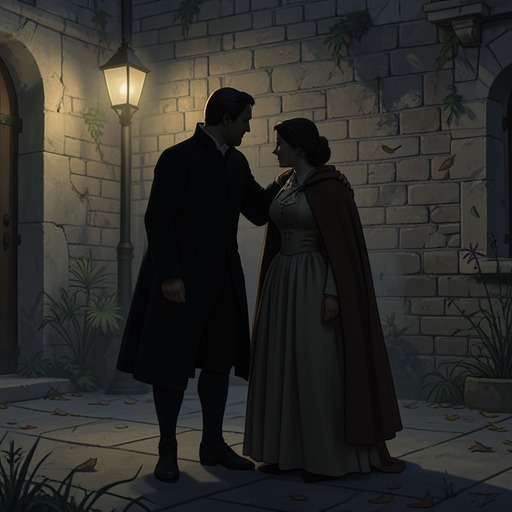
Borachio later recounts the mechanism to Conrade. He says that he wooed Margaret, Hero’s gentlewoman, while using Hero’s name, and that Margaret leaned out from her mistress’s chamber window and repeatedly bid him good night. The scene is already layered: Borachio knows Margaret is Margaret, Margaret knows she is Margaret, but the words exchanged make each participant appear to bear another identity.
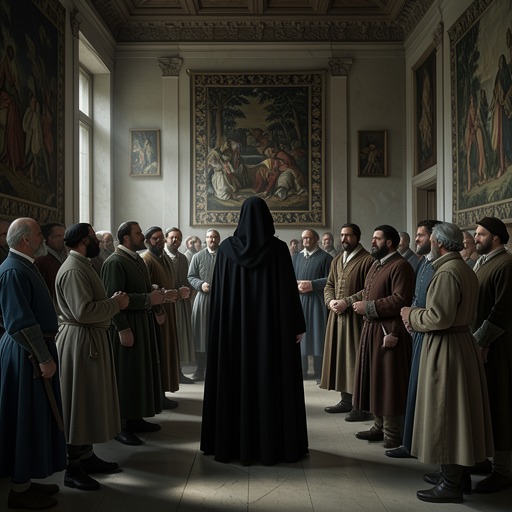
The decisive observers are then positioned at a distance in the orchard. Don Pedro, Claudio, and Borachio’s master Don John see the encounter, but they do not see its true participants or understand its arrangement. Conrade’s immediate question, whether they thought Margaret was Hero, exposes the exact hinge of the fraud. The deception succeeds because the observers’ physical sight is accurate while their interpretation is false. Nothing needs to be hidden from the eye if the eye has been taught what it is looking at.
This structure also makes deception a problem of competing mental models. Borachio knows the entire arrangement; Margaret performs within it; Don John understands how the spectators will construe it; and Don Pedro and Claudio believe that their own witnessing has freed them from dependence on report. The resulting irony is severe: the more confidently they rely on direct observation, the more completely they are controlled by someone who has staged the observed world.
Deception, Gender, and Public Honour
The false scene is especially damaging because it converts a woman’s reputation into a spectacle that male authority claims to interpret. Hero is not allowed to answer the accusation before the marriage is threatened. Her apparent sexual disloyalty becomes, in Claudio’s eyes, an established fact because the deception has been framed as evidence concerning her chastity and the honour of the men connected with her.
The consequences are therefore public rather than private. At the wedding, Claudio’s accusation becomes slander that dishonours Hero before others, and Beatrice describes the wrong in terms of scorn, disgrace, and the threatened public exposure of her kinswoman. Her anger makes clear that deception has not merely produced a romantic misunderstanding; it has imposed a social sentence. Hero’s name is made to carry a crime she did not commit, while the men who believe the staged evidence treat their own wounded honour as justification for condemnation.
Beatrice’s response reveals another effect of deception: it exposes the limits of conventional masculine action. She wishes she were a man so that she could answer the injury directly and says she would eat Claudio’s heart in the marketplace. Her language imagines retaliation as a public, bodily correction to a public, verbal wrong. Benedick accepts this emotional and ethical demand, promising to challenge Claudio and make him render an account. The falsehood therefore redirects the energy of deception into a genuine conflict between former companions.
Confession and the Reversal of Appearance
The truth emerges when Borachio confesses that he deceived even the princes’ eyes. He distinguishes the wisdom of the powerful from the seeming foolishness of the watchmen, who overheard him confessing that Don John incensed him to slander Hero. The confession reconstructs the entire fraud: the spectators were brought into the orchard, saw Borachio court Margaret in Hero’s garments, and disgraced Hero when they should have been preparing to marry her.
Borachio’s admission also restores causality to events that had appeared self-evident. Hero’s supposed betrayal was not discovered but manufactured; Claudio’s certainty was not the product of reliable judgment but the intended result of Don John’s arrangement; and the social catastrophe followed from a performance mistaken for testimony. Borachio accepts the identity of villain and says that he would rather seal his guilt with death than repeat it to his shame, while acknowledging that Hero has died under the false accusation made by him and his master.
The reversal does not erase the damage done by deception. It changes the moral direction of the story, but only after slander, grief, and the threat of violence have exposed how fragile public knowledge can be. Benedick’s challenge to Claudio is itself a consequence of the false scene, even though the truth later makes Claudio a potential kinsman through his relation to Beatrice.
Comic Deception and the Recovery of Identity
The play does not finally reject deception as such. Benedick’s later defence of marriage shows that identity can be remade through a conscious change in relation to other people’s words. He refuses to be driven from his humour by satire or epigram and declares that, since he intends to marry, he will not treat the world’s mockery as decisive. His conclusion that humanity is a changeable thing contrasts with the earlier confidence that appearances could establish permanent guilt.
The comic and destructive forms of deception thus remain structurally related. Disguise can enable Claudio to approach Hero; staged names can make Margaret appear to be Hero; reported confession can expose the manipulation; and public wit can no longer dictate Benedick’s chosen identity once he has accepted love. Deception is most dangerous when it disguises itself as certainty, honour, or direct knowledge. It becomes survivable, and sometimes comic, when the play allows identities to be revised, performances to be recognized, and apparent facts to yield to confession.