Don John
Much Ado About NothingDon John is the resentful bastard brother of Don Pedro and the play’s principal architect of deception. Recently restored to his brother’s favor but inwardly refusing reconciliation, he converts private grievance into a deliberate campaign against Don Pedro, Claudio, Hero, and the marriage they hope to form. His villainy succeeds not through force but through staged appearances and carefully transmitted false information, until the consequences of his plot expose both his methods and the fragility of the honor on which the social world depends.
Identity and Introduction
Don John enters in the company of Don Pedro, Claudio, Benedick, and Balthasar, already positioned within the prince’s circle but not securely reconciled to it. His relationship with Don Pedro is both familial and political: he is the prince’s brother, yet his earlier opposition has left him dependent on a favor he does not trust. Conrade explains that Don Pedro has only newly taken him back into grace, and that Don John must appear agreeable if he is to establish himself again. The advice treats his public conduct as a temporary season to be managed for a later harvest.
Don John rejects that counsel with striking self-definition. He would rather be a canker in a hedge than a rose cultivated in his brother’s favor, and he declares himself a plain-dealing villain rather than a flattering honest man. His images of the muzzle, clog, cage, and withheld liberty present restored favor not as belonging but as confinement. He claims that, if given a mouth, he would bite, and if given liberty, he would act according to his own desire. The declaration does not make him morally candid in practice; instead, it establishes the contradiction at his center. He names himself openly as a villain while working through concealment, impersonation, and manufactured evidence.
Grievance and Immediate Objective
Don John’s resentment is sharpened by the sense that Don Pedro’s victory has given Claudio all the glory of his overthrow. When Borachio reports that Don Pedro intends to woo Hero for himself and then give her to Claudio if she agrees, Don John immediately sees the proposed courtship as material for his displeasure. He asks whether Borachio and Conrade will assist him and treats any adverse result as acceptable so long as it crosses the prince’s success. His objective is therefore not simply personal possession of Hero. It is the interruption of Don Pedro’s generosity, Claudio’s advancement, and the public harmony that makes his own exclusion visible.
The plot soon acquires a precise target. Don John states that Claudio will marry Leonato’s daughter, and the certainty of that intended union gives his hostility a defined object. Borachio supplies the mechanism: Don John must arrange for Don Pedro and Claudio to meet him alone, where he can pretend to reveal that Hero loves Borachio. He is to present the disclosure as an act of zeal for Don Pedro’s honor and Claudio’s reputation, claiming that the marriage rests on the appearance of a maid whose loyalty has already been compromised. Don John accepts the plan and promises Borachio a thousand ducats, turning private malice into a paid conspiracy.
Deception as Performance and Information
The scheme depends on a chain of seeming proof rather than on direct accusation alone. Borachio proposes that Don Pedro and Claudio be brought to see him at Hero’s chamber window, hear him call Margaret by the name of Hero, and hear Margaret address him as Claudio. The encounter is to occur on the night before the wedding, while Hero is deliberately kept absent. Don John’s contribution is the authorization and deployment of this design: he makes the false report credible by presenting it as protective knowledge and by arranging circumstances in which spectators will mistake a staged scene for direct observation.
The evidence later shows how completely Don John has turned visibility into an instrument of falsehood. Borachio explains that Don John placed and positioned the prince and Claudio in the orchard so they would witness his amorous encounter with Margaret while she wore Hero’s garments. The witnesses therefore see something real—a man courting a woman at a chamber window—but interpret it through a false identity. Their eyes are not blind; they are directed toward the wrong conclusion. Don John’s method exploits the authority of observation itself, making apparent certainty the product of prior manipulation.
This deception is also a communication network. Don John gives Borachio a story to transmit, Borachio performs the supposed evidence, Don Pedro and Claudio become both audience and carriers of the conclusion, and Hero’s reputation bears the damage. The falsehood gains force because it travels through socially authoritative figures rather than remaining a private rumor. The play’s information economy is consequently inverted: direct testimony is staged, eyewitnesses are misled, and the truth is eventually recovered from men considered too foolish to understand the matter.
Relationships and Conflict
Don John’s conflict with Don Pedro is the emotional source of the plot. He does not seek a repaired brotherhood, even though Don Pedro has taken him back into favor; he interprets dependence as humiliation and favor as a restraint. His hostility toward Claudio is connected to this family rivalry because Claudio receives the visible benefits of Don Pedro’s power. By attacking Claudio’s marriage, Don John attacks both the prince’s chosen friend and the social display of the prince’s success.
His relation to Borachio is instrumental but effective. Don John supplies purpose, confidence, and money, while Borachio supplies local access and practical ingenuity. The thousand-ducat reward confirms that the conspiracy is organized rather than impulsive. Don John’s command that Borachio be cunning makes deception a shared craft, but the hierarchy remains clear: Don John identifies the injury he wants to inflict, and Borachio constructs the scene that will inflict it.
Hero is the principal victim of this conflict despite having no role in Don John’s grievance. The plot turns her identity into a costume and her chamber window into a stage. Margaret is likewise used as the performer whose mistaken identity will authorize the accusation. Through them, Don John transforms a private resentment between men into a public assault on a woman’s honor and on the marriage ceremony meant to secure social continuity.
Exposure, Consequences, and Ending
Don John maintains his posture of certainty even when Leonato asks whether the reported matters are spoken or merely dreamed. He answers that they are spoken and true, reinforcing the lie through the language of confirmation. Later, when Friar Francis identifies him as the force whose spirits labor in the construction of villainies, the play places Don John’s personal resentment within a broader moral description: his crime is not accidental mischief but deliberate fabrication.
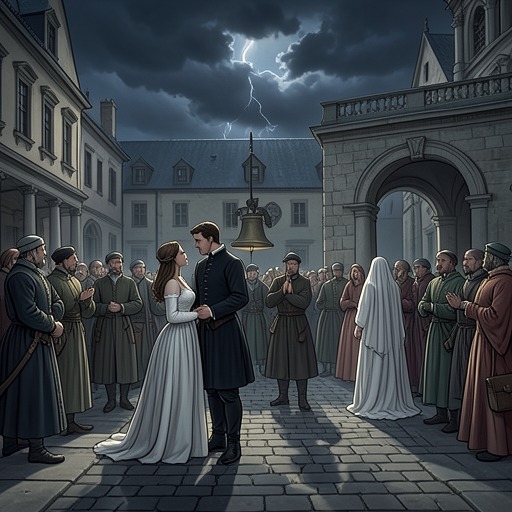
The consequences are severe. Hero is accused and refused at the wedding, and the shock of the accusation is followed by the belief that she has died. Don John himself secretly flees that morning, leaving Borachio and the machinery of his deception behind. His flight does not undo the damage; it marks the collapse of his control once the false scene has been reinterpreted. The Sexton’s report preserves the sequence of accusation, refusal, apparent death, and escape, converting private conspiracy into a matter for public arrest and examination.
Borachio’s confession finally reveals the entire structure. He admits that Don John incensed him to slander Hero, paid him richly for the practice, and arranged for the prince and Claudio to see him court Margaret in Hero’s garments. He also states that the watch overheard this confession and brought the truth to light. The reversal is pointed: the shallow fools whom the conspirators would not fear become the agents who expose what the supposedly wise and honorable men failed to discover. Don John’s success depended on the prestige of appearances, while his defeat begins when ordinary listeners preserve the exact words behind those appearances.
At the close, a messenger reports that John has been taken in flight. The announcement arrives after the social catastrophe has been understood and while the surviving characters are attempting to restore marriage and festivity. Don John’s ending is therefore one of capture rather than repentance or reintegration. He does not receive a redemptive return to the family whose favor he rejected; instead, his flight and arrest confirm the practical and moral failure of a character who could imagine freedom only as the opportunity to bite and destroy.
Narrative Role and Significance
Don John functions as the play’s shadow: a figure who converts exclusion into opposition and turns the ordinary materials of courtship—names, clothing, windows, witnesses, and promises—against the community that gives them meaning. His declared preference for being a canker rather than a rose is realized structurally. He does not build an alternative order; he feeds on the disorder produced when signs are detached from the identities they are supposed to represent.
His villainy also exposes the weakness of honor when honor is treated as something visible and transferable. Claudio believes what he sees because the scene has been made to resemble proof. Don Pedro accepts the apparent evidence because it seems to protect his friend. Don John understands that reputation can be damaged more quickly than truth can be established, and the plot’s crisis follows that asymmetry. Yet his method contains the seed of its defeat: because it requires witnesses, repeated names, costumes, and a rehearsed encounter, it creates a record that can eventually be reconstructed.
Don John’s importance lies in this union of psychological grievance and theatrical method. He is angry at Don Pedro, jealous of Claudio’s place, contemptuous of dependence, and willing to make his resentment everyone else’s catastrophe. At the same time, he is the character who most clearly demonstrates that deception in the play is not merely lying but the management of spectators. Once the spectators are made to believe that Margaret is Hero and Borachio is speaking within a true identity, the lie acquires the appearance of knowledge. His capture restores accountability, but the damage he causes remains a lasting demonstration of how quickly a community can mistake performance for truth.