Leonato’s house
Much Ado About NothingLeonato’s house is the central domestic setting of the play, but it is never merely a backdrop. It is a residence with rooms, halls, a chamber window, and an adjoining orchard, and its boundaries repeatedly determine who may speak, who may listen, and whose interpretation of events will prevail. The house shelters family life while also opening itself to courtship, music, masks, surveillance, accusation, and attempted repair.
Definition and First Appearance
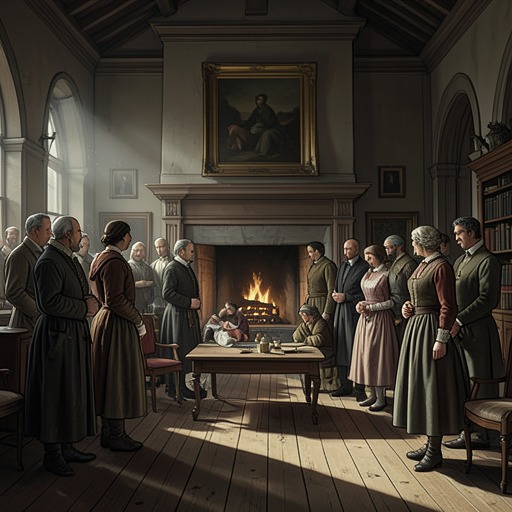
Leonato’s house is introduced as the setting before Leonato’s house, where Leonato, Hero, Beatrice, and a Messenger first appear together. From its opening appearance, the location joins household intimacy to public information: news of Don Pedro’s arrival and the wider political world enters the family residence through a Messenger, while the presence of Hero and Beatrice establishes the house as the social center of Leonato’s family.
The house soon becomes divided into distinct functional spaces. A room in Leonato’s house receives Leonato and Antonio when Antonio reports what has been overheard in Leonato’s orchard. Later, a hall in Leonato’s house gathers Leonato, Antonio, Hero, Beatrice, and others, making the residence a communal stage rather than an exclusively private retreat. Another scene returns to a different room in Leonato’s house, where Leonato is accompanied by Dogberry and Verges. The repeated specification of room, hall, and other room gives the house an internal geography: information circulates through it, but different forms of knowledge and authority occupy different spaces.
Courtship, Alliance, and Household Exchange
The house is where Claudio’s desire for Hero becomes actionable. Claudio describes Hero as the sweetest lady he has ever seen, then admits that he would scarcely trust himself if she were to become his wife. Don Pedro converts that private inclination into a social arrangement: if Claudio loves Hero, Don Pedro will speak with Hero and her father, and Claudio will receive her. The house therefore turns romantic feeling into family negotiation, with Leonato’s consent and Hero’s status as his only child and heir shaping the stakes.
That arrangement is formally completed within the household’s social orbit. Don Pedro announces that he has wooed Hero in Claudio’s name, won her, spoken with her father, and obtained Leonato’s goodwill. Leonato responds by offering his daughter together with his fortunes, while Don Pedro’s grace is invoked as having made the match. The house thus contains an exchange in which affection, inheritance, paternal authority, political favor, and marriage are inseparable. Its domestic walls hold the emotional language of courtship, but they also enclose the transfer of family wealth and social position.
Orchard, Window, and the Production of False Knowledge
The adjoining orchard extends the house’s social space while appearing to remain private. Antonio reports that the Prince and Count Claudio were walking in a thickly planted alley in his orchard and were overheard by one of Leonato’s men. Their conversation concerns Don Pedro’s intention to declare love for Hero at a dance and, if she agrees, to approach Leonato immediately. The orchard therefore produces knowledge through overhearing: a supposedly secluded conversation becomes actionable evidence inside the house.
The same relation between domestic privacy and public interpretation is later weaponized. Borachio explains that he can arrange for Margaret to look out from her lady’s chamber window at any time during the night. The window is not simply an opening in the architecture; it is the instrument that makes deception legible to observers outside it. A staged appearance at the house can be mistaken for proof, and the private chamber becomes the visible surface on which Hero’s reputation is falsely rewritten. The house’s architecture gives the plot its mechanism: rooms conceal, windows display, and observers convert partial sight into certainty.
When Don Pedro, Claudio, and Leonato enter while Benedick hides in the arbour, the house and its garden become spaces of intersecting performances. Benedick’s withdrawal places him in a concealed position, while the arriving men bring music and conversation into the same domestic environment. The residence accommodates both deliberate sociability and hidden listening, allowing words intended for one audience to reach another. In this setting, privacy does not guarantee safety; it creates opportunities for both revelation and manipulation.
Celebration, Surveillance, and Crisis
The house is also the location of preparation and collective movement. Its rooms and halls support gatherings in which family members, visitors, servants, and watchmen occupy overlapping roles. The wedding planned for the following day intensifies activity around Leonato’s door, and Dogberry warns the honest neighbors to watch there because the night will be full of turmoil. The doorway becomes a threshold between household ceremony and nocturnal disorder: guarding it is presented as a practical duty, but it also signals that the house has become vulnerable to what may enter and what may be discovered outside.
Borachio and Conrade’s entrance near the house places the conspirators within the same broader domestic zone that contains the wedding preparations. The proximity is crucial. The plot against Hero does not arise in a distant wilderness or an isolated political court; it unfolds beside a family celebration, using the house’s windows, chambers, doors, and nighttime access to turn domestic anticipation into danger. The nearer the wedding comes, the more completely the house is transformed from a place of welcome into a testing ground for appearances.
The crisis ultimately moves beyond the house to the church, where Don Pedro, Don John, Leonato, Friar Francis, Claudio, Benedick, Hero, Beatrice, and attendants assemble. Yet the church scene remains the consequence of what the house has hosted: courtship, overheard speech, concealed observation, wedding preparation, and the circulation of accusations. The domestic setting supplies the evidence and misunderstandings that the public ceremony then formalizes. A private household event becomes a communal judgment.
Aftermath and Narrative Significance
After the accusation and its consequences, the play returns to the church, where Claudio and Don Pedro appear with tapers and where Leonato later addresses the demands placed upon him. This movement away from the house does not diminish its importance. The house is the origin point from which family bonds, inheritance, romantic promises, and deceptive testimony enter public life. The church exposes the damage, but the residence is where the social machinery of the damage was assembled.
Leonato’s house consequently functions as a contested boundary rather than a stable refuge. It offers the language of family and welcome, yet its orchard permits overhearing, its chamber window enables staged evidence, its hall gathers competing witnesses, and its door requires a watch when celebration is threatened. The location’s decisive significance lies in this tension: domestic space creates intimacy, but intimacy also creates access. Because the house makes private relations visible to selected observers, it becomes the place where love can be arranged, reputation can be manufactured, and family honor can be carried from household conversation into public judgment.