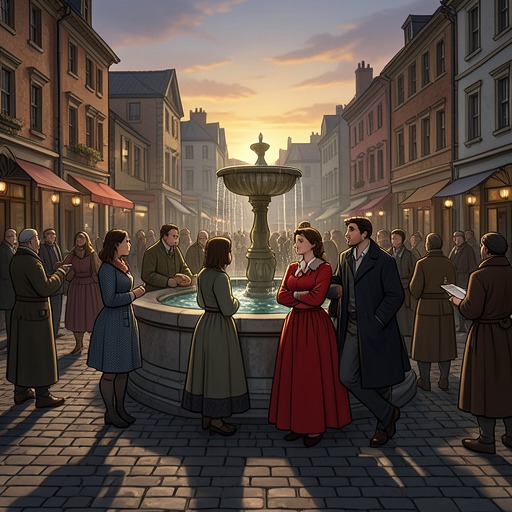
a merry war
Much Ado About Nothing“a merry war” is Leonato’s phrase for the recurring verbal conflict between Beatrice and Benedick, whose meetings become skirmishes of wit rather than ordinary conversation. The expression captures the decisive paradox of their relationship: their exchanges are combative in form but socially intimate in their persistence, making verbal opposition the route through which the comedy develops their eventual emotional transformation.
Definition and First Presentation
Leonato explains that there is “a kind of merry war betwixt Signior Benedick and her,” because Beatrice and Benedick “never meet but there’s a skirmish of wit between them.” The image turns conversation into warfare while qualifying that warfare as merry. Their conflict has repeated rules, recognizable combatants, and a public quality: other characters can identify it as an established pattern rather than an isolated quarrel. The phrase therefore defines not only their sharpness but also the form of their relationship.
Beatrice treats each encounter as an opportunity to diminish Benedick’s reputation. She claims that in their last conflict four of his five wits went halting away, leaving him governed by only one. She then reduces that remaining wit to the sole wealth by which he can be recognized as a reasonable creature. Her attack is extravagant, but its precision shows that the contest depends on invention and timing rather than blunt anger. She knows Benedick well enough to turn his intelligence, his pride, and even his association with his horse into weapons against him.
The Verbal Combatants
When Benedick addresses Beatrice as “my dear Lady Disdain,” he converts her hostility into a title, making her contempt part of her public identity. Beatrice answers that disdain could not die while it had such suitable food as Benedick. She extends the insult into a paradox: even courtesy would have to become disdain in his presence. Benedick replies that courtesy must therefore be a turncoat, refusing to yield the verbal field and treating her accusation as an opportunity for another joke.
Their exchanges repeatedly combine denial with self-display. Benedick says that all ladies love him except Beatrice and wishes he could find it in his heart not to have a hard heart, because he loves none. The boast presents emotional detachment as a personal distinction. Beatrice accepts the claim only to turn it against him, calling his lack of appeal a happiness for women and declaring that she shares his disposition. Her preference for hearing her dog bark at a crow rather than hearing a man swear that he loves her makes romantic refusal into a comic principle. The expression “a merry war” thus covers a struggle over both wit and vulnerability: each character claims immunity from love while ensuring that the other remains the chosen opponent.
The contest also includes gestures of withdrawal that are themselves part of the game. Benedick wishes that his horse had the speed of Beatrice’s tongue and tells her to continue on her way because he has finished. Beatrice immediately identifies this retreat as “a jade’s trick” and says that she knows him of old. His attempted ending becomes another exchange, and her recognition of the tactic confirms that their conflict is sustained by familiarity as much as by antagonism.
Recurrent Forms of Wit
The “war” extends beyond the central encounter into a broader style of verbal competition. Beatrice answers Antonio’s description of her as too curst by distinguishing “too curst” from merely “curst.” She then adapts the proverb that God sends a curst cow short horns, arguing that a cow too curst receives none. The joke makes her own sharpness both subject and instrument: she refuses to accept an accusation in its ordinary sense and instead dismantles it through linguistic excess.
The same competitive energy appears when Benedick is asked to judge Hero. Asked whether he will speak honestly or according to his customary role as a tyrant to women, he first distinguishes the requested mode of speech from his theatrical habit of insult. Yet his supposedly sober judgment becomes another performance of verbal aggression. He describes Hero as too low for high praise, too brown for fair praise, and too little for great praise, before concluding that he does not like her precisely because she is herself. The passage shows how the “merry war” is connected to a larger comic culture in which praise, insult, sincerity, and performance continually change places.
The expression also helps explain why Beatrice and Benedick can speak to one another in ways that would be destructive in a less balanced relationship. Their attacks are personal, but they are answered rather than left unanswered; each recognizes the other’s methods and supplies an immediate counterstroke. The resulting rhythm creates a form of mutual acknowledgment. They deny affection in the very act of granting one another sustained attention.
From Opposition to Social Action
The pattern eventually becomes more than an exchange observed by others. Beatrice is sent, against her will, to summon Benedick to dinner, and even this ordinary task is framed by resistance. Her appearance makes the old conflict visible in a practical setting, while Benedick’s courteous thanks briefly interrupts the established antagonism. The moment does not erase the contest; it demonstrates how deeply their habitual language governs even their most routine contact.
Their style also stands in contrast to the deceptive speech used elsewhere in the plot. Claudio speaks in Benedick’s name only to announce that the prince is wooing for himself, while Borachio instructs Don John to poison Don Pedro’s sense of honor by presenting Hero as contaminated. Those exchanges use language to mislead and injure. Beatrice and Benedick, by contrast, make opposition legible as opposition: the violence of their words is theatrically exposed as play. The “merry war” therefore provides a comic counter-model to slander, where insinuation conceals its purpose and produces real damage.
The contrast reaches a sharper point in the interrogation of Hero, when Claudio asks Leonato to use his fatherly authority to make her answer truly and then says that the questioning is meant to make her answer truly to her name. That coercive language treats speech as an instrument of judgment. Against it, the verbal combat between Beatrice and Benedick remains a contest in which neither speaker possesses unquestioned authority. Its stakes are pride and reputation, but its rules allow reply, correction, and reversal.
Comic and Thematic Significance
“A merry war” condenses the play’s larger interest in the unstable boundary between conflict and intimacy. Beatrice and Benedick begin by presenting love as a threat and independence as a triumph. Their language repeatedly converts possible tenderness into mockery, while mockery itself keeps them in close relation. The expression’s force lies in this tension: the war is real enough to demand skill, yet merry enough to preserve the possibility that combatants may become partners.
The phrase also makes wit a form of character. Beatrice’s insults reveal her speed, confidence, and resistance to conventional courtship; Benedick’s replies reveal his vanity, theatrical self-protection, and need for an opponent capable of matching him. Their verbal equality distinguishes their relationship from the more coercive structures surrounding marriage, honor, and accusation. In a world where declarations can be manipulated into evidence and public speech can ruin a woman, their open contest offers a more reciprocal form of power.
As a recurring expression, “a merry war” is therefore both description and interpretation. It identifies the repeated skirmishes between Beatrice and Benedick, explains why their hostility is comic rather than merely cruel, and foreshadows the possibility that antagonism may become attachment. The phrase gives their relationship its governing image: not silence, submission, or simple reconciliation, but an equality maintained through the continuing exchange of wit.