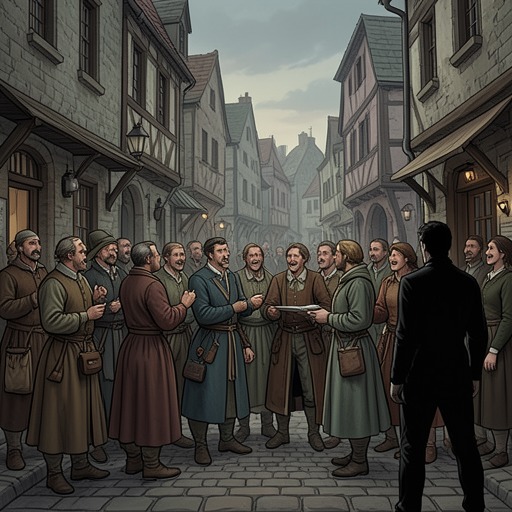
the prison
Much Ado About NothingThe prison is the play’s temporary chamber of custody and inquiry, a sharply functional space where concealed wrongdoing is brought into language, record, and public judgment. Its decisive significance lies in the change it imposes on the story’s evidence: what began as a secret plot and a sequence of overheard or staged appearances is recast as an examination of offenders, allowing the truth about the threatened marriage to move from suspicion toward institutional disclosure.
Definition and Setting
The prison appears explicitly as a scene location after Dogberry has ordered Verges to fetch Francis Seacole with a pen and inkhorn. The order places writing at the center of the space’s operation: the gaol is not merely where suspects are held, but where their words are to be captured and converted into an official account. Dogberry declares that the men are now to be examined, while Verges answers that the process must be conducted wisely. The comic self-importance of the constables does not erase the structural importance of the setting. The prison gives the disorder of the preceding night a bounded room, named officials, and a procedure.
The scene later identifies the prison again when Dogberry, Verges, and the Sexton enter in gowns with the Watch and bring Conrade and Borachio before them. The gowns visually stage authority, even though Dogberry’s language repeatedly exposes the gap between ceremonial office and practical competence. The prison therefore joins confinement to performance: legal power is made visible through clothing, entrance, rank, and the arrangement of prisoners before examiners.
From Secret Plot to Examination
The prison’s importance is prepared by the deception that has operated through private and semi-private spaces. In Leonato’s orchard, a man overhears the Prince and Count Claudio discussing the Prince’s love for Leonato’s daughter and his intention to acknowledge it at a dance. Elsewhere, Borachio explains that he can appoint a woman to look out from her lady’s chamber window at any unseasonable instant of the night. The orchard and the window make knowledge depend on position: someone must be close enough to hear, someone must be placed where another person can see, and appearances can then be mistaken for facts.
The prison reverses that spatial logic. Instead of an unseen listener occupying the edge of a private scene, the examiners deliberately summon the accused into a controlled public setting. Instead of a window framing an arranged spectacle, the prison frames testimony. The movement from orchard and chamber window to gaol is thus a movement from manipulated visibility to compelled speech. The plot’s earlier power came from controlling what others could see; the prison begins to undo that power by asking what the plotters themselves have done and what they can be made to reveal.
Participants and Dramatic Procedure
Dogberry presides over the examination, with Verges as his partner, the Sexton assisting, and the Watch standing behind the process. Conrade and Borachio are the prisoners brought before the constable. The participants are arranged according to a simple institutional opposition: officials on one side, offenders on the other. Yet the scene’s comedy depends on the fact that the people who possess formal authority do not necessarily possess verbal precision. Dogberry insists that the men come before him, and the Sexton clarifies that the offenders must be identified and presented before the master constable.
The pen and inkhorn deepen the contrast between procedure and competence. A written record promises permanence, accuracy, and accountability, while Dogberry’s malapropistic speech makes language unstable. The prison consequently becomes a testing ground for two kinds of authority. The constables claim the power to question and record; the prisoners’ words, once heard, can exceed the constables’ ability to interpret them. Dramatically, the institution is clumsy, but its act of listening is effective.
Consequences and Narrative Significance
The prisoners’ examination changes the moral and evidentiary direction of the plot. Before the prison scene, the threatened marriage has been damaged by a deception designed to make an arranged encounter appear incriminating. The prison gathers the agents of that deception in one place and subjects them to examination, making the concealed machinery of the plot available to the wider story. Its value shift is from secrecy and apparent certainty toward exposure and the possibility of correction.
The setting also marks the threshold between private injury and public repair. The church has been the place where marriage, accusation, and disgrace become ceremonially visible; the prison is the place where the hidden cause of that disgrace can be investigated. After the prison scene, the action returns to a church, now with Don Pedro, Claudio, and attendants carrying tapers. That return gives the prison a mediating role: it is not the final destination of judgment, but the dark interval in which the facts needed for a new public ceremony are brought to light.
Spatial and Thematic Function
The prison is a compact image of how the play produces truth. It restricts bodies, narrows movement, and concentrates speech, yet it also opens a route out of error by forcing the plot’s concealed actors into relation with official listeners. Its walls oppose the earlier freedom of movement through orchards, alleys, chambers, and nighttime approaches, but the restriction creates a different kind of visibility. What cannot safely be seen in the open can be spoken under examination.
Its comic form is inseparable from its serious function. Dogberry’s authority is repeatedly undercut by his language, while the formal setting, gowns, Watch, and writing materials insist that the proceedings matter. The resulting irony does not make justice irrelevant. Instead, it suggests that public truth may emerge through imperfect institutions, provided that testimony is heard and preserved. The prison’s lasting significance is therefore procedural as well as symbolic: it turns deception into evidence, evidence into examination, and examination into the possibility of restoring social and ceremonial order.