
The Power of Unreason
MunichThe characters confront political choices that are not governed by evidence and logic alone, but by fear, vanity, resentment and ideological fixation.
increasing Bearing strength in each event
 decreasing
Bearing strength in each eventdecreasingA Performance of Power
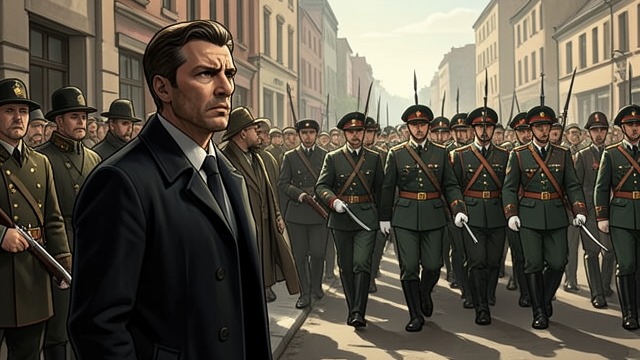
Hitler on the Balcony
A Staged Appearance
Hartmann watches Hitler acknowledge a thin crowd from the Chancellery balcony.
Disappointment Beneath Spectacle
The regime’s display of force cannot entirely hide the public’s reluctance to cheer for war.
Vanity and Decisions

Chamberlain Weighs Mobilisation
Flattery at the Table
A military leader appeals to Chamberlain’s concern that Hitler might mistake caution for weakness.
A Decision Made
The Prime Minister authorises partial mobilisation, showing how personal pride and strategic judgment intersect.
Hitler’s Changing Mood

Rage and Impatience
A Leader Under Constraint
Hitler reacts with irritation to negotiation, delay and popular acclaim for Chamberlain.
Irrational Pressure
His unpredictable mood makes the conference difficult to treat as a stable exchange of rational positions.
Chamberlain’s Hope

Trust in a Symbol
The Declaration Proposed
Chamberlain seeks a personal pledge that might reshape relations beyond the immediate crisis.
Hope as Policy
He treats the signed paper as an opening for peace, although its legal force is slight.
Hartmann Cannot Shoot

The Moment of Possibility
A Brief Opportunity
Hartmann finds himself alone with Hitler and imagines using the pistol hidden in his jacket.
A Fatal Inhibition
He cannot act, recognising that neither he nor the Army appears ready to break the country’s shared political destiny.
27 September 1938, afternoon
27 September 1938, afternoon
29 September 1938, during the conference
30 September 1938, morning
30 September 1938, late morning
