Automatic Pistol
Murder on the Orient ExpressThe automatic pistol is a small, concealable firearm owned by Samuel Edward Ratchett, the murdered American passenger. It appears in the narrative at two critical junctures: first as a prop in Ratchett's attempt to hire Poirot, and later as a silent witness to the victim's helplessness. The weapon's condition and placement after the murder provide crucial evidence about the nature of the crime, revealing that Ratchett was drugged and unable to defend himself, and that the conspirators had carefully planned every detail of the execution.
Appearance and Ratchett's Claim of Self-Defense
Ratchett first produces the automatic pistol during his conversation with Poirot in the restaurant car on the second day of the journey. He brings the weapon from his pocket, displaying it for a moment before returning it, and says grimly, "I don't think I'm the kind of man to be caught napping." This gesture is part of his attempt to persuade Poirot to accept a case involving threats against his life, offering "big money" for protection. The pistol is presented as evidence of Ratchett's preparedness and his belief that he can handle any physical threat. However, Poirot refuses the case, telling Ratchett bluntly, "I do not like your face, M. Ratchett." The pistol thus becomes a symbol of Ratchett's misplaced confidence in his own ability to survive.
Discovery After the Murder
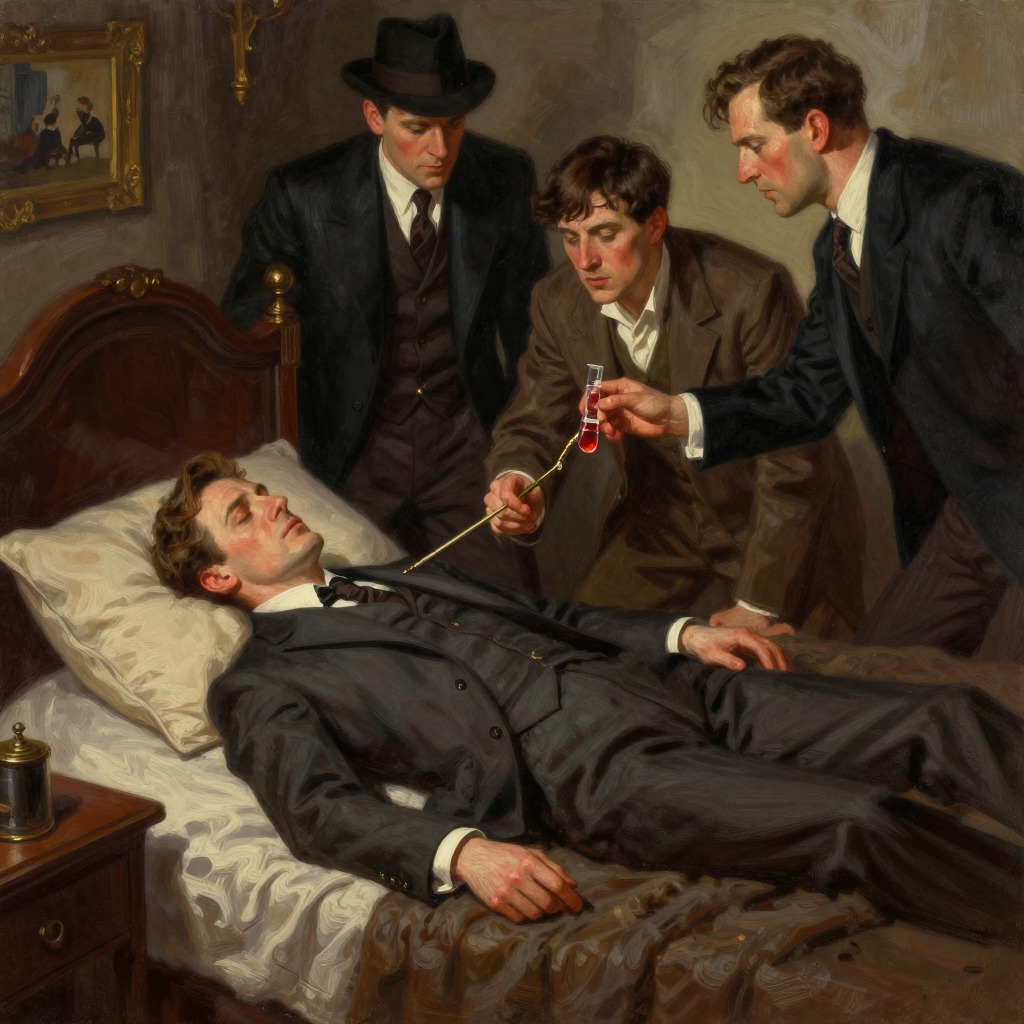
When Poirot and Dr. Constantine examine Ratchett's body the following morning, Poirot slips his hand under the victim's pillow and draws out the automatic pistol. He notes that it is "fully loaded," indicating that Ratchett never had a chance to use it. The discovery is made in the context of a broader examination of the compartment, which reveals that Ratchett had been drugged—an empty glass on the washbasin table is later found to have contained a sleeping draught. The pistol's presence under the pillow, fully loaded and unused, confirms that Ratchett was incapacitated before the attack began. He was unable to reach for the weapon or defend himself against the twelve stab wounds inflicted by the conspirators.
Significance as Evidence of Drugging
The automatic pistol's condition—fully loaded and undisturbed—is a key piece of evidence that supports the theory that Ratchett was drugged. Dr. Constantine picks up the empty glass from the washbasin table and sniffs it, quietly announcing, "Here is the explanation of the victim's inertia." Poirot nods in agreement. The pistol, which Ratchett had boasted of carrying for protection, becomes a silent testament to his vulnerability. The conspirators, led by Hector MacQueen and the valet Edward Masterman, had ensured that Ratchett would be unconscious when they entered his compartment. The pistol's presence under the pillow, rather than in his hand, underscores the calculated nature of the crime and the conspirators' success in neutralizing any possibility of resistance.
Narrative Role and Thematic Significance
The automatic pistol functions as a narrative device that highlights the contrast between Ratchett's perceived invulnerability and his actual helplessness. It also serves as a clue that Poirot uses to reconstruct the sequence of events. The fact that the pistol is fully loaded and untouched contradicts any suggestion that Ratchett was killed in a struggle or that he had time to defend himself. This reinforces the conspirators' careful planning and the collective nature of the murder. The pistol, like the dented watch and the charred note, is part of the "perfect mosaic" of evidence that Poirot ultimately deciphers. It is a material object that, in its stillness and silence, speaks volumes about the crime's execution and the victim's fate.