Brod
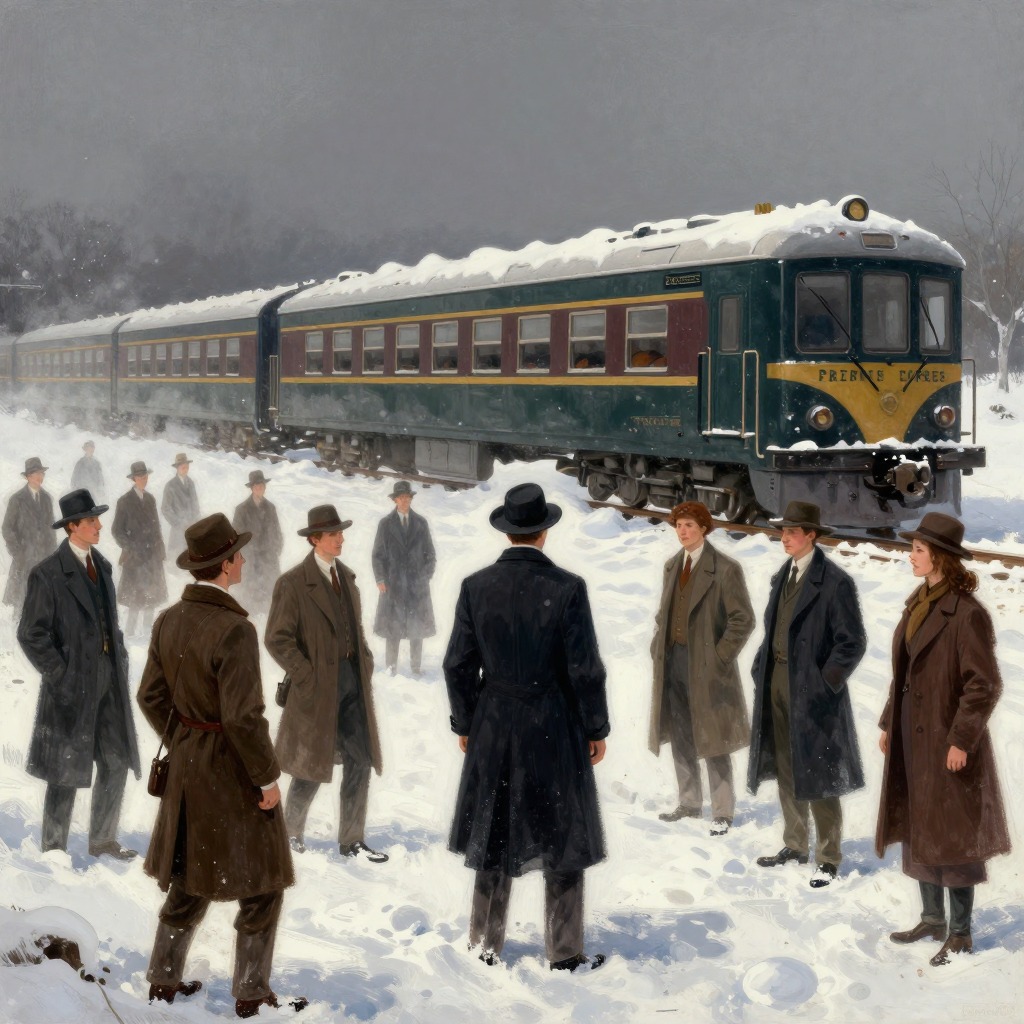
Murder on the Orient ExpressBrod is the station that the Simplon Orient Express never reached. On the second night of its journey from Constantinople to Calais, the train, running late because of heavy snow, came to a halt between Vincovci and Brod after ploughing into a deep snowdrift. That halt, at about half an hour after midnight, turned a straightforward murder into one of the most celebrated locked-room puzzles in detective fiction.
Location and Setting
Brod lies in the region of what was then Jugo-Slavia, a stretch of the line that, as the Wagon Lit conductor Pierre Michel told Hercule Poirot, had seen trains snowed up for as long as seven days in previous winters. The train stopped between Vincovci and Brod, and when Poirot raised his blind the next morning he saw "heavy banks of snow" surrounding the train. The snow was so thick that no one could have left the train after the drift was struck, and no footprints or other traces could have survived outside. The station itself never appears as a scene; it exists only as the intended destination that the train fails to reach, and as the place where, in the original plan of the conspirators, the murderer was supposed to have alighted and disappeared.
The Snowdrift and Its Consequences
The train ran into the snowdrift at half an hour after midnight, as Dr. Constantine later confirmed. This single fact destroyed the elaborate plan that the twelve conspirators had spent months perfecting. In their original scheme, the murderer—disguised as a Wagon Lit conductor—would have stabbed Ratchett, left the uniform in a toilet, and slipped off the train at Brod, where it was due to arrive at 0.58. The open window, the button from the uniform, and the testimony of several passengers would have pointed to an outside assassin who had boarded at Vincovci and left at Brod. But the snow made that impossible. The train did not move again until the following day, and every passenger was trapped aboard. As Poirot later explained to the assembled passengers, the conspirators discovered that "this part of their plan was impossible owing to the accident to the train" and held a hasty consultation, deciding to go through with the murder anyway, knowing that now all of them would come under suspicion.
Narrative Significance
Brod functions as the hinge on which the entire investigation turns. Because the train never reached Brod, the murderer could not escape, and Poirot knew that the killer must still be among the passengers in the Stamboul-Calais coach. This forced him to examine the evidence of each passenger in turn, leading eventually to the discovery that all twelve were connected to the Armstrong kidnapping case. The snowdrift near Brod thus transformed what would have been a routine crime—solved by the Jugo-Slavian police at the next station—into a complex psychological puzzle that required Poirot to "lie back and think" using his "little grey cells." The town itself never appears in the story except as a name on the timetable, but its absence—the journey that was never completed—is the structural cause of the entire investigation.