Caroline Martha Hubbard
Murder on the Orient ExpressCaroline Martha Hubbard, the talkative American lady who occupies compartment No. 3 on the Orient Express, is revealed in the story's final moments to be Linda Arden, the most famous tragic actress of her day and the mother of Sonia Armstrong. Her performance as a fussy, slightly comic widow—endlessly quoting her daughter's advice and complaining about foreign currencies—is a deliberate and masterful disguise, concealing the grief-stricken, vengeful matriarch who has engineered the murder of Samuel Edward Ratchett, the man who destroyed her family.
Identity and Background
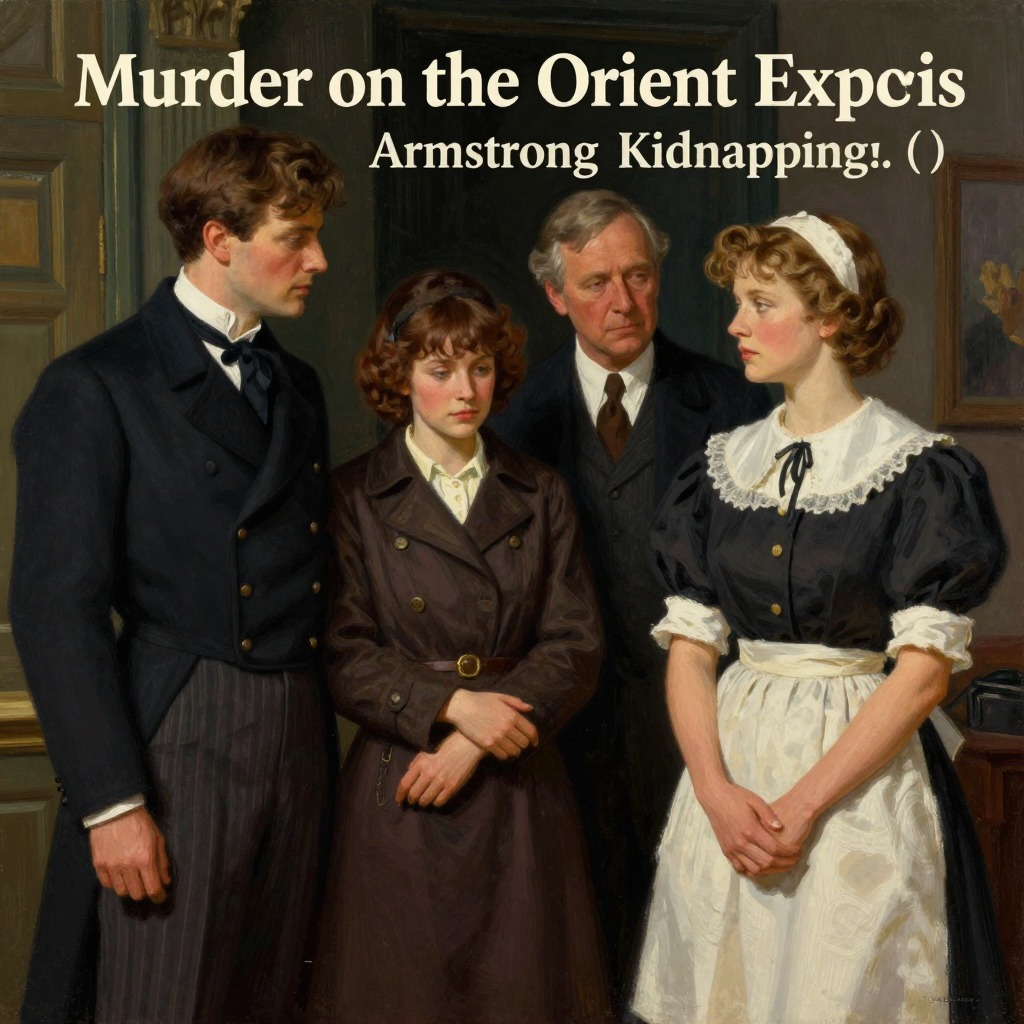
Linda Arden was a celebrated Shakespearean actress, known for her powerful emotional range and her ability to move audiences to tears. She took her stage name from the Forest of Arden in As You Like It. Her real name may have been Goldenberg, suggesting Central European or Jewish ancestry. She had two daughters: Sonia, who married Colonel Armstrong, and a younger daughter, Helena. The Armstrong household was shattered when their three-year-old daughter, Daisy, was kidnapped and murdered by Cassetti (Ratchett). The tragedy triggered a cascade of deaths: Sonia Armstrong died in premature childbirth after the shock, Colonel Armstrong shot himself, and the nursemaid Susanne, wrongly suspected of complicity, threw herself from a window. Linda Arden, already in delicate health and living in retirement, was left with nothing but a consuming desire for justice.
Role in the Conspiracy
Linda Arden was not merely a participant in the plot but its driving force. She herself described the moment of decision: "I was just crazy with grief; so were the servants." It was she who gathered the twelve conspirators—the servants, friends, and family members whose lives had been destroyed by Cassetti—and forged them into a self-appointed jury. The plan was to execute the sentence that American justice had failed to deliver. She played the most dangerous role in the drama: occupying the compartment that communicated directly with Ratchett's, she was the one most exposed to suspicion. Her part required an artist, and she was that artist. She later remarked, with a trace of professional pride, "I always fancied myself in comedy parts." Her performance as Mrs. Hubbard—the voluble, anxious, slightly ridiculous American mother—was flawless, designed to disarm suspicion and to provide the crucial access point for the other conspirators to enter Ratchett's compartment one by one and stab him.
Key Actions and Objectives
Mrs. Hubbard's primary objective was to provide a plausible narrative that would mislead the investigation. She claimed to have woken to find a man in her compartment, a story that was later corroborated by the discovery of a Wagon Lit uniform button. She also claimed that the communicating door between her compartment and Ratchett's was bolted, a detail that was later shown to be a deliberate lie—the bolt on her compartment door was positioned differently from what she described, a slip she later admitted was a failure of rehearsal. She also reported hearing a woman's voice from Ratchett's compartment, further muddying the waters. Her most critical action was simply being there: by occupying the adjoining compartment, she allowed each of the twelve conspirators to pass through her space in the dark, strike their blow, and return, all without her needing to witness the act. She was the gatekeeper of the crime.
Relationships and Conflict
Mrs. Hubbard's relationships with the other passengers are a study in calculated deception. She befriends Greta Ohlsson, the Swedish lady, and comforts her, all while knowing that Ohlsson is the former nurse of her murdered granddaughter. She expresses fear of Ratchett to Poirot, calling him a "murderer" and a "train robber," a performance that establishes her as a potential victim rather than a conspirator. Her deepest bond is with her daughter, Sonia, whose memory drives her. She also has a complex relationship with her younger daughter, Helena (Countess Andrenyi), whom she protects by allowing her husband to take her place in the stabbing, ensuring Helena has an alibi. The central conflict is between her public persona—the harmless, talkative widow—and her private identity as a grieving mother and grandmother who has taken the law into her own hands.
Change and Ending
When Poirot reveals the truth, Mrs. Hubbard's voice changes. The flat, nasal tones of the American matron give way to a "soft rich dreamy voice" that had thrilled audiences in New York. She acknowledges her role without remorse, stating that she would have stabbed Ratchett twelve times willingly. She asks Poirot to lay the blame on her alone, to spare the others—the faithful servants, the young lovers Mary Debenham and Colonel Arbuthnot, and the others who acted out of love and grief. Her final speech is a powerful, emotional plea that echoes the tragic actress she once was. Poirot, M. Bouc, and Dr. Constantine ultimately accept the first, more conventional solution to the crime, allowing the conspiracy to go unpunished. Mrs. Hubbard's fate is left unresolved, but her victory is complete: she has achieved her vengeance, and the system she distrusted has chosen to look the other way.
Thematic Significance
Caroline Martha Hubbard / Linda Arden embodies the novel's central moral dilemma: the conflict between legal justice and personal vengeance. She represents the failure of the American legal system, which allowed a guilty man to escape punishment through wealth and technicalities. Her transformation from a celebrated artist into a cold-blooded conspirator illustrates the corrosive power of grief and the lengths to which a mother will go to avenge her child. Her performance as Mrs. Hubbard is a meta-theatrical commentary on the nature of identity and deception: she is an actress playing a role within a story, and her success depends on her ability to make that role believable. In the end, she is both the victim and the perpetrator, the grieving mother and the ruthless judge, a figure of immense pathos and terrifying resolve.