Dr. Constantine
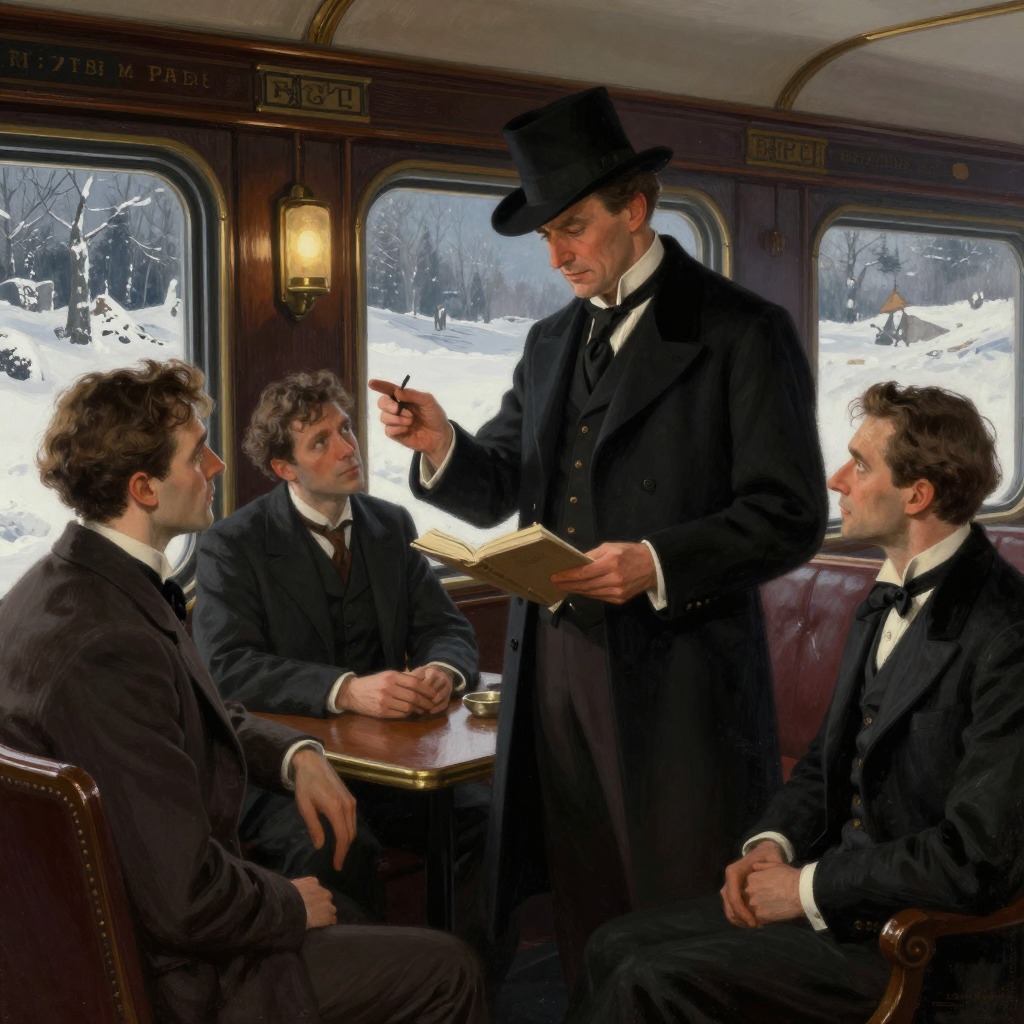
Murder on the Orient ExpressDr. Constantine is the Greek doctor travelling in the Athens-Paris coach of the Simplon Orient Express. He is a small, dark man who is first introduced when M. Bouc summons Hercule Poirot to a second-class compartment to discuss the murder. Constantine is present throughout the investigation, sitting across the aisle in the dining-car as Poirot interviews the passengers, and he becomes one of the three men—alongside Poirot and M. Bouc—who deliberate over the evidence and the possible solutions to the crime.
Medical Examination and Forensic Findings
Constantine is the first medical professional to examine Ratchett's body. He determines that death occurred between midnight and two in the morning, though he cautions that it is difficult to speak exactly in such matters. He notes that the window of the compartment was found wide open, but he immediately concludes that this is a blind, since anyone departing that way would have left distinct traces in the snow—and there were none. His most striking observation concerns the nature of the wounds: Ratchett was stabbed in twelve places, and Constantine points out that one or two of the blows were delivered with such force that they drove through hard belts of bone and muscle, while others are so slight as to be practically scratches. He describes the crime as "most unscientific," with blows delivered haphazardly and at random, as though someone had shut his eyes and struck blindly again and again.
Key Inconsistencies and the Two-Murderer Hypothesis
Constantine draws attention to two crucial inconsistencies in the wounds. First, he observes that two deep cuts, each of which must have severed blood vessels, do not gape and have not bled as expected—suggesting that the man was already dead, perhaps for some time, when those wounds were inflicted. Second, he demonstrates that one wound under the right arm near the right shoulder could not have been delivered with the right hand; it must have been struck with the left hand, while other blows are just as obviously right-handed. These observations lead Constantine and Poirot to hypothesize that there were two murderers: a First Murderer who stabbed the victim and left, and a Second Murderer who came in the dark, did not see that the work had been done, and stabbed at least twice at a dead body. Constantine enthusiastically calls this idea "Magnificent," though Poirot later dismisses it as "a little like the nonsense."
Role in the Investigation and the Final Solution
Throughout the inquiry, Constantine listens attentively to the passengers' evidence and participates in the discussions with Poirot and M. Bouc. He is present when Poirot reveals the identity of Ratchett as Cassetti, the Armstrong kidnapper, and when the detective propounds his two solutions. When Poirot first offers the explanation that the murder was committed by an outsider who left the train, Constantine vehemently rejects it, hitting the table with his fist and declaring that the explanation "will not hold water" and is "deficient in a dozen minor points." This forceful objection prompts Poirot to present his second, true solution: that all twelve passengers in the Stamboul-Calais coach were part of a conspiracy, each striking the victim once. At the conclusion, when Poirot asks M. Bouc what solution to offer the police, Bouc chooses the first theory, and Constantine immediately agrees, adding that as regards the medical evidence, he thinks he "made one or two fantastic suggestions." This final remark confirms that Constantine has understood and accepted the truth of the conspiracy, and he willingly participates in the cover-up that allows the conspirators to go free.