Hercule Poirot
Murder on the Orient ExpressHercule Poirot, the fastidious Belgian detective with an egg-shaped head, enormous moustaches, and a genius for psychological deduction, is the central figure of Agatha Christie's Murder on the Orient Express. His celebrated method of using his 'little grey cells' to solve a seemingly impossible locked-room murder on a snowbound train leads him to uncover a conspiracy of twelve passengers acting as a self-appointed jury to execute the kidnapper-murderer Cassetti. Poirot's journey from a successful mission in Syria to the climactic revelation in the dining car of the Simplon Orient Express forms the spine of the novel, and his final decision to present a false solution to the authorities embodies the book's moral complexity.
Identity and Introduction
Poirot is introduced as a small man muffled up against the cold, of whom nothing is visible but a pink-tipped nose and the two points of an upward-curled moustache. He is a former star of the Belgian police force, now a celebrated private detective who takes only cases that interest him. He has just completed a delicate mission in Syria that saved the honour of the French Army and averted much bloodshed, for which a grateful general has thanked him emotionally. On the Taurus Express, he is initially dismissed by the English passengers, Colonel Arbuthnot and Mary Debenham, as "only some damned foreigner" and a "ridiculous-looking little man." His vanity is evident: when M. Bouc remarks on his success, Poirot tries to look modest but fails signally. He is also a creature of habit and comfort, demanding a bottle of Perrier, using curling-tongs for his moustache, and complaining about the food in Syria not suiting his stomach.
Life and Plot Trajectory
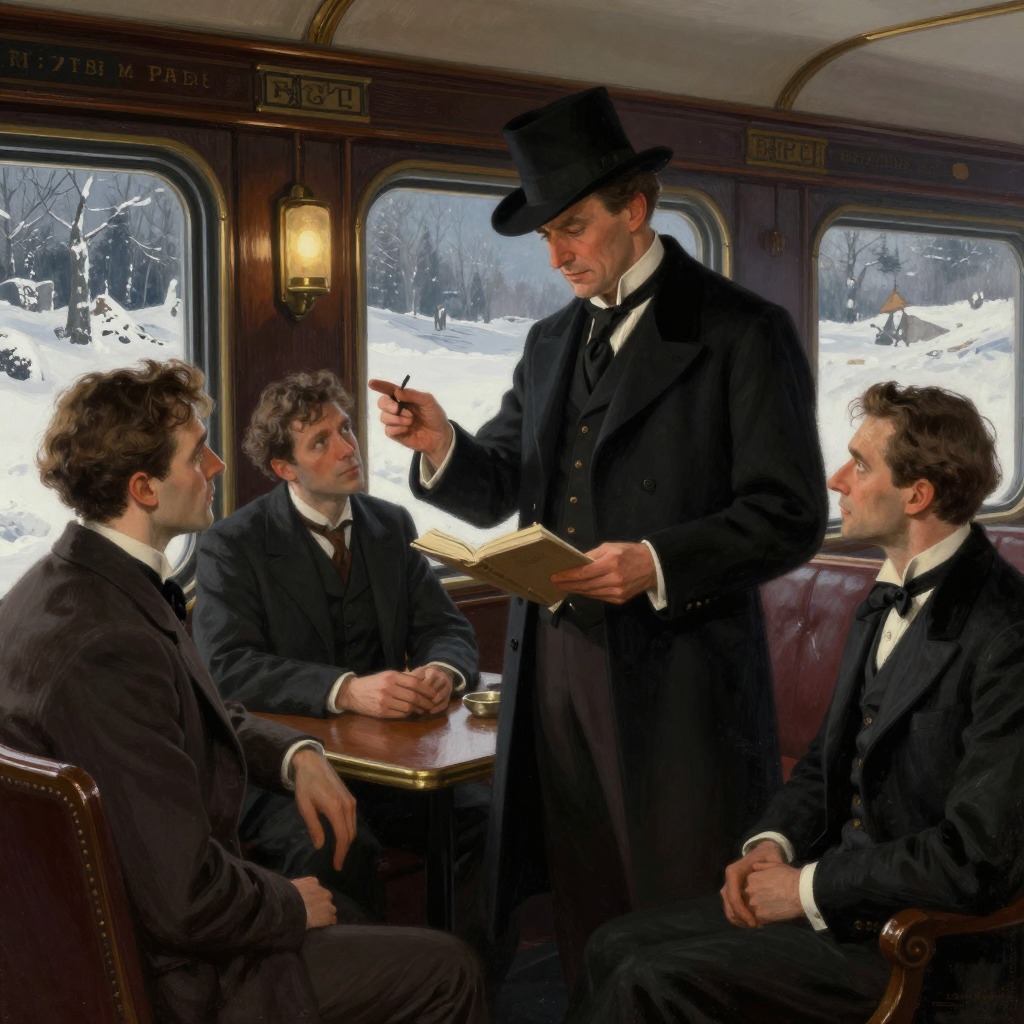
Poirot's journey begins at five o'clock on a winter's morning in Aleppo, where he boards the Taurus Express. His plan to spend a few days as a tourist in Constantinople is abruptly cancelled by a telegram recalling him to London on an important case. At the Tokatlian Hotel, he meets his old friend M. Bouc, a director of the Compagnie Internationale des Wagons Lits, who secures him a berth on the fully booked Simplon Orient Express. Poirot shares a compartment with the young American Hector MacQueen, and during the first day's lunch, he observes the other passengers, including the sinister Samuel Edward Ratchett. When Ratchett attempts to hire him for protection, offering twenty thousand dollars, Poirot refuses, stating bluntly, "I do not like your face, M. Ratchett." That night, Poirot is awakened by a cry and later hears Ratchett speak to the conductor. The next morning, the train is snowbound, and Ratchett is found stabbed to death. M. Bouc immediately asks Poirot to take command of the investigation, and Poirot accepts, intrigued by the problem.
Key Actions and Objectives
Poirot's primary objective is to solve the murder before the Jugo-Slavian police arrive, thereby sparing the Compagnie Internationale des Wagons Lits endless inconvenience. He systematically interviews all twelve passengers in the Stamboul-Calais coach, taking their evidence, examining their passports and tickets, and studying a plan of the carriage. He examines the body with Dr. Constantine, noting the twelve stab wounds, the drugged state of the victim, and the clues left behind: a woman's handkerchief with an initial H, a pipe-cleaner, a dented watch stopped at 1:15, and a button from a Wagon Lit uniform. He uses a spirit stove and curling-tongs to reconstruct a charred note fragment that reveals the word "Armstrong," identifying Ratchett as Cassetti, the mastermind of the infamous Armstrong kidnapping case. He then searches the passengers' luggage, finding the Wagon Lit uniform in Hildegarde Schmidt's suitcase and the scarlet kimono in his own. His key action is the psychological deduction that the passengers are all lying, and he formulates two solutions: one of an outside assassin who left the train, and the true solution of a conspiracy of twelve.
Relationships and Conflict
Poirot's relationship with M. Bouc is one of old friendship and professional respect; Bouc provides the authority of the company and serves as a sounding board. He also works closely with Dr. Constantine, whose medical evidence is crucial. The central conflict is between Poirot's method and the passengers' collective deception. He confronts each passenger with their lies: he exposes Countess Andrenyi as Helena Goldenberg, the sister of Mrs. Armstrong; he forces Mary Debenham to admit she was the governess in the Armstrong household; he reveals Antonio Foscarelli as the chauffeur, Greta Ohlsson as the nurse, and Masterman as Colonel Armstrong's batman. He also traps Hildegarde Schmidt into admitting she is a cook, not a lady's-maid, and deduces that Princess Dragomiroff's handkerchief is hers, the initial H being the Russian letter for N. The most dramatic conflict is with Colonel Arbuthnot, who threatens to break every bone in Poirot's body for making Mary Debenham cry.
Change and Ending
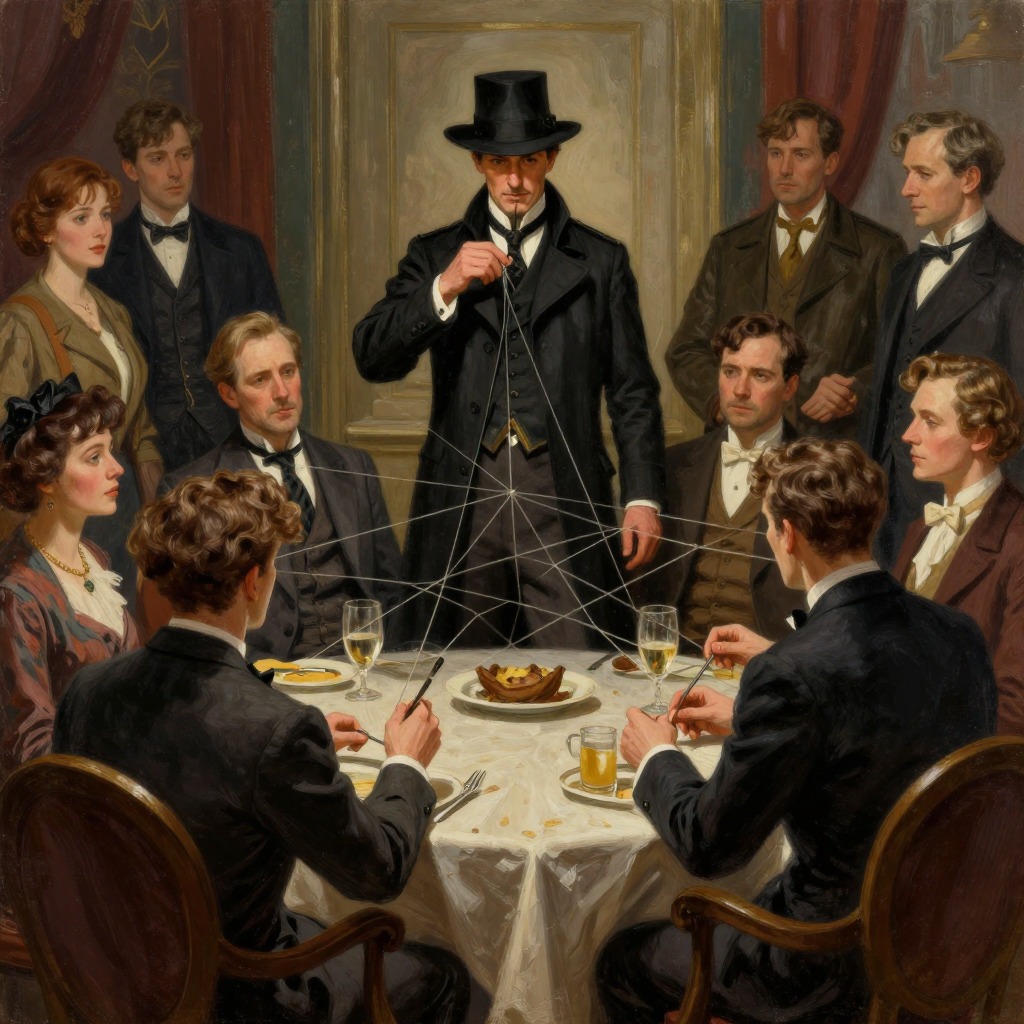
Poirot's understanding of the case undergoes a profound shift. He begins by suspecting individuals, but the sheer number of coincidences and the impossibility of the evidence lead him to the radical conclusion that all twelve passengers are guilty. He realizes that the crime was a premeditated act of private vengeance, a self-appointed jury of twelve people who each stabbed Ratchett once. In the final scene, he propounds two solutions to the assembled passengers. The first, a false solution involving an outside assassin, is accepted by M. Bouc and Dr. Constantine as the official version to be given to the police. The second, the true solution, is the conspiracy of the twelve. Poirot then retires from the case, leaving the moral decision to the director of the company. His final act is not to expose the truth but to allow a lie to stand, recognizing that "strict justice" has been done.
Narrative Role and Evaluation
Poirot functions as the classic detective figure, the lens through which the reader perceives the puzzle. His method is explicitly contrasted with routine police work; he relies on psychology, order, and method, not on fingerprints or cigarette ash. He is a master of the "little grey cells," and his ability to sit back and think is presented as the ultimate tool. The novel is a showcase for his deductive genius, and his final speech, in which he lays out the perfect mosaic of the conspiracy, is the climax of the book. However, Poirot is also a moral agent. His decision to suppress the truth and allow the conspirators to go free elevates him from a mere puzzle-solver to a judge of human justice. He recognizes that the law has failed and that the passengers have carried out a sentence that society had failed to impose. This makes him a complex figure, one who values justice over legalism. His final words, "I have the honour to retire from the case," are a quiet but powerful assertion of his own moral authority.
The character has also been reimagined in a Japanese television adaptation broadcast over two nights in January 2015 on Fuji Television, titled Orient Kyuukou Satsujin Jiken. The main character, Suguro Takeru, modeled on Hercule Poirot, was played by actor Nomura Mansai, with a cast including Ninomiya Kazunari, Matsushima Nanako, Tamaki Hiroshi, Kichise Michiko, Nishida Toshiyuki, and Sawamura Ikki. The first night's storyline remained faithful to the original text but was set in Japan in 1933, with the train Orient Kyuukou running from Shimonoseki to Tokyo and halted by a small avalanche near Sekigahara, Gifu.