Murder of Samuel Ratchett
Murder on the Orient ExpressThe murder of Samuel Edward Ratchett—later identified as Cassetti, the mastermind behind the kidnapping and death of three-year-old Daisy Armstrong—is the pivotal event of Agatha Christie's Murder on the Orient Express. Discovered on the morning after the train became trapped in a snowdrift between Vincovci and Brod, the crime presents an apparent locked-room mystery: Ratchett's compartment door is chained from the inside, the window is open but shows no footprints in the fresh snow, and the victim has been stabbed twelve times. The investigation, led by Hercule Poirot at the request of his friend M. Bouc, a director of the Compagnie Internationale des Wagons Lits, gradually reveals that the murder is not a single act but a collective execution, a conspiracy of twelve passengers each connected to the Armstrong case.
Background and Motive
The roots of the murder lie in the Armstrong kidnapping case of several years earlier. Cassetti, then operating under his real name, led a gang that kidnapped three-year-old Daisy Armstrong, the daughter of Colonel Armstrong (a V.C. and half-American heir to the Van der Halt fortune) and his wife Sonia, the daughter of the celebrated actress Linda Arden. Despite the Armstrongs paying a ransom of two hundred thousand dollars, Daisy's dead body was discovered; she had been dead for at least a fortnight. The shock caused Mrs. Armstrong to give birth prematurely to a stillborn child and to die herself; the broken-hearted Colonel Armstrong shot himself. An innocent French nursemaid, Susanne, was wrongly suspected of complicity and, in despair, threw herself from a window to her death. Cassetti was arrested but, using his wealth and influence, was acquitted on a technicality and fled America under the alias Ratchett. The twelve people on the Orient Express—including family members, servants, and friends of the Armstrongs—had tracked him down and resolved to carry out the death sentence that the American legal system had failed to deliver.
The Crime and Its Execution
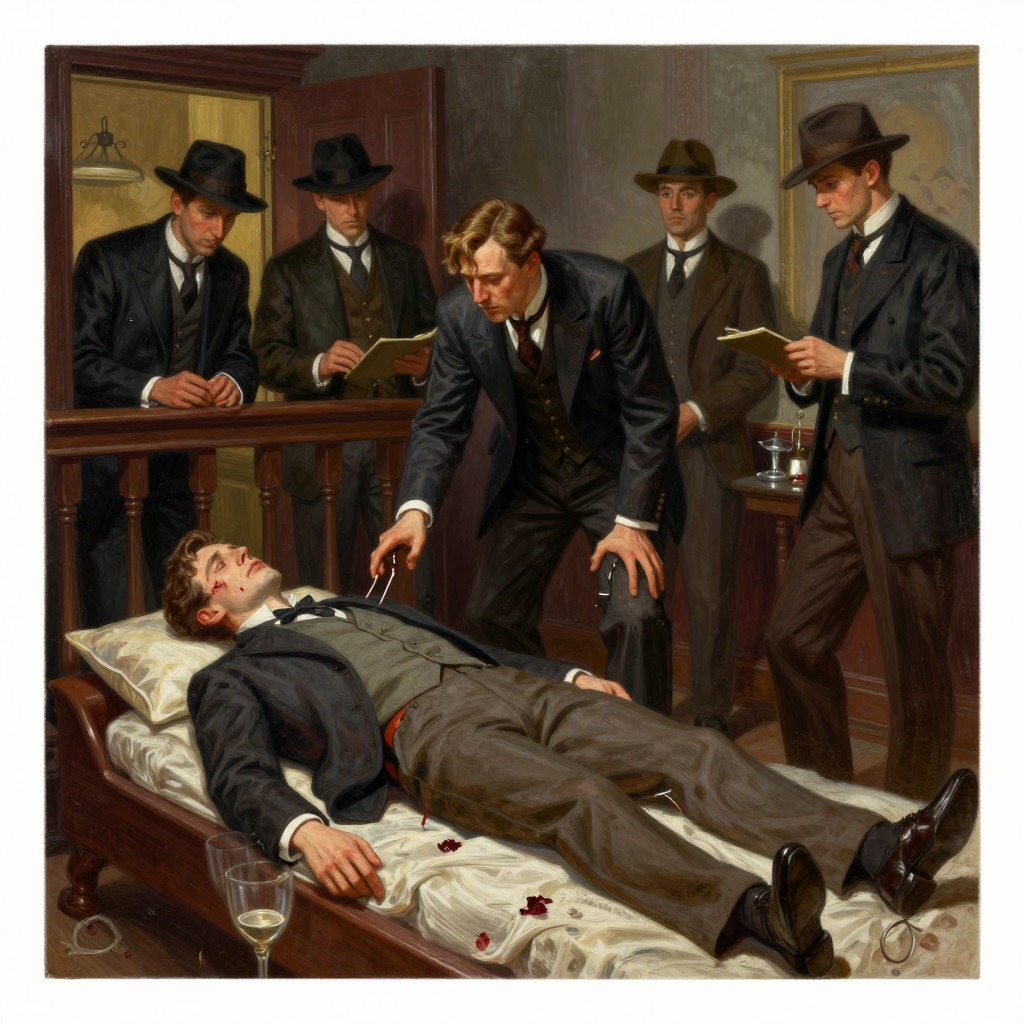
The murder was planned as a collective act, with each of the twelve conspirators taking a turn to stab the drugged Ratchett in his darkened compartment. The victim had been given a sleeping draught by his valet, Masterman, ensuring he would be unconscious and unable to resist. The conspirators entered through the communicating door from Mrs. Hubbard's compartment (No. 3), which had been left unlocked. Each person struck once, using a cheap Oriental dagger that had been purchased in Constantinople. The twelve wounds—some feeble, some deep, some delivered with the right hand and others with the left—reflected the varying strength and handedness of the participants. Dr. Constantine, who examined the body, noted that the wounds were inconsistent with a single assailant, a clue that Poirot later interprets as evidence of multiple attackers. The conspirators had also planted false clues: a pipe-cleaner to implicate Colonel Arbuthnot, and a handkerchief monogrammed with an H (which Princess Dragomiroff later claimed as hers, the H being the Cyrillic equivalent of N) to mislead the investigation. A scarlet kimono was used to create the illusion of a mysterious woman in the corridor, and a Wagon Lit uniform was planted in Hildegarde Schmidt's suitcase to suggest an outside intruder.
Consequences and Aftermath
The snowdrift that stopped the train near Brod forced the conspirators to abandon their original plan, which had been to make the murder appear to be the work of an outsider who would have left the train at the scheduled stop. Instead, they were trapped with the body, and Poirot's investigation inevitably closed in on them. Through a series of interviews and deductions, Poirot uncovers the connections: Countess Andrenyi is Helena Goldenberg, Mrs. Armstrong's younger sister; Mary Debenham was the governess in the Armstrong household; Greta Ohlsson was Daisy's nurse; Antonio Foscarelli was the chauffeur; Masterman had been Colonel Armstrong's batman; Pierre Michel, the Wagon Lit conductor, is the father of the dead nursemaid Susanne; and Mrs. Hubbard is none other than Linda Arden herself, the grandmother of the murdered child. Poirot ultimately presents two solutions to M. Bouc and Dr. Constantine: the official one, which blames a fictitious outsider, and the true one, which reveals the conspiracy of the twelve. The novel ends with M. Bouc and Dr. Constantine accepting the first solution, allowing the conspirators to go free, as Poirot "retires from the case."