Pipe-cleaner
Murder on the Orient ExpressThe pipe-cleaner is a small, flexible wire implement used to clean tobacco residue from a pipe, and in the investigation of Ratchett's murder it becomes one of the most conspicuous—and most deliberately misleading—pieces of physical evidence. Found on the floor of the dead man's compartment, it appears at first to be a straightforward clue pointing to a pipe-smoker among the passengers. Yet its very presence, alongside a woman's handkerchief also left at the scene, raises the central question of whether these objects were dropped by accident or placed there to frame an innocent person. The pipe-cleaner thus functions as a test of the detective's method: will he take the clue at face value, or will he see through the artifice to the larger design behind the crime?
Discovery and Physical Description
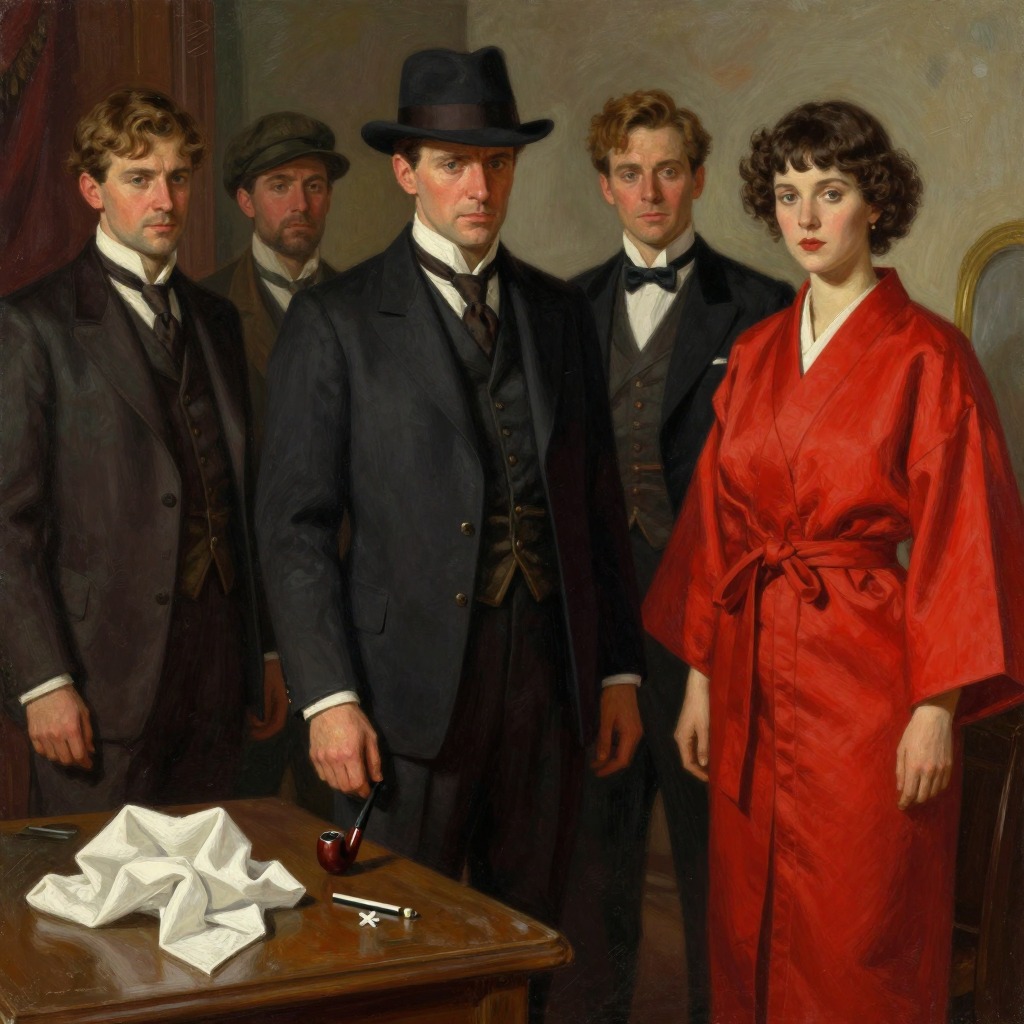
Poirot discovers the pipe-cleaner during his initial examination of Ratchett's compartment, bending to pick it up from the floor after he has already retrieved a woman's handkerchief marked with the initial H. The pipe-cleaner is an ordinary, unremarkable specimen of its kind—a flexible wire core wrapped in soft fibre, used to draw moisture and residue from the stem of a tobacco pipe. No pipe is found among Ratchett's belongings, and the victim himself smoked only cigars, as evidenced by the cigar butt in the ashtray of his compartment. The pipe-cleaner therefore cannot belong to the dead man, and its presence on the floor immediately marks it as a clue left by someone else.
The Only Pipe-Smoker on the Train
When Poirot interviews the passengers, he establishes that Colonel Arbuthnot is the only person in the Stamboul-Calais coach who smokes a pipe. Arbuthnot freely admits to using a pipe and to carrying pipe-cleaners of the same type as the one found. During the search of his luggage, Poirot notes a packet of pipe-cleaners and confirms that they match the discovered specimen exactly. Yet Arbuthnot denies having dropped the cleaner in Ratchett's compartment, and he has a strong alibi: he spent the critical hours after midnight talking with Hector MacQueen, and the conductor confirms that he returned to his own compartment and did not leave it. The pipe-cleaner thus points to Arbuthnot but cannot be reconciled with the evidence that he never entered the victim's compartment.
A Deliberately Planted Clue
Poirot quickly concludes that the pipe-cleaner is a fake clue, planted to incriminate Arbuthnot and confuse the investigation. He reasons that the crime scene contains too many convenient objects—the handkerchief, the dented watch, the pipe-cleaner—for all of them to be genuine oversights. The pipe-cleaner, in particular, is too obvious: it points directly to the one passenger who smokes a pipe, and that passenger has an unshakeable alibi. Poirot tells Arbuthnot directly that he can think of eleven other explanations for the pipe-cleaner's presence, dismissing it as irrelevant to the real solution. The clue is therefore not a mistake by the murderer but a calculated piece of misdirection, part of the elaborate plan to make the crime appear to have been committed by an outsider or by a single, identifiable culprit.
Thematic Significance: The Limits of Physical Evidence
The pipe-cleaner exemplifies the novel's deeper argument about the nature of evidence in detective fiction. In a conventional mystery, such a clue would lead inexorably to the pipe-smoker; here, it leads nowhere, because the crime was committed not by one person but by twelve, each of whom struck the victim in the dark. The pipe-cleaner is a red herring, planted by the conspirators to exploit the very expectations that readers and detectives bring to a murder case. Its presence forces Poirot—and the reader—to question whether any physical object at the scene can be trusted. The pipe-cleaner thus becomes a symbol of the gap between appearance and reality, a reminder that the most obvious clue may be the most carefully fabricated lie.