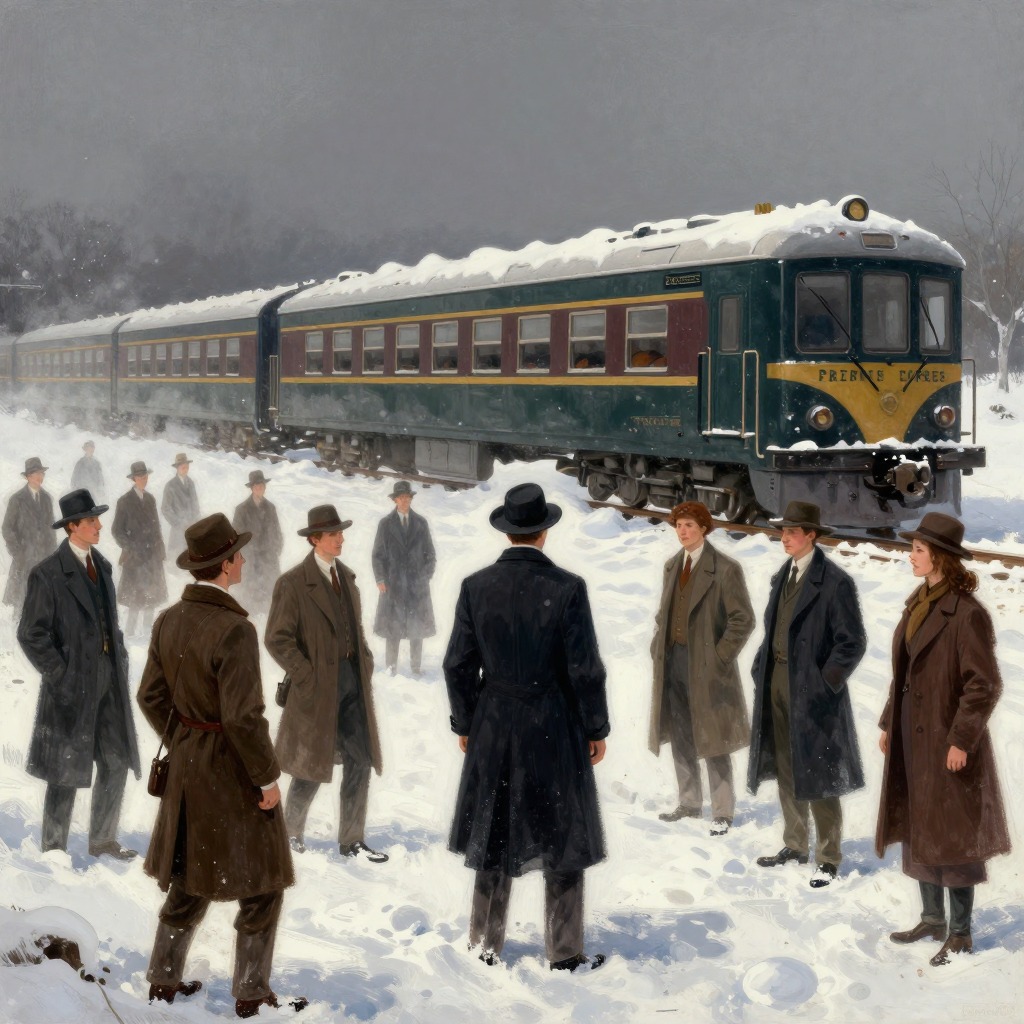
Snowdrift
Murder on the Orient ExpressThe snowdrift that halted the Simplon Orient Express in the early hours of the morning was the single most disruptive physical event of the journey, transforming a carefully planned murder into an impossible locked-room puzzle. Without it, the conspirators' original scheme—to make the killing appear to be the work of an outsider who left the train at Brod—would likely have succeeded. Instead, the snow trapped every passenger and all evidence aboard, forcing the twelve executioners to improvise and ultimately giving Hercule Poirot the closed environment he needed to unravel the truth.
Causes and Onset
The train ran into the snowdrift at half an hour after midnight, shortly after leaving Vincovci. The weather had been worsening throughout the journey: at Belgrade, heavy snow was falling outside, and the conductor remarked that there had not been so much snow for years. The train's progress had already been delayed—it left Vincovci twenty minutes late, at 12:10 a.m. instead of 11:58 p.m.—and the worsening blizzard soon brought it to a complete standstill between Vincovci and Brod. The conductor, Pierre Michel, informed Poirot that the train had run into a snowdrift and that he remembered once being snowed up for seven days. The passengers awoke to find the train surrounded by heavy banks of snow, with no prospect of early rescue.
Immediate Consequences for the Investigation
The snowdrift created the central condition of the mystery: the murderer could not have left the train. As Dr. Constantine pointed out, at half an hour after midnight the train ran into the snowdrift, and no one could have left it since then. M. Bouc solemnly declared, "The murderer is with us—on the train now." This transformed the case from one in which an outside assassin could have escaped at a scheduled stop into a closed-circle puzzle in which every passenger was a suspect. The snow also prevented the arrival of any local police, since the train was stranded in Jugo-Slavia, a country through which it passed without its own police on board. M. Bouc therefore appealed to Poirot to solve the case before the Jugo-Slavian police could arrive, arguing that presenting them with a ready solution would avoid endless delays and annoyances to innocent persons.
Disruption of the Conspirators' Plan
The snowdrift wrecked the original plan, which had been designed to look like an outside job. As Poirot later reconstructed it, the murder was meant to be discovered at the Italian frontier, with the Wagon Lit uniform found cast off in a toilet and the assumption that the assassin had left the train at Brod, where it was timed to arrive at 0:58. The snow made that impossible. The conspirators were forced to hold a hasty consultation and decide to go through with the crime anyway, knowing that now all of them would come under suspicion. The additional clues—the pipe-cleaner and the handkerchief—were planted to confuse the issue further, and the scarlet kimono was deployed as a red herring. The snow also explains why the murderer remained in the compartment with his victim for so long: he was waiting for the train to go on, and only when he realised it was not going on did he adapt his plans.
Narrative and Thematic Significance
The snowdrift functions as both a plot device and a thematic symbol. It creates the classic "impossible crime" scenario that detective fiction thrives on, forcing Poirot to rely entirely on his "little grey cells" rather than on routine police work. The snow also isolates the passengers, breaking down the barriers between them and uniting them in a common misfortune, as seen in the communal lamentations in the dining-car. Thematically, the snow represents the unforeseen force that compels justice to be done openly rather than in secret: the conspirators' elaborate plan to escape detection is thwarted by a natural event, and the truth must be confronted. Poirot himself notes that the snow has upset all the murderer's original plan, and that without it the affair would have appeared to the outside world as a simple outside job. The snowdrift, then, is the element that makes the case solvable—and that makes the novel's famous denouement possible.