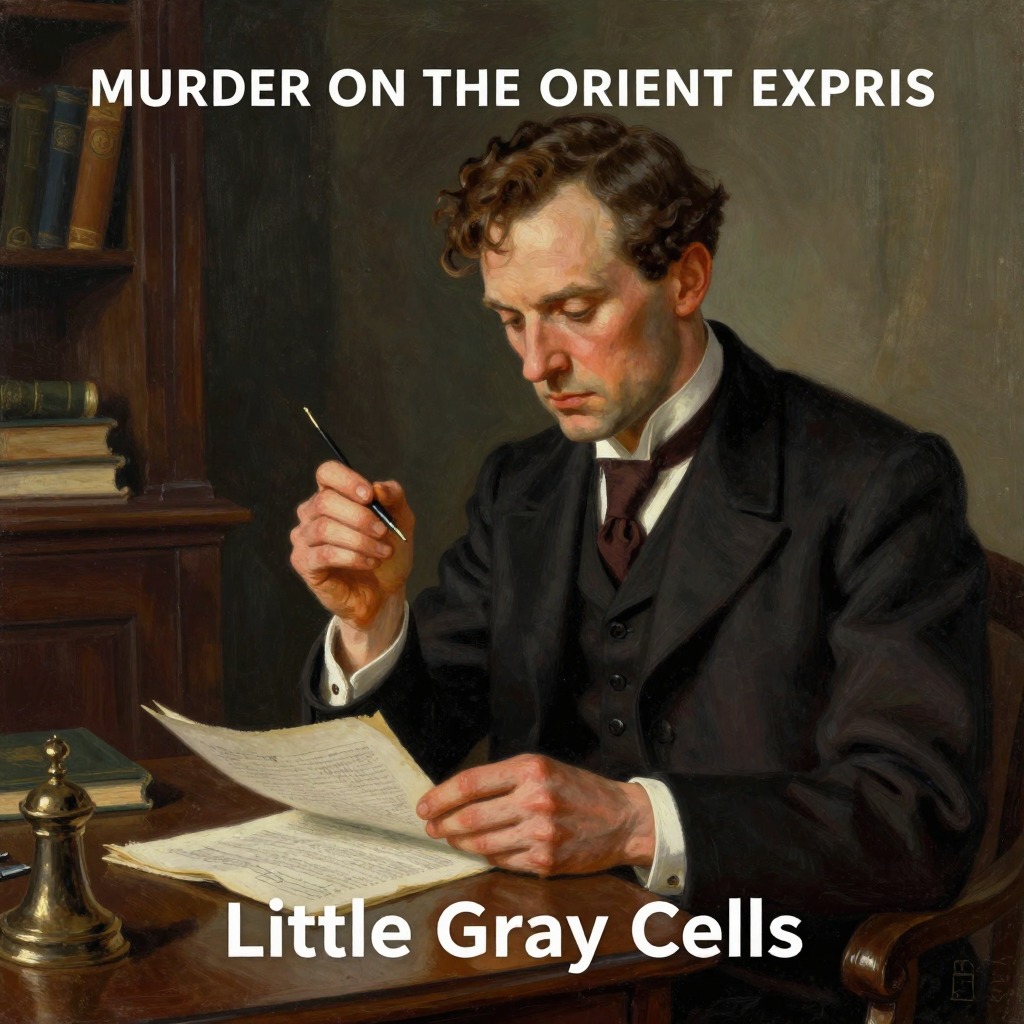
the little grey cells
Murder on the Orient ExpressThe little grey cells are the central metaphor for Hercule Poirot's method of detection, representing a faith in pure reasoning that sets him apart from conventional police procedure. The phrase crystallizes his belief that a detective need only lie back in his chair and think, using the intellect rather than fingerprints or cigarette ash to arrive at the truth. In Murder on the Orient Express, Poirot invokes the concept at the decisive moment when he agrees to take command of the investigation, and the phrase becomes the philosophical foundation of his entire inquiry.
Origin and Meaning of the Method
The phrase emerges during Poirot's conversation with his old friend M. Bouc, a director of the Compagnie Internationale des Wagons Lits, shortly after the discovery of Ratchett's body. Bouc, desperate for a solution before the Jugo-Slavian police arrive, appeals to Poirot by recalling his friend's own words: "have I not heard you say often that to solve a case a man has only to lie back in his chair and think?" Bouc then urges Poirot to "use (as I have heard you say so often) the little grey cells of the mind—and you will know!" The phrase is thus presented as a well-known axiom of Poirot's professional philosophy, one that Bouc has heard him repeat on previous occasions. Poirot does not merely accept the compliment; he leans forward, looking affectionately at Bouc, and says, "Your faith touches me, my friend." He then immediately declares that the problem intrigues him and that he was reflecting, not half an hour earlier, on the boredom that lay ahead—and now a problem lies ready to his hand. The little grey cells are therefore not a last resort but his preferred and primary instrument.
Contrast with Physical Evidence
Poirot's reliance on the little grey cells is explicitly set against the kind of forensic work that other detectives might prioritize. Later, while examining Ratchett's compartment, he tells Dr. Constantine, "See you, my dear doctor, me, I am not one to rely upon the expert procedure. It is the psychology I seek, not the fingerprint or the cigarette ash." He acknowledges that in this particular case he would welcome scientific assistance, but only because the compartment is so full of clues that he cannot be sure whether they are genuine or faked. The little grey cells, by contrast, are the tool for sorting the authentic from the planted. The phrase thus defines a hierarchy: physical clues are secondary, to be interpreted by the mind, not trusted at face value.
Application in the Investigation
Poirot puts the method into practice in the most literal way. After all the passengers have been interviewed and the luggage searched, he leads M. Bouc and Dr. Constantine back to the dining-car and announces that they must now use their brains. He tells them, "From now on, it is all here," tapping himself on the forehead. He then instructs both men to close their eyes and think, and for a full quarter of an hour he sits completely still, his eyebrows eventually beginning to move slowly up his forehead as the solution takes shape. When he finally speaks, he says, "Eh bien. I have thought. And you?" The little grey cells have done their work: the impossible has become possible, and the elaborate conspiracy of the twelve passengers is revealed.
Thematic Significance
The little grey cells are more than a personal catchphrase; they embody the novel's celebration of deductive reasoning as a form of justice. In a case where the legal system has failed—Cassetti was acquitted on a technicality and escaped punishment—Poirot's mental powers become the instrument that uncovers the truth. Yet the phrase also carries an ironic weight: the solution that the little grey cells produce is not a simple identification of one guilty party but the recognition of a collective execution carried out by a self-appointed jury. Poirot's reasoning leads him to a moral as well as a factual conclusion, and the little grey cells ultimately serve not to condemn but to decide which version of the truth will be offered to the authorities. The method, in the end, is as much about judgment as about detection.