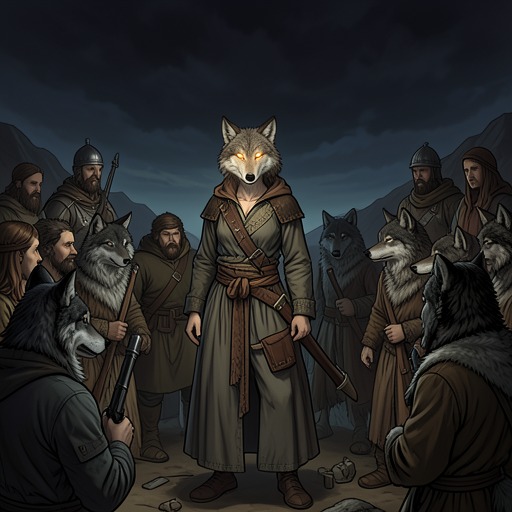
Dual-animal shifter
My Dark Mate: A Rejected Mate Werewolf Shifter RomanceA Dual-animal shifter is a rare Shifter who possesses two animal natures at once. In Caleb Chase's case, those natures are a wolf and a bear, and the condition is not merely an unusual biological trait: it becomes the hidden structure of his identity, his history, and his eventual transformation. The story first presents Caleb as a man determined to keep his animals from emerging, then gradually reveals that the animal he feared and suppressed is the part of himself most closely aligned with his true nature.
Definition and Physical Signs
A Dual-animal shifter differs from an ordinary Shifter because two animals can seek expression through the same body. Caleb's condition is visibly marked by his eyes. When his animals want to come forth, his left eye turns golden brown while his right remains gray, producing the distinctive two-toned gaze that he must consciously prevent from appearing. The change is involuntary enough to frighten him, and he treats the emergence of either animal as something that must not happen again.
The two animals are not interchangeable manifestations of one instinct. They possess contrasting tendencies and exert different pressures on Caleb's consciousness. His wolf is vocal, reactive, and familiar to him, while his bear is initially quieter and less acknowledged but proves stronger, more territorial, more patient, and more stealthy. The condition therefore creates not a simple doubling of physical power but an internal plurality in which Caleb must learn to recognize separate forms of knowledge, desire, and control.
Caleb's Suppression and Family History
Caleb's family taught him to regard his dual nature as abnormal. Trey Chase explains that Caleb had always shown a stronger and more dominant territorial side, but his parents disliked those qualities and encouraged him to suppress them. Their insistence that it was not normal to have two animals gradually narrowed Caleb's shifting until, by the time the brothers were grown, he shifted only as a wolf.
That history explains why Caleb assumed that his wolf was his stronger animal. His bear had not disappeared; it had been denied access to his life. Caleb's suppression was reinforced by his effort to preserve a socially acceptable identity and by the belief that control required exclusion. He consequently treated the bear as a danger rather than as an integral part of himself, making self-rejection the practical condition of his adulthood.
The consequences extend into Caleb's earlier relationship with Joyce. Trey observes that even when Caleb was with Joyce, only his wolf was present: the two-toned eyes never appeared, and the bear did not participate in the relationship. This distinction complicates Caleb's earlier belief that his fated bond with Joyce represented the whole truth of his nature. The relationship was real to the wolf he allowed to live, but it did not include the suppressed animal that later becomes decisive.
Strength, Instinct, and the Awakening Bear
The rarity of Caleb's condition makes him unusually powerful. Ren Sheppard Chase learns that Caleb is an ex-Enforcer with two animals, a combination considered so rare that it makes him stronger than even the Alpha. Yet the narrative initially presents this power as a liability because Caleb has convinced himself that keeping his wolf weak is his only option and that he will never be mated again.
The bear's strength becomes undeniable when Ren is injured and taken. Caleb hears and scents the danger before his reasoning can contain it; his bear roars, vibrates through him, and claims Ren as its mate. The response is not a controlled performance of duty. It is physical panic, murderous rage, and heartbreak, revealing that the suppressed animal has its own attachment and its own urgent understanding of what is at stake.
During the rescue, Caleb experiences an even more important reversal. He sees himself moving beyond the division between his wolf and bear and recognizes that the command to kill comes from him—not from the wolf and not from the bear alone. His dual nature no longer erases personal agency. Instead, the emergence of both animals allows Caleb to act as an integrated self, with instinct supplying force while consciousness remains capable of choosing.
The Combined Form and Reclaimed Identity
A waking vision gives Ren an image of Caleb's fully realized power: his eyes are both golden, and he shifts into an enormous russet-brown wolf that appears as though his bear and wolf have shifted together. The image makes visible what Caleb has spent years refusing to acknowledge. His ultimate form is not a choice between wolf and bear but a union in which both animals contribute to the body that others must confront.
This combined form also changes the meaning of Caleb's earlier restraint. What had seemed like discipline was partly self-erasure, and what he had feared as monstrous becomes evidence of an authentic, formidable identity. The enormous russet animal is frightening because it exceeds the familiar category Caleb had been trained to accept, but its monstrosity is also the narrative's image of recovered wholeness.
After allowing the animals more control than ever before, Caleb discovers that the bear is much stronger than the wolf. The bear is also more cunning in its quietness: it is stealthier and more patient, whereas the wolf is more readily recognized and more immediately reactive. This discovery creates a new responsibility. Caleb no longer needs to keep both animals imprisoned, but freedom does not eliminate danger; he must now watch the bear precisely because its power and subtlety can exceed his expectations.
Relation to Mating and Emotional Recovery
The Dual-animal shifter concept reshapes Caleb's understanding of mating. He had believed that Joyce was the correct partner because he had completed a fated bond with her, but Trey argues that the bond did not fit Caleb as a whole person. Joyce was connected to the wolf Caleb presented, while Ren Sheppard Chase reaches the bear as well. The difference explains why Caleb's relationship with Ren awakens a happiness that his previous life never fully contained.
Caleb's eventual recognition of this distinction is inseparable from grief. He realizes that losing Joyce meant not only losing her but also losing everything he had wanted while pursuing what he thought was right. His love for Ren forces him to separate social expectation, prior fate, and personal truth. Trey identifies the central contrast directly: Caleb is a bear, and the wolf-centered identity of his former life was not, by itself, the whole of who he was.
The concept therefore gives Caleb's emotional change a bodily foundation. His recovery is not achieved by suppressing pain or choosing one acceptable self over another. It occurs when the parts he had treated as incompatible are permitted to participate in love, protection, anger, and judgment. His bond with Ren becomes proof that integration can produce happiness rather than the chaos Caleb had feared.
Narrative Significance
The Dual-animal shifter is both a supernatural category and the novel's clearest model of divided identity. Caleb's family and his former assumptions define normality as having one animal and mastering the other through silence. The plot reverses that lesson: the suppressed bear is not an alien invasion of the self but a neglected component of it, and the most dangerous period is the period in which Caleb denies its existence.
The concept also gives nonhuman agency a direct role in the story. Caleb's bear notices, desires, protects, grieves, and argues for action; it is not merely a metaphor placed over human emotion. At the same time, the narrative does not surrender Caleb's personhood to instinct. His crucial breakthrough is that he can recognize the command to kill as his own, rather than attributing every decisive act to one animal. The dual body thus becomes a relational and ethical structure: Caleb must negotiate with the beings within him without reducing either one to a tool.
By the end of this development, Caleb's two animals signify more than unusual strength. They mark the recovery of a self that had been fractured by family judgment, fear, and an incomplete understanding of his earlier bond. The bear's emergence, the wolf's persistence, and their eventual coordination turn duality from a shameful secret into the condition through which Caleb can protect Ren, understand his past, and accept the love he had believed impossible.