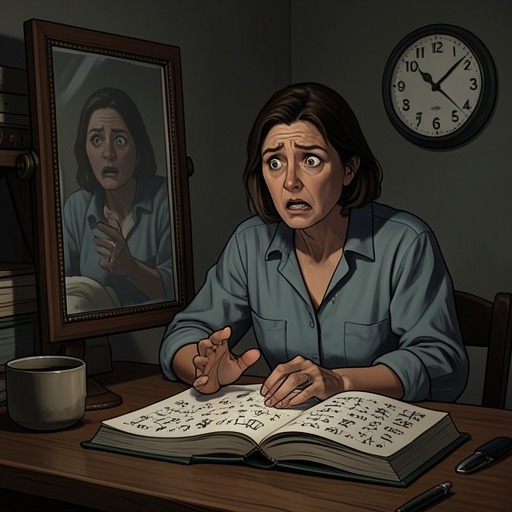
Ren Sheppard Chase
My Dark Mate: A Rejected Mate Werewolf Shifter RomanceRen Sheppard Chase is the novel’s emotional center: a survivor of Shane Sheppard’s violent pursuit who begins the story haunted by the cliffside death that ended their marriage and concludes it as Caleb Chase’s loved and claimed mate, pregnant with their cub and surrounded by a community she now recognizes as family. Her defining movement is not simply from danger to safety, but from believing that she is a rejected, unwanted “poor mouse” to knowing that she is wanted, protected, and capable of building durable attachments.
Identity and Introduction
Ren enters the story in motion, running through icy rain while her heart pounds and her lungs burn. The pursuit has reduced the world to a narrowing strip of ground: if she stops, she knows she is finished. Her fear is physical rather than abstract, expressed through bruising heartbeats, straining breath, and rain striking her skin like knives. The scene establishes her as someone whose courage is inseparable from terror; she keeps moving not because she feels safe, but because stopping would surrender her life.
The immediate threat is Shane Sheppard, her former husband and the man who tried to hurt her. When he lunges, Ren twists away and watches him plunge over the cliff. She remembers that she had intended to try to save him even while knowing she was in danger, yet the aftermath leaves her struggling against the belief that his death might somehow be her fault. Her own account insists on the crucial distinction: Shane chased her and was going to hurt her; when he fell, he effectively killed himself while trying to grab her. Ren’s repeated effort to return responsibility to him shows how thoroughly the violence has distorted her sense of agency.
A month later, the memory still behaves like a nightmare. Ren jolts herself out of it in the front seat of her car, panting, and describes the recollection as part memory and part something she cannot name. At night, dreams revisit the event, while her mind alters the remembered details by adding things that did not belong. The resulting narrative pattern is one of intrusion and interruption: the past breaks into the present just as she is trying to obtain employment and construct a life beyond Shane. Even entering a prospective workplace becomes an act of defiance against the trailer-bound safety that both shelters and confines her.
Survival, Humor, and the First Steps Toward Belonging
Ren’s principal coping strategy is determined, often comic optimism. She tells herself that the job must come first and that Caleb Chase merely needs time to know her before he can love her as a friend. When her inner voice and animal side are less than comforting, she answers them with jokes about changing her name to Ramona and fleeing to a beach in Mexico, complete with margaritas and salsa. The humor does not erase her distress; it gives her a temporary language in which distress can be endured without becoming the whole of her identity.
That optimism is a form of survival with a double edge. Ren repeatedly searches for a silver lining, telling herself that everything will be all right even when fear suggests otherwise. She can use hope to get through a difficult day, but hope also encourages her to postpone the full force of what has happened to her. The novel therefore presents her cheerfulness as neither simple denial nor uncomplicated strength. It helps her persist, yet it can also keep her looking toward a future rescue before she has fully acknowledged the danger and grief shaping the present.
Her arrival in Caleb’s house turns employment into an encounter with another person’s history. While cleaning, Ren discovers portraits and recognizes the depth of Caleb’s attachment to a woman he had loved through the mysterious fating bond. The discovery forces Ren to reconsider her own marriage to Shane. She had married him, but she does not regard the relationship as a true mating: they never shifted and ran together, never bonded, and Shane never bit her to claim her. By contrast, what she sees in Caleb’s past suggests a melding powerful enough to explain why he may still love the woman he lost. Ren’s sympathy for Caleb grows precisely as she understands that love and marriage are not interchangeable.
Her first attempt to cross the emotional distance between them is awkward and direct. When Caleb finds her in the room with the portraits, she babbles that she is cleaning and asks whether they can be friends, admitting that she knows he does not like her yet. The scene makes her vulnerability visible: she is frightened by his anger, but she also reminds herself that Caleb is not Shane and that she does not have to be afraid of him. That distinction becomes one of the foundations of her later attachment to Caleb, even though their relationship will repeatedly test her ability to separate present intimacy from past violence.
Chosen Family and Relationships
Ren’s connection with the Chase brothers gives her the first unmistakable experience of belonging. When Cole Chase and Trey Chase defend her by publicly confronting women who have insulted or humiliated her, Ren feels pity for the woman being rebuked but also admits that the scene makes her feel good. Watching Cole and Trey care for one of their own allows a new possibility to take root: this might be what family feels like. The emotional consequence is immediate and inwardly expansive. Ren realizes that she has people now and can hardly wait to return home and tell Caleb.
Trey Chase becomes especially important as her friend and protector. He calls her “Renny,” lends her his car keys, and later comforts her when her relationship with Caleb appears to have collapsed. His care is not merely a substitute for romance. Ren explicitly identifies Trey as her best friend and refuses to turn his devotion into a false mating. When Trey makes plans around a mating that will never happen, she insists that she is fated to his brother and tells Trey that she wants him to fall in love, attend his mating, and see his first cub born. Her affection for him is therefore expressed through an insistence that he deserves a complete love of his own.
Ren’s wider circle also grows beyond blood and formal mating. She is delighted to have made a female friend in Mandy and creates a no-boys rule for their time together, even as Caleb grumbles about it. Mandy becomes particularly valuable during Ren’s pregnancy, helping her manage intense hormonal surges and explaining the demands of carrying a shifter baby. Ren’s sense of family is thus built through protection, friendship, shared work, and practical care rather than through one institution alone. The community that finally holds her includes a mate, brothers, a female friend, and the larger Walker Pack.
Caleb remains the relationship through which Ren’s deepest fears and hopes are organized. She wants his friendship before she can securely imagine his love, and she interprets his anger through the memory of Shane while repeatedly trying to reassure herself that Caleb is different. Their fated bond eventually becomes undeniable when Ren bites Caleb. His shocked response exposes the act as a rupture rather than a simple romantic confirmation: he feels betrayed, while Ren cries that she did not mean to do it, that she could not stop her animal, and that she loves him. The bite reveals both the force of the bond and the danger of desire when bodily instinct outruns conscious consent and emotional readiness.
Crisis, Separation, and Return
Ren’s bond with Caleb does not spare her from abandonment. When Caleb’s thoughts reveal how deeply he hates the idea of mating, Ren’s already damaged heart breaks further. She accepts that the relationship may be over and fears the anger and rejection she saw in his face before he left. Trey tries to comfort her and speaks of a mating that cannot happen, but Ren rejects the reassurance because she understands that love alone cannot manufacture the true melding of hearts, minds, and spirits she associates with a genuine mating. Her grief is complicated: she loves Trey as a friend, loves Caleb as her fated mate, and knows that neither attachment can be handled by simply replacing one with the other.
The later confrontation with Shane returns Ren to the original physical grammar of the novel: pursuit, a lunge, and the loss of solid ground. Shane rushes at her, and Ren falls. From Caleb’s viewpoint, she is shoved backward into empty air, her blond hair flying as her screams disappear below the cliff. The recurrence is significant because the earlier traumatic memory is no longer merely something Ren replays alone; it becomes the crisis around which Caleb must act. Her body is again placed at the edge of death, but this time the narrative gives her a mate who refuses to let her disappearance become an ending.
Caleb’s response is equally important to Ren’s trajectory. Seeing her fall drives him toward the feral state he once feared, as both his bear and wolf roar in denial and grief. His decision to stop fighting that transformation is framed by the conviction that life without Ren is intolerable. Ren’s peril therefore forces the relationship out of hesitation and into action. The rescue, Caleb’s recovery of her from the cliff, and the mating bite that revives her convert the bond from a source of uncertainty into an active promise of protection and return.
Change and Ending
Ren’s final movement is marked by separation anxiety, pregnancy, and renewed confidence rather than by the disappearance of vulnerability. She misses Caleb intensely and feels alone, while pregnancy hormones amplify her fear, happiness, and excitement. The pregnancy also gives concrete form to the future she once could not trust. A shifter pregnancy lasts six months and brings abrupt bodily changes, intense appetite, mood swings, and hormonal surges severe enough that Caleb locks away the guns after Ren tries to shoot him once. The comic detail preserves her recognizable voice while showing that her new domestic life remains physically and emotionally demanding.
At the formal mating ceremony, Ren’s happiness is not ultimately produced by the lavish celebration, her white dress, or the presence of every pack member. It comes from being held and kissed by Caleb, from seeing her friend Mandy among the gathered people, and from recognizing that she now has relationships beyond the isolated life she once defended as safety. Her mother’s sour reaction provides a contrast to the acceptance surrounding her: Ren’s chosen community matters because it stands beside her even when her original family does not.
The closing image completes the transformation. Ren describes Caleb as her sun and says that she loves him more than life itself; with their cub coming, she believes that things are looking up. She still smiles, but no longer merely to force herself through another crisis. She smiles because she is happy and loved. Caleb is hers, she is wanted, and the animal within her and the turmoil in her head have finally become calm through the bear and wolf she shares with her mate. Ren’s ending is therefore a movement from rejected outsider to relationally integrated partner and parent, with safety defined not as retreat into a trailer but as reciprocal belonging.
Narrative Role and Significance
Ren’s first-person consciousness makes trauma, humor, animal embodiment, and attachment inseparable. The story repeatedly places bodily sensation beside mental interruption: burning lungs, a racing heart, nightmares, an inner voice, and an animal presence that can act before conscious intention. Her experience of being a shifter is not a simple metaphor for instinct. She understands the animal as a separate being inside her head, one that must be brought into a symbiotic bond. Her eventual calm with Caleb therefore represents an integration of competing parts of the self as well as a romantic resolution.
Her narrative voice also gives the novel its tonal tension. Ren can move from terror to sarcasm, from grief to a joke, and from fear of abandonment to a stubborn declaration that there is always a silver lining. This tonal flexibility keeps optimism from becoming sentimental. It is an active practice by which she refuses to let Shane’s violence, Caleb’s rejection, or pregnancy’s upheavals define the limits of her future.
Most importantly, Ren makes family a process rather than a given. The Chase brothers’ defense, Trey’s friendship, Mandy’s pregnancy guidance, Caleb’s eventual commitment, and the Walker Pack’s presence at the ceremony collectively answer the loneliness with which she begins. Her happy ending does not simply reward her with a mate; it gives her a network in which she can be protected, challenged, teased, cared for, and recognized. Ren Sheppard Chase’s decisive achievement is learning that love is not only something fate imposes. It is also something people build through loyalty, honesty, protection, friendship, and the repeated choice to remain together.