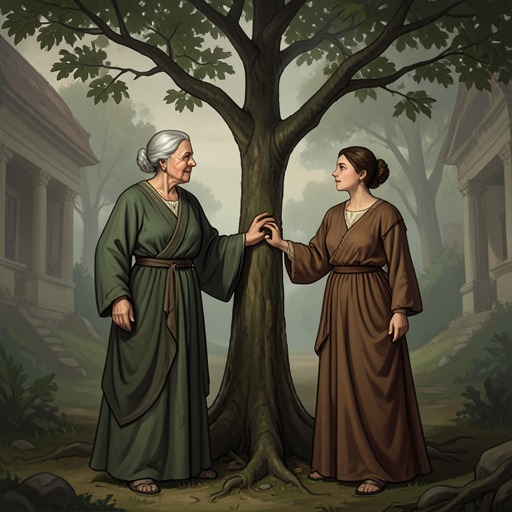
Ren awakens from coma after falling
My Dark Mate: A Rejected Mate Werewolf Shifter RomanceRen from Coma After the Fall is the recovery event that reverses the apparent finality of Ren's flight from Shane and the cliff. Her return begins in confusion and bodily weakness, passes through a liminal encounter with her grandmother, and culminates in Caleb's mating bite and her awakening beside him. The event changes the central value at stake from death to the possibility of living—and, more specifically, from Ren's belief that she has little left to return to the difficult prospect of love, family, and a future with Caleb.
Causes and Background
Ren's unconsciousness follows the traumatic pursuit in which Shane corners her near the cliff. The pattern of the fall is prepared by the novel's recurring bodily language of panic: a racing heart, lungs burning under pressure, rain striking like knives, and the conviction that stopping means death. The earlier memory of Shane plunging over the edge has already become an intrusive nightmare that Ren struggles to suppress. She identifies the event as the night her ex tried to kill her and died himself, while the repeated presence of storms, cliffs, enclosed shelter, and pursuit keeps the danger active in her body rather than safely contained in the past.
The fall therefore does not end the trauma when Ren loses consciousness. It suspends her between survival and death. When she opens her eyes, clarity arrives slowly, accompanied by a throb in her temples and the immediate recognition that something terrible has happened. Her first response is not triumph but bewilderment and moral self-questioning: she wonders why this is happening to her and whether the place around her might be hell. The language makes survival feel provisional, almost unbelievable, because Ren expected the fall to produce an irreversible physical end.
What Happens
Ren's first discovery is that she is not dead. The blunt confirmation that she is alive forces her to reconstruct the fall from incomplete memory. She believes she passed out halfway down and cannot remember a final impact, leaving her suspended between what she feared and what actually occurred. Her body confirms that she has survived, but it does not offer an uncomplicated recovery: she is injured, weak, and disoriented, with the aftermath of immobility written into her stiffness.
During this liminal interval, Ren encounters her grandmother, the person she remembers as having always been there for her. Ren says that she misses her and sees little reason to return, because she feels she has so little waiting for her. Her grandmother rejects that surrender physically and verbally, reminding her that life is a gift and refusing to treat grief as a sufficient reason to abandon it. The exchange turns Ren's survival from an accident into a choice. Missing the dead is acknowledged as real, but it cannot become permission to join them.
The conversation also redirects Ren toward Caleb. When she describes Caleb as emotionally damaged, inconsistent, and difficult, her grandmother supplies the missing context: Caleb loved someone before, was nearly destroyed by that loss, and is now faced with being fated again while fearing another injury. Ren is told to be fair and give him a chance. The advice does not erase the history of Caleb's rejection, particularly his habit of leaving when Ren was in heat, but it alters the meaning Ren assigns to his withdrawal. His behavior can still hurt her while also revealing fear rather than simple indifference.
The grandmother's final message binds love to effort rather than fantasy. She tells Ren that love is two hearts meeting, that it requires work, and that its difficulty does not make it unworthy. She then disappears, leaving Ren to fall again. The disappearance preserves the scene's dreamlike, threshold quality: the grandmother cannot accompany Ren back into ordinary life, but she gives Ren a reason to return to it. Her departure is thus both another separation and a form of guidance.
At Ren's bedside, Caleb remains physically present and refuses to leave. He had expected a shifter's healing to make the recovery quick, but Ren's long separation from shifting, small stature, relative weakness, and apparent lack of a reason to live complicate that expectation. Caleb recognizes that the danger is not merely the damage caused by the fall. Ren's will to return has also been weakened by abandonment, grief, and the injuries he inflicted on her emotionally.
Caleb's response is the mating bite. When his bear urges him to bite Ren, he accepts the instinct instead of resisting it, leans over her, and sinks his teeth into her shoulder as gently as possible. The act is described as a last hope, but its meaning is more specific than a supernatural remedy. Caleb has given Ren the bite before; this time he gives it as an expression of his own love and need, rather than as an act performed only on behalf of his animals or the mating bond. He pours what he has into the bite, licks the wound, kisses her, and waits without knowing whether she will stir.
Consequences and Aftermath
Ren wakes quickly after Caleb has spent the crisis beside her. For a moment she sees only darkness, then finds Caleb asleep in a chair next to the bed. His haggard appearance makes her smile, and her first private response combines affection with mischievous satisfaction: he has suffered while keeping watch. The emotional reversal is important. Ren is not simply a passive patient being restored by Caleb's action; consciousness returns with her humor, judgment, and ability to evaluate him.
Her physical condition remains serious but is no longer immediately fatal. She hurts and feels as though her muscles have been immobile for a long time, yet the pain is stiffness rather than the catastrophic sensation she associates with falling from a cliff. Survival has become tangible in the difference between these two kinds of pain. The body that seemed to be moving toward death is now beginning the slower work of reentering life.
The recovery does not resolve the relationship automatically. Ren still remembers every rejection and every time Caleb left her in heat, and she remains angry that he has repeatedly run from what binds them. When she later confronts him, she identifies the deeper injury: she is mated to a man who does not seem to want her, nearly died without receiving the love and family she imagined, and has been made to feel that her needs are excessive. Her demand is deliberately modest. She does not want the world or to be treated as a helpless big-city woman; she wants love and a family.
Ren also names the losses that make the awakening consequential rather than merely miraculous. She has lost a baby, lost herself with Shane, and nearly lost her life when others accused her of killing him. Yet she insists that she kept her chin up, maintained her smile, and never gave up. The statement reframes the entire event: the cliff fall is not the first time Ren has been forced to survive an imposed catastrophe, but it is the moment when survival finally requires her to admit what she wants from the life she keeps preserving.
Narrative Significance
Structurally, the event functions as a resurrection beat after the darkest physical and emotional crisis in Ren's story. The fall creates the expectation of death; the awakening reverses it. The grandmother's intervention supplies the moral decision to return, while Caleb's mating bite supplies the intimate, embodied gesture that makes return possible. Together they join the dead past, the damaged present, and the hoped-for future without pretending that any of them can simply be erased.
The event also gives form to Ren's trauma. Storms and pursuit have repeatedly reduced her experience to breathlessness, terror, intrusive memory, and the instinct to hide. Here, the same pattern reaches the cliff, the place where escape appears impossible, but the aftermath introduces recognition and testimony. Ren remembers what she has endured, identifies the people and losses that shaped her, and speaks the desire that has been obscured by survival: love, family, and a life not organized entirely around danger.
Most decisively, the awakening changes the charge of Ren and Caleb's bond. Before it, the mating relationship is marked by rejection, avoidance, and uncertainty. During it, Caleb stays, acknowledges the depth of Ren's fragility and his own responsibility, and uses the mating bite as a fully personal declaration of need. After it, Ren is alive to challenge him rather than merely be rescued by him. The event therefore does not conclude their conflict; it restores the conditions under which that conflict can become an honest negotiation between two people who still want one another and must decide whether they are willing to do the work her grandmother described.