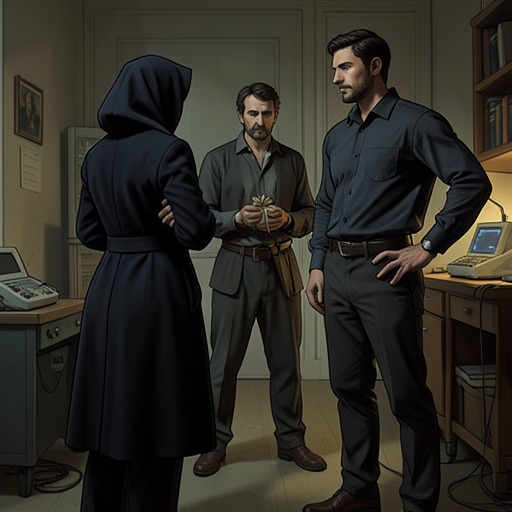
Ren discovered the truck had been invaded and moved into Caleb's house
My Dark Mate: A Rejected Mate Werewolf Shifter RomanceRen discovers that her trailer has been invaded and moves into Caleb Chase’s house, an action that converts private terror into enforced dependence and brings the central relationship into direct conflict. The break-in is not merely damage to property: it destroys the precarious refuge Ren has built after Shane Sheppard’s attack and forces her to choose safety, companionship, and protection over the independence she has been trying to preserve.
The Discovery of the Break-In
Ren returns to her trailer already exhausted and wanting only an aspirin, a shower, and sleep. Instead, she notices that the dental floss stretched across the porch steps has been broken. The small trap had been meant to reveal an intruder, and its failure makes the danger concrete. She then checks the other improvised safeguards: tracks mark the dirt, and the toothpick wedged into the door is also broken. These details establish that someone entered deliberately and that Ren’s attempt to monitor the place has failed before she even crosses the threshold.
The discovery immediately reactivates the trauma associated with Shane Sheppard. Ren’s shotgun is inside, leaving her without the weapon she intended to use for protection, and the prospect of entering alone makes her panic. The trailer becomes terrifying precisely because it is enclosed and familiar; it recalls the earlier confinement in which Shane tried to kill her rather than offering shelter from it. Her fear is therefore grounded in a repeated bodily memory, not simple reluctance to investigate.
Trey Chase’s Intervention
Ren asks Trey Chase to accompany her and check the trailer. Trey rejects any cautious delay, tears open the door, and enters without hesitation. Ren follows him and finds the interior trashed: everything she owns has been broken or disturbed, including possessions she cannot easily replace while she saves money for a modest house closer to work and to Trey. The material destruction gives the intrusion a lasting consequence. The danger has not only entered her home; it has damaged the ordinary future she was trying to finance.
Trey’s response reveals a sharper and more protective side beneath his polished suit, easygoing manner, and apparent nonchalance. He embraces Ren, growls with fury, tells her not to let the destruction frighten her, and proposes packing her belongings while members of his group investigate through printing and crime-scene work. When Ren points out that no scent remains, Trey recognizes the implication: the intruder knows how to conceal his presence. That absence of evidence makes the threat more serious rather than less, because it suggests preparation and skill.
Trey therefore refuses to let Ren remain alone. He orders her to pack, gathers her suitcases, and tells her that she will stay with him from now on. His protection is practical and immediate, but it also carries a relational charge. Ren is frightened by the prospect of being unprotected and vulnerable, yet she does not argue herself out of leaving with him. The action briefly places Trey in the role of the safe ally while exposing how much Caleb Chase’s reaction matters to her.
Caleb Chase Takes Control
Caleb arrives just as Trey is taking Ren and her luggage away. He sees the cases, storms toward them, and takes command of the situation. Rather than allowing Ren to remain with Trey, he puts her in his truck, drives her to his house, and retrieves her bags. His intervention is possessive and abrupt, continuing the pattern in which his concern is expressed through control rather than discussion.
At Caleb’s house, Ren is prepared to protest and insist on going with Trey, but Caleb cuts off the argument. He tells her to enter the house, eat the dinner she cooked, take a bath, and sleep, observing that she looks exhausted. His manner remains gruff, yet his touch is gentle when he places a hand against her cheek, and he locks up behind him before leaving. The contrast is central to the action: Caleb does not initially offer Ren a negotiated choice, but he does provide immediate physical security and attentive care when she is too tired and tense to resist.
Ren ultimately abandons dinner for the guest bathroom and accepts the temporary arrangement, while recognizing that she and Caleb will soon need to talk. The move thus settles the immediate threat without resolving the emotional dispute. It relocates Ren from a destroyed trailer to Caleb’s protected household, but it also makes their unresolved intimacy impossible to avoid.
Consequences for Ren and Caleb
The break-in shifts the value at stake from independence to safety, and then from safety toward emotional belonging. Ren’s trailer had represented an affordable, self-directed life, however fragile. Its violation strips that independence of its protective power. Trey’s offer supplies one possible refuge, but Caleb’s arrival redirects the sequence toward the home that Ren both resists and desires.
That contradiction becomes explicit later when Ren accuses Caleb of repeatedly rejecting her, leaving during her heat, and refusing to see what stands before him. She explains that what she wants is not to be treated as a helpless city woman but to have love and a family. Her anger gives the move into Caleb’s house a larger meaning: protection alone is insufficient if it reproduces the abandonment and exclusion she has already suffered. Caleb must learn that bringing Ren home is not the same as accepting her emotionally.
The domestic arrangement also changes Caleb. When Ren is endangered, he acts before explaining himself, but his later care begins to move beyond possession. He gathers her close after her connection with Lacy Baneblood and admits that, despite his fear, he owes Ren a part of himself. When he later carries Ren from Trey’s guest room to retrieve her, she is angry that he assumes she will accept being taken after her previous kidnapping, yet the encounter exposes that he has come for her rather than left her alone. The pattern reaches its emotional correction when Caleb apologizes for staying away and pulling back, while Ren admits that she should not have bitten him without speaking first and promises not to run when hurt.
Narrative Significance
Ren’s move from the violated trailer to Caleb’s house is a threshold action in the romance and in Ren’s recovery from violence. It begins with broken dental floss, disturbed dirt, a shattered toothpick, and a home reduced to broken possessions; it ends with a locked house, a bath, sleep, and the promise of a conversation that can no longer be postponed. The physical movement is therefore also a movement between forms of vulnerability: from being alone in a compromised refuge, through Trey Chase’s protective intervention, into Caleb’s forceful but increasingly caring shelter.
The action gains further weight because Ren’s wider story repeatedly links enclosed spaces, pursuit, storms, cliffs, and bodily panic to the memory of Shane Sheppard’s death. Her fear is not erased when Caleb takes her in. Instead, the new household becomes the setting in which protection must be tested against autonomy, and in which Caleb’s possessive impulses must develop into apology, care, and shared commitment. The violated trailer causes the relocation, but the lasting consequence is relational: Ren and Caleb are compelled to confront whether a home can mean more than confinement and whether protection can become a form of love rather than another claim imposed on Ren.