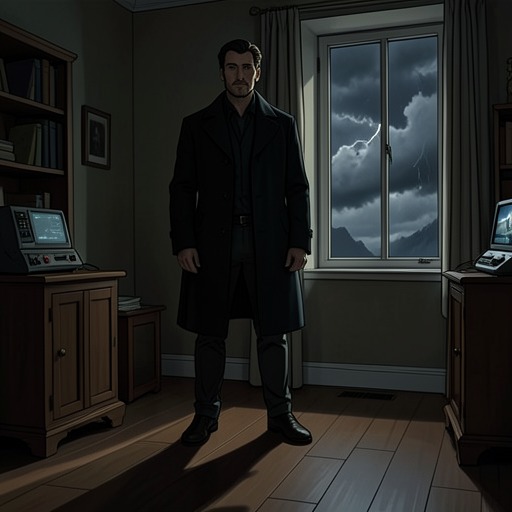
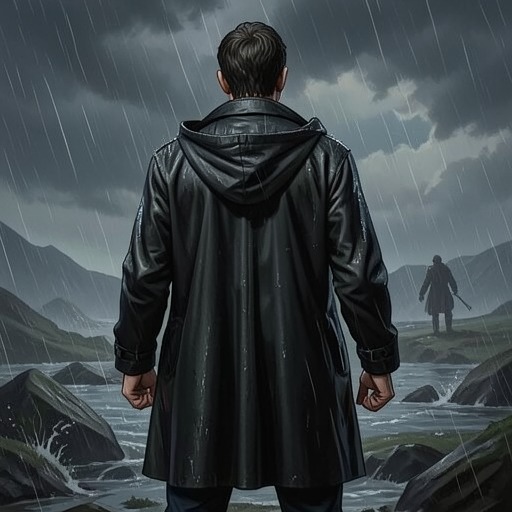
Ren escapes Shane and causes him to fall from the cliff
My Dark Mate: A Rejected Mate Werewolf Shifter RomanceRen's escape from Shane is the decisive survival event behind the novel's central wounds and later relationships. After Shane, her former husband, stalks and terrorizes her, Ren runs from him during a storm and reaches a cliff edge. When Shane lunges at her, she twists away and watches the man she once swore she would always love plunge over the edge. The immediate result is Shane's death and Ren's survival; the longer result is a trauma that follows her into every attempt to find safety, work, belonging, and love.
Causes and Circumstances
Ren's flight begins after she returns to her trailer and discovers Shane waiting for her. The evidence presents him not as a frightened pursuer or accidental companion but as an abusive threat who had already been stalking and terrorizing her. He breaks into the trailer, waits for her, and follows when she escapes. In Caleb's later account, Shane is described as a three-hundred-pound enraged shifter male, making Ren's flight an act of immediate self-preservation rather than a planned confrontation.
The wider community nevertheless converts Ren's survival into an accusation. She knows that people assume she had something to do with Shane's death, even though she insists that she merely ran and that Shane threw himself at her when she had already moved away from the cliff edge. The accusation is intensified by her social vulnerability: she is associated with the Baneblood Pack, a group Caleb initially distrusts, and her former mother-in-law has helped shape an unfavorable public impression of her. Ren is therefore forced to survive two threats at once—the physical pursuit itself and the social judgment that follows it.
The Flight to the Cliff
The scene is narrated through Ren's bodily panic. Her heart races with bruising force, blood rushes through lungs already straining, and icy rain strikes her skin while thunder rolls around her. The narration makes continued movement a condition of life: if she stops, she is finished, and she knows that the ground behind her is running out. Fear is not merely an emotion she reports after the fact; it governs her breathing, muscles, hearing, and split-second decisions.
As Shane closes the distance, Ren reaches the trees and recognizes that she must choose what to do before he catches her. Something scrapes her shoulder, and she hears the growl of the living nightmare behind her. She turns left, intending to tell Shane what lies ahead, but he lunges at her. Ren twists aside, screams, and sees him plunge over the edge. The reversal is stark: the pursuer who appears to control the chase becomes the one who falls, while the person treated afterward as a killer is the one who escaped.
The storm gives the event a fractured, nightmare quality. Lightning briefly turns the dark landscape into a horror scene, and Ren later experiences the memory as part recollection and part something she cannot name. Her inability to classify the experience does not make it less real; it shows how the event remains lodged between remembered fact, fear, and involuntary replay. The escape is complete in physical terms but unfinished psychologically.
Immediate Aftermath and Public Stigma
Ren survives the cliff incident, but survival does not restore ordinary life. A month later, she still regards it as a miracle that she is alive and sane. The memory intrudes while she sits in her car outside a prospective job, forcing her to interrupt the recollection and command herself to return to the present. Her need for employment is directly tied to the consequences of the event: without a new start, she fears becoming homeless, without a pack, and ultimately dead.
The community's version of the event follows her into public spaces. At the grocery store, women surround her and call her a killer. Ren places the cart between herself and them, trapped against the milk refrigerator while her wolf growls in warning. The confrontation demonstrates how Shane's death has been stripped of its context. The stalking, the break-in, the storm, and the chase disappear behind a single hostile label. Ren's denial that she is a killer is met not with inquiry but with further humiliation.
Cole Chase and Trey Chase intervene, changing the immediate balance of power. Cole attacks the women's contempt for Ren and reminds them that Shane did not want her, while Trey joins in the intimidation. Their defense is deliberately aggressive rather than conciliatory, but it gives Ren a moment of protection in a place where she had expected to be cornered and hurt. The episode also shows that Ren's reputation is contested: some people repeat the accusation, while members of the Chase family recognize her vulnerability and refuse to leave her isolated.
Caleb's Reinterpretation of the Event
The truth of Ren's escape reaches Caleb Chase through an account of what happened that night. He learns that Shane went after Ren again despite warnings from the Enforcers, that Cole Chase found Ren screaming, bleeding, and hysterical in the middle of the storm, and that Shane had broken into her trailer before pursuing her. Cole tracked the pair's trail after Ren explained what had happened. These details transform Caleb's understanding of Ren from suspicion to protective concern.
Caleb also learns that Ren belongs to the Baneblood Pack, a fact that initially triggers his hostility because of his assumptions about that group. Yet the explanation immediately distinguishes Ren from those assumptions, describing her as sweet and innocent. The contrast matters: Ren's identity as a Baneblood does not determine her conduct, and her association with the pack becomes one more source of danger and misreading rather than evidence of guilt.
The event consequently becomes part of Caleb's emotional investment in Ren. He recognizes that another person tracked her during her darkest hour and did what no one else did, saving her life and sanity. Ren's flight therefore establishes the protective bond that later develops between them, even before their relationship is fully understood. Her escape from Shane is not only a death scene; it is the buried cause of Caleb's refusal to treat her as the community does.
Lasting Consequences and Narrative Significance
The cliff incident functions as both an escape plot and a trauma plot. Ren succeeds in the immediate objective—putting distance between herself and Shane—but the result is not uncomplicated freedom. She carries the memory into work, public errands, pack politics, and intimate relationships, while others impose the identity of killer upon her. The event's value shift is therefore double: life is preserved, but safety, reputation, and emotional stability are damaged.
Its recurrence also establishes the novel's pattern of concealed truth becoming gradually legible. Ren initially insists that the death was not her fault, while the surrounding community treats her explanation as a lie. Later testimony supplies the missing circumstances and allows Caleb to see the event as attempted violence against Ren. The narrative thus contrasts public certainty with fuller knowledge: the accusation is simple because it excludes the chase, whereas the truth is difficult because it requires following Ren's fear back to Shane's pursuit.
By the epilogue, the event no longer defines Ren's entire future, although it remains the wound from which that future had to be built. At her formal mating ceremony with Caleb Chase, every pack member is present, Ren wears a white dress, and Caleb's open possessiveness is met with happiness rather than panic. She understands that she is not merely being mated and married; she is loved. The ceremony does not erase the cliff or the stigma attached to it, but it places the memory within a later life in which Ren has protection, belonging, and a publicly affirmed relationship instead of isolation and flight.