Dragon Ferry
My Father's DragonThe Dragon Ferry is the forced river-crossing service imposed on Baby Dragon by the animals of Wild Island. It is presented as an ingenious answer to a real travel problem, but its convenience rests on a young dragon’s captivity: tied by the neck, driven across the river, and punished when he resists. The name points to a route; the machinery beneath it is a rope, a crank, and a body kept under threat.
The crossing problem
The Wild Island River cuts across much of the island, running from near one end to the ocean at the other. Before the ferry, animals who wanted to reach the opposite bank had to walk around the river’s beginning. The detour made visits inconvenient and slowed mail deliveries, especially during the Christmas rush. Crocodiles might have carried passengers and mail, but the animals considered them moody and unreliable, and feared that they would be looking for something to eat. For years, then, the animals accepted the long walk rather than depend on the crocodiles.
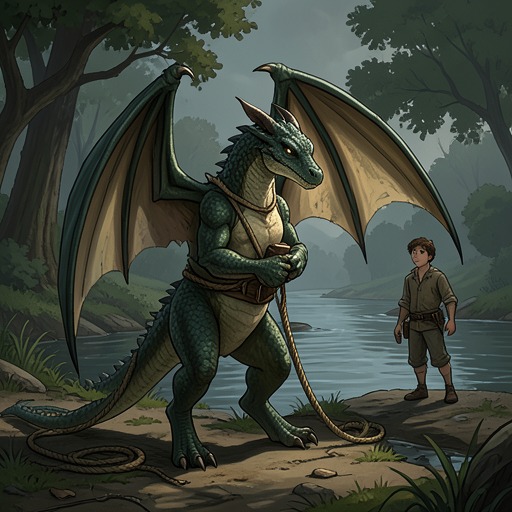
The ferry is introduced as a response to that inconvenience. About four months before Old Alley Cat arrived on Wild Island, Baby Dragon fell from a low-flying cloud onto the riverbank. He was too young to fly well, and one wing was badly bruised, leaving him unable to return to his cloud. The animals saw his arrival not as a need to help a stranded young creature, but as an opportunity to solve their crossing problem. They tied a large rope around his neck and waited for his wing to heal; once it had, they began training him to carry passengers. The service therefore begins with a sharp reversal: the very injury that left Baby Dragon dependent on the animals made him available for their use.
How the service works
The Dragon Ferry’s route is made visible in the island’s signs. At a crossroads, one arrow points toward the Beginning of the River, another toward the Ocean Rocks, and a third toward the Dragon Ferry. At the riverbank, the operating apparatus is a high flagpole, a rope running over a loop at its top and down to a large crank. A sign instructs users to yank the crank to summon the dragon and directs reports of disorderly conduct to Gorilla. The route is thus marked as an ordinary public convenience, with a designated mechanism for calling its captive operator and a named authority for complaints.
The rope does more than connect the apparatus to the dragon. Its other end is tied around Baby Dragon’s neck, and the animals keep him attached to a stake by a length just sufficient for crossing the river. The same tether that makes the ferry available also confines its worker. If Baby Dragon is on one bank, Gorilla twists his wings until the pain makes him fly to the other. If he is on the far bank, Gorilla turns the crank, pulling the rope until the dragon would either choke or fly back. The service can therefore be made to run in either direction, not through cooperation or consent but through opposing forms of bodily coercion.
Labor and captivity
Old Alley Cat’s account makes clear that the ferry is not occasional assistance. Though Baby Dragon is still a baby, the animals work him all day and sometimes all night, and give him loads that are much too heavy. When he complains, they twist his wings and beat him. His labor is treated as an island resource, while his pain becomes the method for enforcing the schedule. The animals’ desire for quicker journeys and mail delivery is set against the unrelieved demands placed on the dragon who supplies both.
The rope embodies that imbalance. Old Alley Cat describes it as exceptionally large and tough, with so many knots that untying them would take days. Its strength and knots make escape difficult; the stake restricts Baby Dragon’s movement, while the rope can also be tightened from the crank. His isolation compounds the physical restraint: his only friends are the Crocodiles, who greet him once a week if they remember. The animals who had rejected Crocodiles as an unreliable ferry option have instead created a service whose reliability depends on keeping Baby Dragon bound and available.
Exposure and interruption
Elmer Elevator learns how the system works from Old Alley Cat, who had secretly spoken with Baby Dragon in the bushes and promised to help him. Later, Elmer reaches the river and recognizes that the rope is tied around the dragon’s neck. He understands that calling across would alert Gorilla, and considers climbing the flagpole and crossing hand over hand along the rope. The crossing apparatus that serves the animals could also become a dangerous path for a rescuer, but the muddy river and the possibility of hostile creatures make that route perilous too.
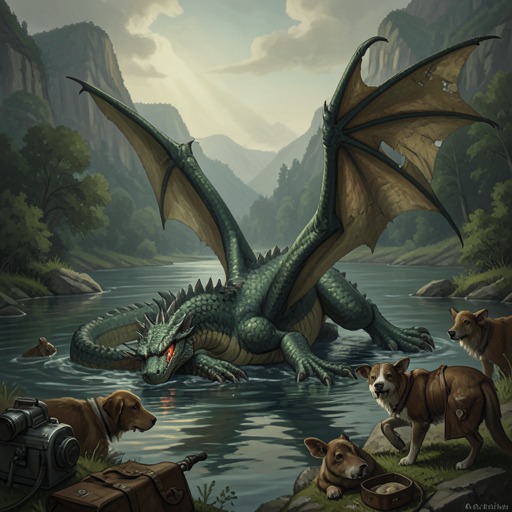
At the rescue, Elmer runs to Baby Dragon with a very sharp jackknife and begins sawing through the rope, urging him to stand still. The pursuing animals are already crossing on the Crocodiles, so the scene places the captive ferry beside a competing, improvised bridge: the animals who once avoided relying on Crocodiles now use them to pursue the person cutting their dragon loose. The evidence establishes the immediate act of cutting, rather than a later operating history for the ferry. Its significance lies in the reversal: the rope designed to summon and control Baby Dragon is treated as something to sever, not as infrastructure to improve. The Dragon Ferry makes convenience legible as a question of who bears its cost, and turns the island’s shortcut into the material sign of Baby Dragon’s captivity.