Gorilla
My Father's DragonGorilla is a physically imposing authority figure on Wild Island whose control over Baby Dragon is part of the island’s coercive ferry system. When Elmer Elevator encounters him, Gorilla threatens to treat him as he treats the captive dragon; an improvised flea hunt then distracts him long enough for Elmer to slip away. The episode makes Gorilla both an immediate danger and a source of comic interruption, without suggesting that the interruption ends his role in the pursuit.
Identity and Authority
Gorilla appears as an enormous, fierce figure who drops from a palm tree near the river and lands at Elmer’s feet. His presence is announced first by the crash and then by a demand that Elmer explain himself. Gorilla claims the authority to question a stranger about his name, business, age, and possessions, but gives him almost no time to respond. The rushed interrogation establishes a world in which Gorilla expects compliance rather than conversation: he begins counting before Elmer can give even his name and occupation.
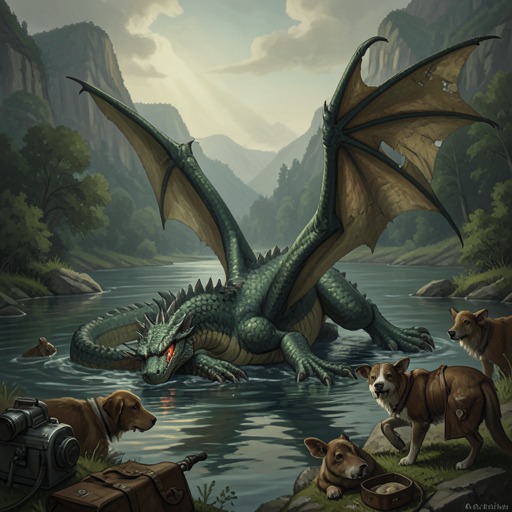
That authority is connected to the treatment of Baby Dragon. The alley cat has told Elmer that the animals use the young dragon to carry passengers across the river, work him for long stretches, and punish him when he complains. Gorilla’s threat to twist Elmer’s arms as he twists the dragon’s wings links the enforcer directly to that established system. His words make clear that the dragon’s suffering is not an abstract rumor to him; Gorilla invokes the practice as a familiar means of making someone hurry.
The River Encounter
The confrontation takes place while Elmer is searching for a way across the river to reach Baby Dragon. After reaching the bank and finding no dragon in sight, Elmer sits beneath a palm tree to think. Gorilla’s sudden arrival turns this pause into a test of nerve and quick judgment. He demands an account of Elmer and his knapsack, then seizes his arms when Elmer cannot answer quickly enough. The threat is practical as well as intimidating: if Gorilla follows through, Elmer may be unable to continue his rescue attempt.
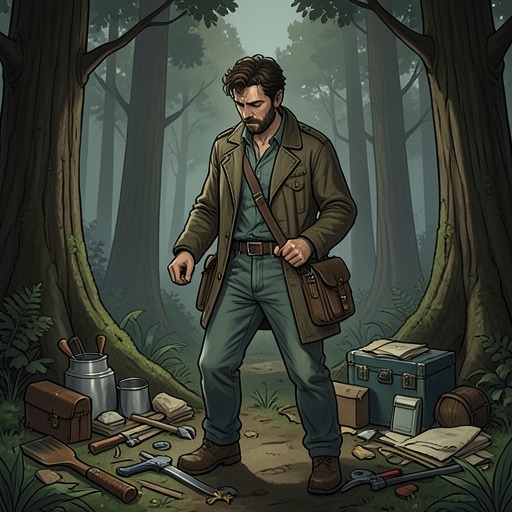
Gorilla’s attention shifts when he begins scratching at his chest and complains that fleas are troubling him. He calls for six helpers, who come from the tree and search through his chest hair, but the problem remains unsolved. The interruption gives Elmer an opportunity to act on what he carries rather than answer Gorilla’s questions. Elmer offers six magnifying glasses from his knapsack, matching the number of searchers and turning an ordinary travel item into a tool for distraction.
The Flea Hunt and Elmer’s Escape
The magnifying glasses change the scale of the scene. The helpers can now see the fleas, and their report that there are hundreds of them intensifies the search instead of ending it. More helpers arrive from a nearby mangrove clump to look through the glasses. As they gather around Gorilla, the hunt draws attention away from Elmer; Gorilla can no longer see him and forgets to twist his arms. Elmer’s escape therefore depends not on overpowering Gorilla but on redirecting his attention through a practical object and a growing crowd.
Gorilla’s wink at Elmer, just before Elmer offers the glasses, gives the exchange an ambiguous note. It makes the moment seem more knowing than a wholly accidental interruption, but the story does not explain what Gorilla intends by the gesture. What is clear is the immediate consequence: he releases Elmer’s arms, becomes absorbed in the search, and does not keep him under observation. The scene’s comedy rests on that reversal. A character who had set a strict countdown and threatened force is temporarily undone by the very problem he cannot inspect unaided.
Connection to the Dragon Ferry
Gorilla’s authority is also made visible in the river’s equipment. At the bank, Elmer finds a flagpole with a rope running across the river and down to a crank. A sign instructs users to yank the crank to summon the dragon and to report disorderly conduct to Gorilla. The directions place Gorilla inside the machinery of control: the rope calls the captive dragon to the crossing, while the sign presents Gorilla as the official recipient of complaints. The system turns Baby Dragon’s movement into something regulated by a device and overseen by an enforcer.
Elmer understands what the apparatus means because he knows that the rope is tied around Baby Dragon’s neck. Whether the dragon is on one side of the river or the other, the crank and Gorilla’s authority leave him subject to being compelled across. Elmer’s pity for the dragon deepens as he recognizes that the crossing is not a voluntary service. Gorilla thus represents more than a physical obstacle; he is one person through whom the animals’ arrangement is enforced. The scene does not describe a formal institution beyond the sign and its instructions, but it shows how a simple mechanism and the threat of punishment work together.
Pursuit and Narrative Role
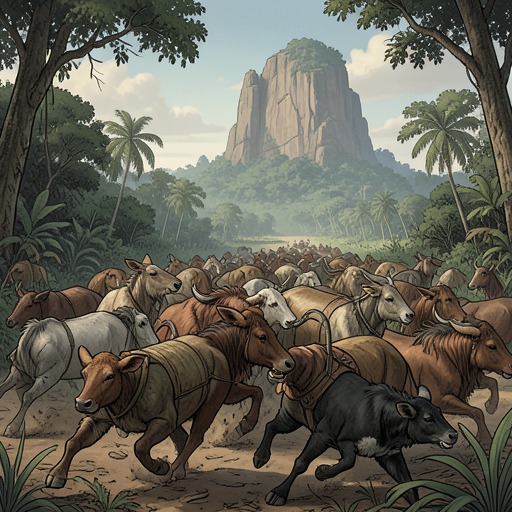
The distraction is temporary. While Elmer uses the crocodiles as a bridge and reaches the opposite bank, Gorilla joins the larger group of animals rushing toward the river. The crowd includes the Seven Tigers, a Rhinoceros, two Lions, Wild Boars, and numerous helpers; together they cry that an invasion is under way and that the intruder is after their dragon. Gorilla’s presence among them reconnects the comic flea episode to the larger danger. He may have lost track of Elmer at the bank, but nothing in the scene establishes a change in his allegiance to the group or in his opposition to the rescue.
Gorilla’s role consequently combines intimidation, enforcement, and an opening for escape. His brief distraction gives Elmer time to continue toward Baby Dragon, while his later participation in the pursuit keeps the rescue urgent. The contrast also sharpens the story’s reversal of power: Gorilla can threaten Elmer and command attention, yet the magnifying glasses and the helpers’ curiosity interrupt that authority at a decisive moment. The account leaves Gorilla in motion with the pursuing animals rather than resolving his part in the conflict, preserving him as an active danger as Elmer reaches the dragon.