Wild Island
My Father's DragonWild Island is a remote, jungle-covered setting whose muddy river and chain of offshore rocks shape both its isolation and its central conflict. The animals’ attempt to make the river easier to cross turns Baby Dragon into an unwilling ferry, making the island’s geography inseparable from his captivity and Elmer Elevator’s effort to free him.
Geography and Access
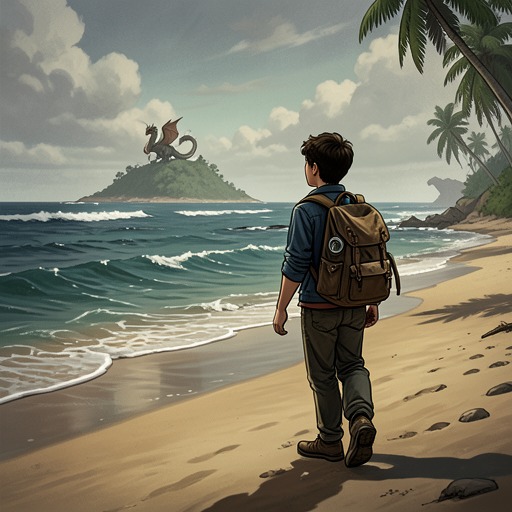
Wild Island lies near the Island of Tangerina, with the two landmasses joined by a long string of rocks. The route is unusual but traversable: Old Alley Cat describes crossing the rocks to explore the island after missing a boat at the port of Cranberry. Wild Island is mostly jungle and inhabited by very wild animals, which helps explain why people do not go there. Its connection to a settled port is thus close enough to invite exploration, yet the island itself remains a place defined by difficult access and danger.
The River Crossing and Baby Dragon’s Captivity
The Wild Island River made the island’s division a daily inconvenience. Because the animals disliked walking all the way around its source to reach the opposite bank, visits were awkward and mail deliveries slow, especially during the Christmas rush. Crocodiles might have carried passengers and mail, but their moods, unreliability, and appetite made them an unsafe alternative; for years, the animals simply took the long way around.
That problem became an excuse to exploit Baby Dragon. About four months before Old Alley Cat reached Wild Island, he fell from a low-flying cloud onto the riverbank. Too young to fly well and with one wing badly bruised, he could not return to his cloud. The animals saw him as the solution to their crossing troubles, tied a large rope around his neck, and waited for his wing to heal. Once it did, they trained him to ferry passengers—and made him carry loads that were too heavy, working him all day and sometimes all night. When he complained, they twisted his wings and beat him.
The rope kept Baby Dragon tethered to a stake, with just enough length to cross the river. Its size and toughness, and the many knots securing it, made escape difficult: Old Alley Cat judged that untying them would take days. The crocodiles were his only companions, greeting him about once a week when they remembered. Having befriended him in secret, Old Alley Cat left Wild Island promising to help someday; when Elmer Elevator wished to fly, she proposed rescuing Baby Dragon, who might let him ride if treated kindly.
Riverbank Hazards and the Rescue
The river’s banks are not merely an obstacle to travel; they are places where danger and coercion take physical form. During his passage through the island, Elmer Elevator is caught over a private weeping pool by a Rhinoceros, who says he drowns anyone he finds using it. The Rhinoceros explains that his distress comes chiefly from his tusk turning from pearly white to yellow-gray with age. The episode gives the island’s landscape a personal, absurdly particular hazard, while showing how readily its inhabitants turn a claimed grievance into a threat against a trespasser.
At the river crossing, the animals’ solution to inconvenient geography has become an apparatus of control. Elmer finds a high flagpole with a rope running across the river through a loop and down to a crank; a sign instructs anyone seeking the dragon to yank it and report disorderly conduct to Gorilla. Knowing that the far end is tied around Baby Dragon’s neck, Elmer understands the trap from either bank: Gorilla can twist the dragon’s wings to force him across, or crank the rope until he risks choking or is driven back. The crossing is therefore not a neutral service but a mechanism that keeps Baby Dragon under threat wherever he stands.
Unable to call to Baby Dragon without alerting Gorilla, Elmer considers climbing the pole and crossing hand over hand above the muddy water. Before he can attempt it, the crocodiles form a bridge across the river. Elmer leaps to the opposite bank as a Wild Boar follows over the crocodiles, and Baby Dragon runs from the bushes, calling out that the pursuers are coming. With two Wild Boars, Seven Tigers, two Lions, the Rhinoceros, Gorilla, and countless monkeys closing in, Elmer reaches Baby Dragon and uses his sharp jackknife to saw through the rope. The river crossing changes in that moment from the instrument of the dragon’s forced labor into the route by which his rescue—and the animals’ pursuit—must proceed.
Narrative Significance
Wild Island’s geography exposes the difference between making passage possible and making it just. The animals’ answer to inconvenience is an arrangement that treats Baby Dragon’s body as infrastructure, while the rope and crank turn that arrangement into a means of enforcing obedience. Nothing in the island’s established order offers him protection: relief depends instead on Old Alley Cat’s private friendship and Elmer Elevator’s decision to act on her promise. The rescue consequently challenges not only a tether but the assumption that one creature’s freedom may be traded for everyone else’s convenience.