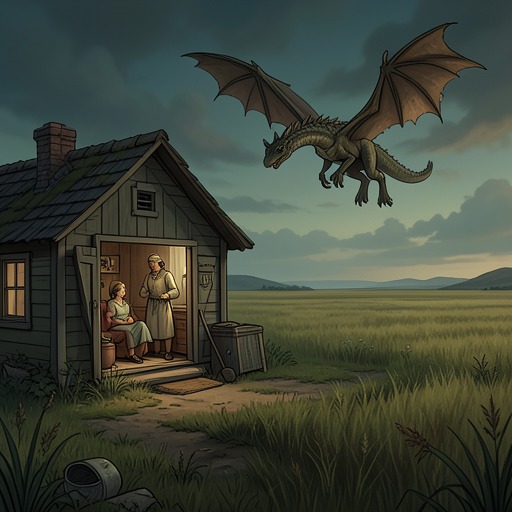
Elmer runs away to rescue the dragon
My Father's DragonElmer runs away to rescue the dragon begins when Old Alley Cat turns Elmer Elevator’s interest in flying into a concrete rescue plan. After learning that Baby Dragon has been tied up and made to work as a river ferry, Elmer agrees to leave home, gathers supplies in secret, and hides aboard a ship bound for the Island of Tangerina. The episode moves from the cat’s account of captivity to Elmer’s preparations and clandestine departure, setting the rescue in motion before he has even reached Wild Island.
The Rescue Call
Old Alley Cat explains that Baby Dragon fell from a low-flying cloud onto the bank of Wild Island’s river about four months before she arrived. He was too young to fly well, and a badly bruised wing kept him from returning to his cloud. The animals found him and saw an answer to their own inconvenience: the river divided the island, and going around its beginning to reach the far side made visits difficult and mail deliveries slow, especially during the Christmas rush. Crocodiles might have carried passengers and mail, but the animals considered them moody, unreliable, and liable to look for something to eat. Instead, the islanders made the young dragon their means of crossing.
Once Baby Dragon’s wing healed, the animals trained him to carry passengers. Old Alley Cat says they worked him all day and sometimes all night, loaded him too heavily, and twisted his wings or beat him when he complained. They kept him tied to a stake with a rope long enough to let him cross the river, but not escape. The only company she identifies is the Crocodiles, who greeted him once a week if they remembered. The account makes the proposed rescue more than an adventure: Elmer is being asked to intervene in a system that treats a young animal’s body and labor as a convenient public service.
Old Alley Cat speaks from personal knowledge, not hearsay. She had hidden in the bushes to talk with Baby Dragon when no one else was around, and the two had become friends. When she left Wild Island, she promised she would try to help him someday, although she could see no way to do it. She stresses that the rope around his neck is exceptionally large and tough, with so many knots that untying them would take days. Her proposal therefore gives Elmer both a purpose and an obstacle: if he can free the dragon, Baby Dragon may let him ride, provided Elmer treats him kindly.
Decision to Leave Home
The rescue idea grows directly out of Elmer’s wish to fly. When he asks about airplanes, Old Alley Cat suggests that a rescued Baby Dragon could carry him instead. Elmer responds eagerly. His decision is also sharpened by a separate grievance: he is angry with his mother for being rude to Old Alley Cat, and that anger leaves him without the sadness he might otherwise have felt about running away for a while. The departure thus joins an attraction to flight with sympathy for the dragon and loyalty to the cat; it is not presented as a simple escape from home.
That very afternoon, Elmer and Old Alley Cat go to the docks to ask about ships sailing to the Island of Tangerina. They learn that one will leave the following week and begin planning the rescue at once. Old Alley Cat helps choose what Elmer should bring and tells him everything she knows about Wild Island. She is too old to accompany him, so her role is that of guide and planner rather than traveling companion. The plan depends on knowledge she gathered through her friendship with Baby Dragon, while the actual crossing and rescue will have to be undertaken by Elmer alone.
Secret Preparations and Stowaway Departure
Elmer and Old Alley Cat keep the preparations hidden. Whenever they find or buy something for the trip, they conceal it behind a rock in the park. On the night before the voyage, Elmer borrows his father’s knapsack, and the two pack it carefully. The provisions and tools combine ordinary travel needs with objects that later matter to the dangers of Wild Island: chewing gum, two dozen pink lollipops, rubber bands, black rubber boots, a compass, a toothbrush and toothpaste, six magnifying glasses, a very sharp jackknife, a comb and hairbrush, and seven hair ribbons in different colors. They also include an empty grain bag labeled Cranberry, clean clothes, and enough food for the time aboard ship. Because Elmer cannot live on mice, he packs twenty-five peanut butter and jelly sandwiches and the six apples he can find in the pantry.
The amount and variety of the equipment show that the rescue is being prepared as a practical undertaking, even though its success remains uncertain. The jackknife is especially consequential later: when Elmer reaches Baby Dragon, he uses it to saw through the thick rope rather than attempt the many knots Old Alley Cat has described. Other items suit the various encounters the island will bring, so the careful packing links the cat’s advance knowledge to Elmer’s resourcefulness on the journey.
At the docks, a night watchman threatens to expose the plan. Old Alley Cat distracts him by making loud, queer noises, giving Elmer time to run across the gangplank and enter the ship. He hides in the hold among bags of wheat; the ship sails early the next morning. The method of departure matches the secrecy of the preparations: Elmer does not board openly as a passenger but slips away concealed among cargo, with the cat’s help making the escape possible.
The Mission’s Stakes and Consequences
The events after the departure confirm what the rescue requires. On Wild Island, Elmer finds a flagpole and a rope-and-crank arrangement used to summon Baby Dragon. A sign instructs anyone seeking the dragon to yank the crank and report disorderly conduct to Gorilla. Knowing from Old Alley Cat that the rope is tied around Baby Dragon’s neck, Elmer understands that the mechanism gives Gorilla a means to force the dragon across the river: if Baby Dragon is on one side, Gorilla can hurt his wings until he flies to the other; if he is on the other side, the rope can be cranked until he risks choking or is driven back. The river crossing that once seemed to promise Elmer flight is also the instrument of the dragon’s coercion.
When Elmer finally reaches Baby Dragon, the pursuers are closing in. He takes out the sharp jackknife and begins sawing through the rope, telling the dragon to stand still as he works. Wild Boars, Seven Tigers, two Lions, Rhinoceros, Gorilla, and screeching monkeys are on their way across the Crocodiles, leaving little time to cut through the remaining rope. The departure from home has therefore led not to an uncomplicated ride, but to a rescue whose urgency is measured in the length of the chain still binding Baby Dragon and the crowd approaching behind Elmer.
As an episode, Elmer’s flight from home makes the cat’s promise actionable: what she could not accomplish alone becomes a journey undertaken by someone willing to help. Its contrast between the animals’ practical need for a river crossing and their violence toward the dragon exposes the cost hidden inside their convenience. Elmer’s own preparations—from the borrowed knapsack and hidden supplies to the concealed passage among wheat bags—turn the wish to fly into a deliberate attempt to break that arrangement.