Monkey
My Father's DragonThe monkeys of Wild Island have two distinct roles in Elmer Elevator’s rescue attempt: six named monkeys help the Gorilla search for fleas, then a much larger monkey crowd joins the island animals pursuing Elmer. Their magnifying glasses turn a threat into a diversion, while their later appearance among the pursuers shows how quickly the island’s alarm gathers force.
The Six Monkeys and the Gorilla
When Elmer meets the Gorilla, the encounter begins with an ultimatum: he must give his name, business, age, and the contents of his pack before the Gorilla finishes counting. Elmer has no time to answer. The Gorilla threatens to treat him as he treats Baby Dragon, but abruptly releases his arms when fleas distract him. The small crisis changes the direction of the scene: instead of continuing to question Elmer, the Gorilla calls for help.
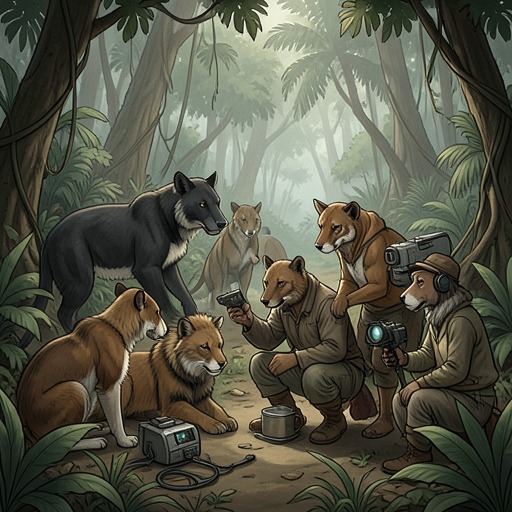
Six little monkeys tumble out of a palm tree and begin combing the hair on the Gorilla’s chest. They are individually named Rosie, Rhoda, Rachel, Ruthie, Ruby, and Roberta, and the Gorilla addresses them collectively as the people who can remove the flea. Their immediate task is practical, but they cannot easily see what they are searching for. When the Gorilla asks whether the flea is gone, they report that they are still looking and that the fleas are difficult to see. The episode establishes the six as a coordinated group responding to the Gorilla’s summons, without distinguishing one monkey’s behavior from another’s.
Magnifying Glasses and Distraction
Elmer turns the contents of his knapsack into a means of escape. He offers six magnifying glasses, one to each monkey, matching the number of tools to the number of searchers. With the glasses, the monkeys can see the fleas more clearly; they react with surprise at how many there are and continue searching. The objects solve the immediate problem of visibility while opening a larger distraction: more monkeys emerge from a nearby clump of mangroves to look through the glasses.
The newcomers crowd around until they completely surround the Gorilla. In that commotion, he can no longer see Elmer and forgets to twist his arms. The escape depends not on overpowering the Gorilla but on redirecting attention: an interruption caused by fleas becomes a gathering, and the gathering gives Elmer time to get away. The Gorilla has winked at Elmer during the earlier flea episode, but the text does not establish that the monkeys know about Elmer’s danger or are deliberately helping him. Their search, curiosity, and crowding create the opening regardless.
From Local Scene to Island Pursuit
The monkeys’ presence is not limited to the encounter beside the mangroves. As Elmer crosses the river on the backs of the Crocodiles, countless screeching monkeys are among the animals who rush toward the bank. The pursuing group also includes seven Tigers, a Rhinoceros, two Lions, a Gorilla, and two Wild Boars leading the crowd. The animals shout that there has been an invasion and that the intruder must be after their dragon; the monkeys therefore appear within a collective alarm directed against Elmer’s rescue attempt.
This later episode widens the scale of the monkeys’ earlier appearance. At first, six searchers and the additional monkeys gathered around one Gorilla create a localized disturbance. During the river crossing, monkeys are part of a mass pursuit that reaches the bank as Elmer nears the other side. The evidence does not identify the pursuing monkeys individually or specify which of them previously used the magnifying glasses, so the later crowd is best understood as a wider group rather than a confirmed return by the same six.
Narrative Role
The monkeys help give the rescue sequence its pattern of reversals. Elmer’s encounter with the Gorilla appears to leave him exposed to the same coercive treatment used against Baby Dragon; instead, a flea search interrupts the threat. The magnifying glasses, ordinary objects from Elmer’s pack, enlarge that interruption into a crowd and allow him to continue toward the river. Later, the monkeys are part of the danger rather than the diversion, joining the pursuit as the animals try to stop the perceived invasion.
Their scenes also connect comic activity to the story’s central stakes. Searching for fleas and peering through magnifying glasses provide the immediate action, but the interruption matters because it prevents the Gorilla from detaining Elmer while Baby Dragon remains captive. The monkeys are not presented as individually developed characters or as independent planners. Their significance lies in the changing effects of group behavior: first a small group’s task and the curiosity it attracts loosen the Gorilla’s hold, then a much larger animal crowd helps press the pursuit toward the river.