The animals of Wild Island and the dragon
My Father's DragonThe animals of Wild Island and the dragon describes a relationship that begins with a practical problem and hardens into captivity: the island animals make Baby Dragon their river crossing, keeping him tied and forcing him to carry passengers and loads. Old Alley Cat’s account reveals the bodily cost of that arrangement, while Elmer Elevator’s attempt to cut The dragon’s rope marks a direct challenge to it.
A crossing problem becomes captivity
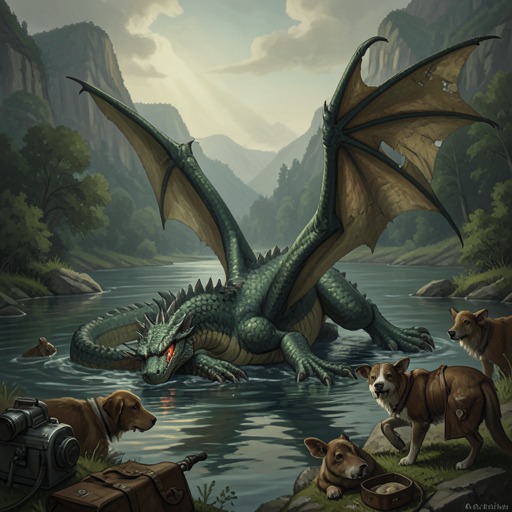
Wild Island is divided by a wide, muddy river. For years, the animals walked around it because Crocodiles were considered moody, unreliable carriers who might be looking for something to eat. The detour made visits inconvenient and mail deliveries slow, especially during the Christmas rush. Against that background, Baby Dragon’s arrival seemed to the animals to offer a convenient solution.
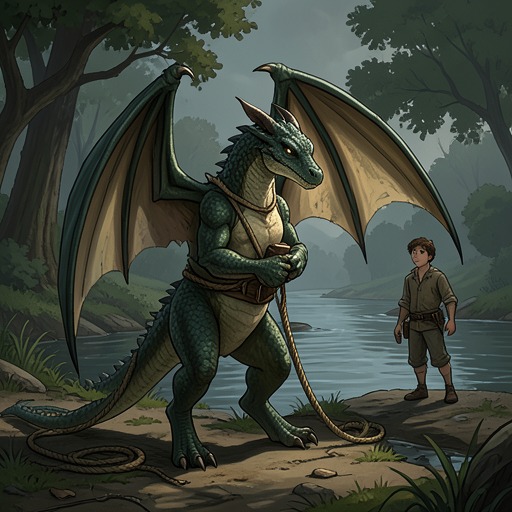
About four months before Old Alley Cat arrived on the island, Baby Dragon fell from a low-flying cloud onto the riverbank. He was too young to fly well and had badly bruised one wing. The animals found him, tied a large rope around his neck, and waited for his wing to heal, expecting him to end their crossing difficulties. Their first response to his vulnerability was therefore not to protect his freedom, but to secure his usefulness.
Forced service and physical control
Once Baby Dragon’s wing recovered, the animals trained him to carry passengers. Old Alley Cat reports that the work continued all day and sometimes all night, and that the animals loaded him beyond what he could manage. When he complained, they twisted his wings and beat him. His tether allowed him to travel only far enough to cross the river, making the very route he served the boundary of his confinement.
The dragon’s rope was large, tough, and knotted so extensively that untying it would take days. Its function was reinforced by a flagpole and crank on the riverbank. A sign instructed people to summon Baby Dragon by yanking the crank and to report disorderly conduct to Gorilla. Elmer understands the rope not as a neutral piece of transport equipment but as the means by which the animals can compel the dragon to move.
The arrangement works through coercion from either bank. As Elmer reasons, if Baby Dragon were on one side, Gorilla could twist his wings until pain forced him to fly across; if he were on the other, the crank could haul him back, with the rope threatening to choke him unless he returned. The crossing system thus offers no safe position outside the service demanded of him. Its apparent convenience for the animals depends on keeping Baby Dragon under control.
Isolation, friendship, and resistance
Old Alley Cat, who hid in the bushes to talk with Baby Dragon, describes him as miserable and says that she promised to help him before leaving the island. She also reports that his only other friends were Crocodiles, who greeted him about once a week when they remembered. That limited companionship contrasts with the wider group’s use of him: the animals regard him as a solution to their travel problem, while the Crocodiles at least make occasional contact with him as a companion.
The contrast is pointed because Crocodiles had earlier been dismissed as unsuitable ferry operators. Although the animals did not trust them to carry passengers and mail, they did rely on Baby Dragon, whose youth and injured wing made him vulnerable to being tied and trained. Old Alley Cat’s friendship, and the Crocodiles’ intermittent greetings, expose how little social care the larger arrangement provides alongside its exploitation.
When Elmer reaches the river, the crank and rope make the animals’ control visible to him. He sees that calling Baby Dragon across would alert Gorilla, and considers climbing the flagpole and crossing hand over hand instead. Once he reaches the opposite bank, Baby Dragon recognizes that Elmer has come to rescue him and calls urgently for help as the animals pursue. Elmer takes out his sharp jackknife and begins sawing through The dragon’s rope, urging Baby Dragon to stand still. The rescue attempt directly reverses the rope’s purpose: instead of summoning and controlling the dragon, Elmer uses a blade to try to end his captivity.