The dragon’s captivity and forced labor
My Father's DragonThe dragon’s captivity and forced labor are the central injustice behind the rescue journey: after Baby Dragon falls onto Wild Island, its animals make his ability to fly serve their convenience, keeping him tethered and compelling him to ferry passengers across the Wild Island River. His release by Elmer Elevator ends not merely a period of confinement but an imposed use of his body as infrastructure.
Capture and conversion into transport
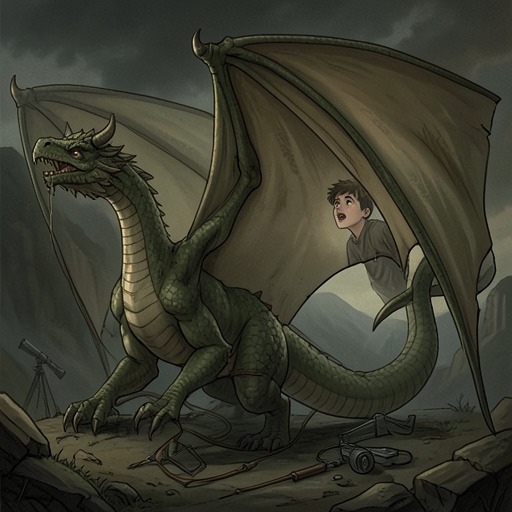
Baby Dragon’s captivity begins about four months before Old Alley Cat arrives on Wild Island. He falls from a low-flying cloud onto the riverbank while still too young to fly well; one wing is badly bruised, leaving him unable to return to the cloud. The animals find him and see in his predicament a solution to a long-standing inconvenience: rather than travel around the wide, muddy river, they can use a dragon to cross it. They tie a large rope around his neck and wait for his wing to recover, treating his temporary inability to leave as the opening for a permanent arrangement.
The plan is presented as a communal convenience, not as a relationship of mutual agreement. The animals train Baby Dragon to carry passengers, then make him transport loads too heavy for him. His small size and youth do not protect him from the work; he is made to labor through the day and sometimes through the night. The contrast is defining: the animals’ former problem was that crossing the river took too long, while the dragon’s imposed role makes their journeys easier by restricting his own freedom.
Confinement and isolation
The rope is both restraint and boundary. Baby Dragon is kept tied to a stake, with just enough length to travel across the river and back. Old Alley Cat describes the rope as exceptionally tough and tangled with so many knots that freeing him by untying it would take days. His captivity is therefore not simply a matter of being assigned work: the tether physically limits where he can go and makes the animals’ control continuous.
The account also makes clear that the work is enforced. When Baby Dragon complains, the animals respond with punishment, including twisting his wings and beating him. The threat is aimed at the same capacity that makes him useful: his ability to fly. As long as the animals control the rope and can hurt him into moving, his flight does not amount to freedom. It is turned into a means of compelled service.
His social world is correspondingly narrow. Old Alley Cat secretly hides in the bushes to talk with him when no one else is around, and she identifies herself as his friend. The Crocodiles are described as his only other companions; they greet him about once a week, when they remember. That occasional contact offers a small counterpoint to his isolation, but it does not interrupt the labor or remove the tether. Old Alley Cat leaves having promised to help him someday, although she cannot see how she might do so.
A system maintained by the animals
The river crossing has a visible mechanism for summoning the dragon. On one bank, a high flagpole carries a rope running through a loop at its top and down to a large crank. A sign instructs anyone seeking the dragon to yank the crank and report disorderly conduct to Gorilla. The apparatus makes the arrangement appear organized and routine: the animals need only operate the crank to call for the worker they have confined.
Elmer Elevator understands the mechanism’s threat when he reaches the river. From Old Alley Cat’s account, he knows the rope’s other end is around Baby Dragon’s neck. If the dragon is on Elmer’s side, Gorilla can use force to make him fly back across; if he is on the opposite bank, the rope can be cranked to force him back or place him in mortal danger. The system leaves the dragon no safe choice of direction. Its control does not depend only on the rope’s strength, but also on the animals’ ability to compel movement from either bank.
This machinery gives practical form to the animals’ treatment of Baby Dragon: his movement is managed for their convenience, while his complaints and wishes carry no power to stop the work. The narrative sets that fixed, coercive arrangement against Old Alley Cat’s promise and Elmer’s decision to rescue him. The contrast is not between two ways of operating a ferry, but between treating the dragon as transport and recognizing him as a being who should be able to choose where he goes.
Release and aftermath
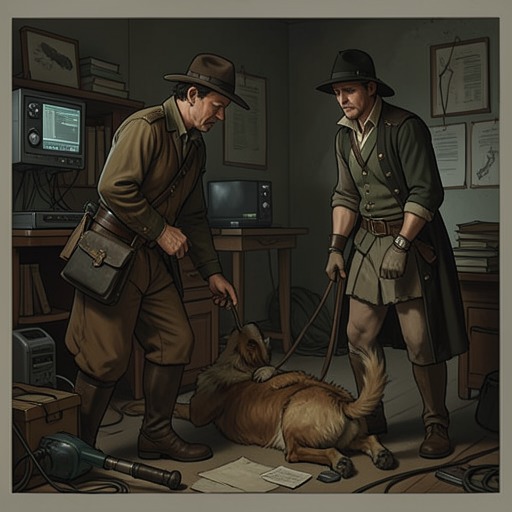
Elmer approaches the rope with a sharp jackknife and begins sawing through it, urging Baby Dragon to stand still while he works. The danger of discovery grows as the animals pursue Elmer across a bridge formed by the Crocodiles. Before they can reach him, however, the Crocodiles turn away from the bank and swim downriver, carrying the pursuing animals with them. The distraction gives Elmer time to finish cutting the rope; the animals’ attempt to cross the river becomes a comic procession away from the captive they had meant to reclaim.
Once free, Baby Dragon circles excitedly and tries a somersault. His immediate response marks the difference between compulsory flight and movement he can make for himself. Elmer climbs onto his back, and they leave together, heading toward the shores of Tangerina before beginning the long journey home. The escape ends the dragon’s forced ferry service and removes the rope that had confined him to the river crossing. His captivity has served as the motive for Elmer’s rescue, but its conclusion also restores Baby Dragon to the story as a companion who can travel by choice rather than a resource summoned by a crank.