The dragon’s rope
My Father's DragonThe dragon’s rope is both a physical restraint and the central mechanism of Baby Dragon’s forced service on Wild Island. Tied around his neck after he falls from a cloud with an injured wing, it first keeps him captive while the animals wait for him to recover. Later, secured to a stake and connected to a river-crossing apparatus, it makes his body available for the animals’ use. Its severing by Elmer Elevator is therefore more than the removal of an obstacle: it ends the system of control the rope has held together.
Capture and Forced Service
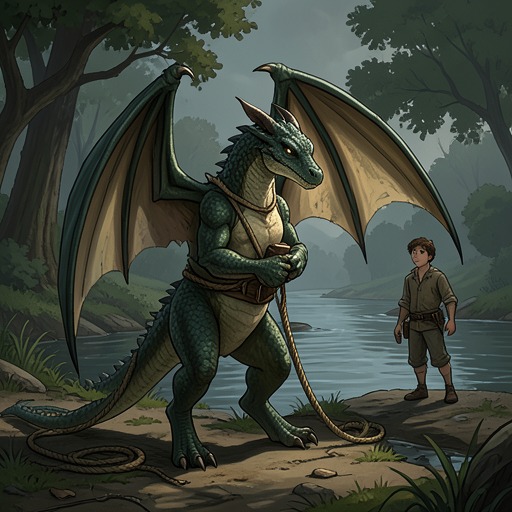
Baby Dragon arrives on the riverbank too young to fly well and unable to return to his cloud because he has badly bruised a wing. The animals see his arrival as a solution to their long-standing inconvenience: rather than walk around the wide, muddy river, they can make him carry passengers across. They tie a large rope around his neck and wait for his wing to heal. The rope thus enters the story not as protection for an injured animal but as preparation for turning him into transport.
Once his wing is well, the animals train Baby Dragon to carry passengers. The work extends beyond occasional crossings: he is made to labor all day, and sometimes all night, and to carry loads that are much too heavy. If he complains, the animals twist his wings and beat him. The account makes the rope part of a broader coercive arrangement, but also gives it a specific function: it keeps Baby Dragon tethered to the place where the animals can summon and use him.
The tether is described as exceptionally tough and knotted so densely that untying it would take days. Its length is limited to the distance across the river, confining Baby Dragon to the very route he is forced to serve. The detail about the knots makes clear why simply loosening or untying the rope is no practical escape. The eventual rescue will require a different method.
The River-Crossing Mechanism
By the time Elmer reaches the river, the rope has become part of an apparatus built to control Baby Dragon from either bank. A rope passes over a high flagpole, through a loop at its top, and down to a large crank. A sign instructs anyone seeking the dragon to yank the crank and report disorderly conduct to Gorilla. The sign reduces an act of coercion to an official-sounding procedure: Baby Dragon can be summoned as though he were equipment assigned to the crossing.
Elmer understands how the system works because Old Alley Cat had told him about Baby Dragon’s captivity. If Baby Dragon is on Elmer’s side of the river, Gorilla can twist his wings until pain forces him to fly back. If he is on the opposite bank, Gorilla can crank the rope until Baby Dragon either risks choking or flies back again. The rope therefore controls movement in both directions. The river is not an escape route while the tether remains attached; wherever Baby Dragon goes, the apparatus can drag or drive him back into service.
This arrangement gives the rope a grimly practical double role. It is a collar fastened to Baby Dragon, but its reach across the river also makes it an instrument operated by others at a distance. The crank and sign turn the animals’ control into visible infrastructure, while the threat of injury supplies the force the machinery itself cannot exert. The rope’s apparent usefulness to the island’s crossings depends on Baby Dragon having no choice about carrying anyone.
Cutting the Tether
Elmer cannot safely call to Baby Dragon across the river because Gorilla would hear him. After approaching the crossing, Elmer waits until he can reach the bank where Baby Dragon is held. When Baby Dragon runs out of the bushes and calls for him to hurry, Elmer takes out a very sharp jackknife and begins sawing through the rope. He tells Baby Dragon to stand still as the pursuing animals approach over a bridge formed by the Crocodiles.
The rescue is urgent because the rope is tough and there is still a great deal of it to cut. The nearby danger does not change the task: while the tether holds, Baby Dragon remains within the animals’ reach and control. Elmer continues cutting as the animals draw closer. The scene makes the rope’s material strength matter to the outcome; compassion alone cannot free Baby Dragon, and the knot-heavy restraint cannot be undone quickly by hand.
The pursuit is disrupted when the Crocodiles, distracted by pink lollipops, swim away down the river with the animals riding on their backs. Once Elmer and Baby Dragon have recovered from laughing at the sight, Elmer finishes cutting the rope. Baby Dragon races in circles and tries to turn a somersault, a sharp change from the fixed span and forced crossings imposed by the tether. Elmer climbs onto his back, and the two fly away toward the shores of Tangerina.
Meaning and Consequences
The rope links the story’s practical problem—a difficult river crossing—to the animals’ exploitation of Baby Dragon. It offers them a convenient alternative to walking around the river, but that convenience rests on forced labor, physical punishment, and the restriction of a young animal’s movement. The story does not treat the crossing apparatus as neutral: the flagpole, crank, and sign show how the rope makes domination routine and readily repeatable.
Its length, knots, and resistance also shape the rescue as a physical contest against captivity. Elmer cannot simply ask the animals to release Baby Dragon or untie the many knots in time; he must reach him and cut the tether. The knife reverses the rope’s function: where the crank lets the animals control Baby Dragon’s movement, Elmer’s blade breaks their control. Once cut, the tether no longer sets the limits of Baby Dragon’s travel. His departure with Elmer completes the rope’s narrative arc, from a device meant to keep him available for the river crossing to the bond whose destruction makes escape possible.