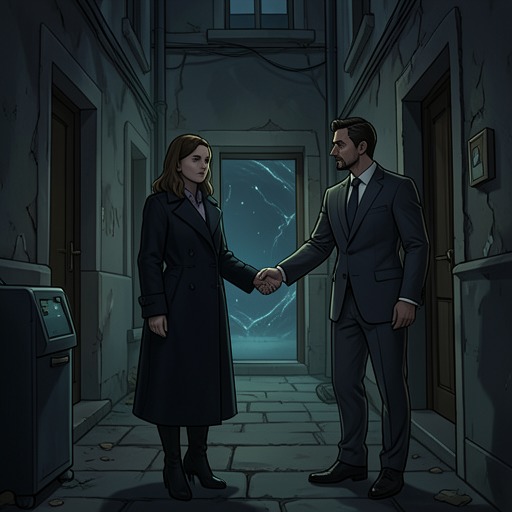
Gill
My Hot Secret: Geheimes Baby mit dem CEO Milliardär - Enemies to Lovers (German Edition)Gill is Ava’s FBI partner and former superior, but their partnership is defined less by cooperation than by resentment, hierarchy, and forced professional dependence. He has known Ava since she came out of Quantico, when he was already in a supervisory role and made her life difficult. Even after Ava began working as a consultant outside the FBI, Gill continued to speak to her as though he were her commander or mentor. Their history is not merely abrasive: Ava holds him responsible for the misconduct report that led to her official expulsion from the Bureau, and she remains openly bitter about it.
Institutional Authority and Personal Grievance
Gill represents an authority Ava no longer accepts as legitimate. Although they are technically partners, he continues to address her in a disciplinary tone, expecting the deference normally owed to a superior. When he tells her to show respect, Ava regards his demand as undeserved, believing that she already gives him the minimum respect he has earned. Her hostility therefore comes from a specific professional history rather than from ordinary impatience: Gill’s institutional power helped remove her from the FBI, while the Bureau still relies on the specialist knowledge that made her valuable.
The contradiction is central to Gill’s role. Ava is outside the FBI formally, yet the agency hires her as a consultant because of her expertise in art theft. Gill’s department had used her knowledge in connection with a previous insurance company, confirming that the organization that expelled her still needs her abilities. He thus becomes the personification of a system that can punish Ava, retain control over her professional identity, and summon her expertise when it becomes useful.
Conflict with Ava
Gill’s interactions with Ava are marked by command, correction, and deliberate irritation. When he finds her at her desk, he addresses her by her surname and immediately demands respect. Ava answers with barely concealed contempt. She resists his attempt to restore the old hierarchy, even while recognizing that she remains on the FBI payroll for the duration of the assignment and cannot simply provoke him without consequence.
Her response to Gill’s authority takes the form of theatrical emotional labor. She stands, flutters her eyelashes, adopts an exaggeratedly frightened expression, and offers a grotesquely sweet series of services, including coffee and a deliberately insulting suggestion about removing the figurative stick from him. The performance turns the gendered expectation that she should behave like a lady into a weapon. It humiliates Gill publicly, drawing laughter from agents and insurance investigators nearby, while allowing Ava to expose the absurdity of his demand for obedience without openly abandoning the assignment.
The scene also shows the cost of their conflict. Ava has been awake for three days and is in no mood for Gill’s behavior, but she ultimately tells him to explain why he has come. Her restraint is tactical rather than conciliatory. Gill’s anger matters less to her than the work, and the professional obligation that binds them survives the personal hostility.
The Gomez Interrogation
Gill comes to Ava because Arturo Gomez, a fifty-five-year-old known antique thief, is in the interrogation room and refuses to speak unless he can talk to Ava, and only Ava. Gill presents the information as though it were a summons and supplies a condescending reminder of Gomez’s identity and criminal history. Ava immediately points out that she has arrested Gomez twice before, making his attempted briefing unnecessary.
Gill’s insistence that Ava may need a refresher because it has been some time since she entered an FBI interrogation room carries a second insult: it reminds her that she is no longer where she once belonged. Ava answers that the research in the dossier is poor and asks, in effect, who is actually out of practice. The exchange reverses the expected hierarchy. Gill controls access to the room, but Ava possesses the experience and investigative authority that Gomez specifically requests.
The episode establishes Gill as both obstruction and conduit. He aggravates Ava and polices her behavior, yet he is also the one who brings her to the case. His usefulness does not soften the antagonism; instead, it makes their relationship more structurally tense, because Ava must work through a man she considers partly responsible for her professional downfall.
Power, Surveillance, and Narrative Function
Gill’s authority operates through speech, records, and access. He invokes respect, reminds Ava of the interrogation rooms she has lost, and controls the transition between her consultant’s desk and the FBI’s investigative machinery. His conduct belongs to the same wider pattern of surveillance and institutional judgment that appears elsewhere in the story: private life is questioned, evidence is collected, conversations are recorded, and professional status is used as leverage.
Ava’s later work against Trevor shows a contrasting use of documentation. She confronts Trevor with papers supporting the embezzlement accusation and then raises her phone to reveal that she has recorded their conversation. Gill is not the investigator in that confrontation, but his presence in the larger FBI structure helps frame the difference between authority imposed from above and evidence deployed by someone whom authority has tried to exclude. Ava remains angry at Gill, yet she continues to operate with investigative habits and skills that the Bureau itself helped form.
Gill is therefore a sharply drawn antagonist rather than a fully developed intimate character. His defining function is to embody the coercive, patronizing face of the FBI and to keep Ava’s expulsion from becoming a closed chapter. At the same time, his dependence on her expertise prevents the conflict from becoming simple rejection: the institution can dismiss Ava, but it cannot make her knowledge unnecessary. Through Gill, the story turns professional resentment into an ongoing power struggle in which Ava’s competence repeatedly outlasts the authority used against her.