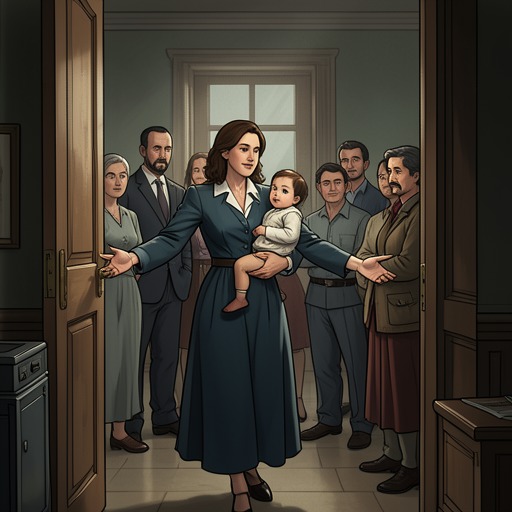
Ava and Gabriel's final confrontation outside the bakery
My Hot Secret: Geheimes Baby mit dem CEO Milliardär - Enemies to Lovers (German Edition)Ava and Gabriel’s final confrontation outside the bakery is the decisive rupture between them. What begins with Ava cautiously calling Gabriel back becomes an encounter in which hidden identity, professional conflict, inherited resentment, and fear of loss converge. Gabriel discloses that Harvest Foods International is not merely the company Ava has been hired to save: it is his father’s company, his company, and a living symbol of the father’s choice to value business over his son. The confrontation ends with Gabriel rejecting Ava and ordering her out of his life, transforming their relationship from an intimate possibility into an enforced separation.
Causes and Hidden Identities
The confrontation is made possible by a long-standing asymmetry of knowledge. Ava has been working as a corporate consultant for Harvest Foods International without realizing that the man she has come to love is directly bound to the organization. Earlier, her professional entrance into the company already required a performance of composure: she straightened her wrinkled blouse, tucked her hair behind her ear, and introduced herself to John as the new corporate consultant. John’s dismissive appraisal and unexpectedly weak handshake established a workplace in which her authority had to be proved rather than assumed. Later, when she arrived late to a presentation, John and Trevor were waiting in a conference room, and Trevor greeted her with open sarcasm. Her work at HFI therefore carries both practical pressure and a continuing demand to defend her competence.
Gabriel’s concealed position is the confrontation’s central revelation. When Ava approaches him outside the bakery, he first speaks as though their relationship itself is the problem. He then names Harvest Foods International and explains that it is his father’s company and his own. The disclosure changes the meaning of their earlier encounters: Ava has been trying to rescue the institution Gabriel associates with abandonment, while Gabriel has been building intimacy with the person professionally committed to preserving it. His bakery identity had allowed him to appear separate from that inheritance. When he once told Ava that he was the boss, he meant that the bakery belonged to him; the statement had been a revelation of one kind of authority, but not of the corporate power that now stands between them.
Course of the Confrontation
After the bakery’s departure leaves an opening, Ava calls Gabriel’s name carefully and steps toward him. He turns with a brief trace of pain before retreating emotionally, answering her with a terse, suspicious acknowledgment. When Ava tries to close the physical and emotional distance, Gabriel steps back again. The movement makes his conflict visible: he is not indifferent, but he treats closeness as something from which he must protect himself.
Gabriel tells Ava that he cannot continue “the thing between them” and admits that she briefly knocked him off balance. He then identifies the source of the conflict: Ava is attempting to save the company he hates, the company that mattered more to his father than he did. His bitterness makes the corporation personal rather than merely economic. Ava can insist that being assigned to HFI was not her fault, but she cannot remove the company from the relationship because, for Gabriel, it embodies a history of emotional abandonment.
The confrontation intensifies when Gabriel recalls that Ava has told him she loves him. His response is not to dispute the feeling but to treat it as an additional danger. He says that he cannot bear to lose someone again after losing his mother and explains that this is why he has never entered a serious relationship. The statement clarifies the larger pattern behind his rejection: his refusal is presented as self-protection, yet it also guarantees the very loss he fears. His grief is converted into an anti-commitment principle, and Ava becomes the person forced to absorb its consequences.
Gabriel finally tells Ava that he no longer wants to see her. He turns and walks away while she remains motionless on the sidewalk, hoping he will reverse himself, retract the words, or reveal that the rejection was not meant seriously. He does none of these things. The absence of a return is the confrontation’s immediate finality: the scene does not resolve through reassurance, explanation, or compromise, but through a physical departure that confirms the emotional severance.
Relationship and Value Conflict
The scene’s conflict is not simply between a couple and a company. It places two incompatible understandings of responsibility against each other. Ava’s professional responsibility is to preserve HFI, and her personal commitment is to take a risk on love. Gabriel’s inherited responsibility has been experienced as a burden imposed by his father, so the company cannot appear to Ava as a neutral workplace. The same institution therefore represents duty to one character and betrayal to the other.
This collision also reverses the roles they have performed elsewhere. Gabriel’s mastery of baking, his knowledge of enriched dough, and his confident handling of flour, milk, butter, eggs, and sugar present him as a skilled craftsman whose identity seems grounded in tangible labor. Ava, meanwhile, is the consultant who enters offices and conference rooms prepared to manage crises. Outside the bakery, those separate roles collapse into one field of conflict. The baker is revealed as the heir to HFI, and the consultant is revealed as the woman whose labor threatens his emotional boundary.
The surrounding narrative repeatedly contrasts work with intimacy. Ava later admits that she has gone through an entire trip without thinking about work, even though work had previously been her only contentment and virtually everything she had. Gabriel’s care during the Napa Valley Wine Train journey follows the same tension: he refuses champagne because its smell has made Ava ill, without knowing why she is avoiding alcohol or pressing her for an explanation. His attentiveness demonstrates the relationship’s capacity for respect and care, but the confrontation shows that care alone cannot overcome a concealed structure of family trauma and corporate inheritance.
Consequences and Later Reversal
The rejection initially confirms Gabriel’s rule against serious relationships and leaves Ava isolated with the knowledge that emotional openness has not protected her from abandonment. Yet the confrontation does not remain the final word on the relationship. Ava later returns to the bakery and makes a public declaration of continued love, telling Gabriel that she believes he loves her too and wants to be on his team and fight beside him. She describes love as a risk worth taking and understands her decision as a leap into cold water. In contrast to the sidewalk scene, where Gabriel controls the ending by walking away, the bakery declaration places Ava’s choice openly before him and refuses to let fear define the whole relationship.
Gabriel’s eventual response extends beyond romantic reconciliation into a decision about responsibility. He says he no longer wants to be the man who avoids responsibility or teach their child to run from problems. He then resolves to regain control of HFI and turn it from a symbol of his father’s abandonment into something positive. The company that caused the rupture thus becomes the site at which Gabriel attempts to revise his inheritance. The confrontation’s wound remains essential to that later decision: without the exposure of HFI’s meaning, his assumption of responsibility would not carry the same personal and generational force.
The event’s importance is therefore double-edged. As an immediate scene, it is a breakup produced by withheld identity and unresolved grief. As a structural turning point, it makes the hidden terms of the relationship impossible to evade. Gabriel’s withdrawal gives visible form to his fear of losing another loved one; Ava’s later return answers that withdrawal by choosing emotional risk, partnership, and shared responsibility. The bakery outside which the separation occurs is consequently more than a setting. It marks the boundary between Gabriel’s carefully separated selves and the moment when love, family history, and HFI can no longer be kept apart.