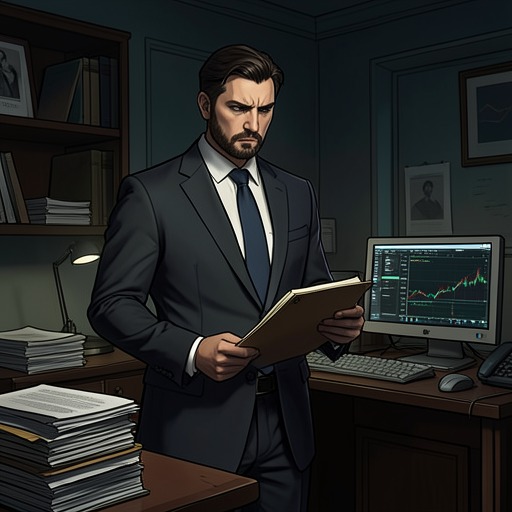
Long-term embezzlement and coup plot of Trevor against HFI exposed
My Hot Secret: Geheimes Baby mit dem CEO Milliardär - Enemies to Lovers (German Edition)The exposure of Trevor’s long-running embezzlement and attempted takeover of Harvest Foods International is the decisive reversal in the company’s crisis. What first appears to be a failing corporation requiring urgent financial rescue is revealed as the result of a sustained internal campaign: Trevor has been diverting money, obstructing Ava’s recovery plan, and trying to make Harvest Foods International cheap enough to acquire for himself. The discovery changes the conflict from a difficult consultancy assignment into a coordinated effort by Ava and Gabriel to defend the company and expose the person engineering its collapse.
The Crisis Behind Harvest Foods International
Harvest Foods International enters the story as an international corporation that had earned billions of dollars in previous years and held stakes in familiar food brands across many countries. John tells Ava that the company has nevertheless been making losses for more than a year and faces debts coming due. Unless the business is repaired quickly, it risks bankruptcy. The scale and speed of the decline shock Ava: the company’s commercial reach and earlier profitability make the collapse seem too severe to be explained by ordinary mismanagement.
Ava responds by treating the crisis as a problem that can be solved through disciplined work. She is given a demanding rescue assignment and initially believes that the company can be restored with the right approach. When Trevor requests a progress report before the end of the week, she sets aside her personal turmoil as far as she can and produces extensive tables and charts designed to let the numbers speak for themselves. Her review suggests that Harvest Foods International’s revenue is higher than she had first assumed and that its recovery should be comparatively straightforward if the correct measures are adopted.
Trevor’s conduct gradually makes the company’s condition look less like an accidental downturn and more like a controlled obstruction. He dismisses Ava’s work despite the favorable figures, challenges her calculations over a misplaced decimal, and questions whether her private life is affecting her performance. His insinuation that her competence might depend on whether she is seeing someone turns a financial review into an exercise of personal intimidation. Later, even after acknowledging that Ava has done her homework and offered strong, workable solutions, Trevor singles out her reference to embezzlement as the unacceptable element, warning that investors do not respond well to such an alarming accusation. His managerial language thus helps conceal the very misconduct the investigation is approaching.
Discovery of the Secret Accounts
The breakthrough comes after several days in which Ava divides her time between repairing Harvest Foods International’s operations during the day and examining documents at night. While Gabriel cooks dinner, she finds the decisive clue on her laptop: multiple secret bank accounts have been receiving company money for years. The evidence does not merely indicate a recent theft or an isolated bookkeeping irregularity. Its duration and structure point to a deliberate system of extraction concealed within the company’s financial records.
Gabriel confirms that the accounts are held in Trevor’s name. The discovery connects the hostile executive’s behavior to the missing funds and gives Ava the proof she has been seeking. It also places the fraud within Gabriel’s family history. Gabriel observes that the transfers began after his father’s death, a detail that makes the financial crime inseparable from the succession struggle surrounding Harvest Foods International.
The dates and sums reveal a second layer to the scheme. Ava realizes that Trevor has not been stealing millions merely for personal enrichment; he has been systematically reducing the company’s value. Gabriel explains that, after his father died, Trevor approached him and asked to be appointed chief executive, effectively handing the company over to him. Gabriel refused. Trevor then continued looking for another route to control the business. His plan was to hollow Harvest Foods International out from within until Gabriel would have no practical choice but to sell it at a fraction of its true worth, after which Trevor could buy it with the money he had diverted.
Building the Case Against Trevor
The exposure becomes persuasive because Ava and Gabriel assemble several kinds of evidence rather than relying on the secret accounts alone. The banking records establish the flow of money and its connection to Trevor. Ava also obtains a copy of an email that contradicts her recovery plans, preserving evidence that Trevor had actively undermined her efforts to make the company profitable. His opposition to her recommendations therefore appears not as a disagreement over business strategy but as part of the wider effort to keep Harvest Foods International weakened.
A confrontation follows in Trevor’s office. Ava remains standing when he gestures for her to sit and presents the papers documenting his embezzlement. Trevor answers with mockery and denial, attempting to retain control of the encounter through sarcasm and posture. Gabriel then states the underlying scheme plainly: Trevor sought to turn the company into a sinking ship, force a sale at an artificially low price, and use the stolen money to purchase it. Trevor’s momentary panic exposes the limits of his performance. The executive who had earlier examined Ava, questioned her private life, and dismissed her figures now faces records that make his own conduct visible.
The case is strengthened by John’s testimony. Gabriel has persuaded John to enter the room, although John appears intimidated and ashamed. John confirms that he overheard Trevor tell other investors that he intended to dismantle the company from the inside and buy it back cheaply. He also explains that Trevor threatened to fire him and prevent him from finding work elsewhere if he spoke. This testimony reveals the organizational mechanism that allowed the scheme to persist: Trevor did not depend only on hidden accounts, but also on fear, silence, and control over employees’ livelihoods.
Ava and Gabriel add a recorded conversation to the documentary and testimonial evidence. Ava raises her phone and tells Trevor that she recorded the exchange, closing another possible route of denial. Trevor protests that they cannot do this, but Gabriel answers that they can and will. The confrontation therefore shifts from an argument between executives to a documented case supported by financial records, internal correspondence, a witness, and an audio recording.
Consequences and Narrative Significance
The immediate consequence is Trevor’s dismissal and the involvement of the authorities. Gabriel tells him that he is not only fired but that the authorities have already been contacted, making clear that the matter will not end as a private corporate dispute. The exposure redirects the future of Harvest Foods International away from Trevor’s attempted acquisition and toward Ava and Gabriel’s effort to restore the company honestly.
The event also reinterprets Ava’s earlier encounters with Trevor. His polished business language, his complaints about her methods, his insistence on disputing the figures, and his intrusive questions about her personal life all become instruments of control. He presents himself as a guardian of accuracy and investor confidence while suppressing information that would reveal the company’s deliberate impoverishment. The story consequently distinguishes between legitimate managerial scrutiny and the weaponization of corporate procedure to protect white-collar crime.
The financial conspiracy also forms a deliberate contrast with the book’s other criminal storyline, the theft of the Rampant Lion Diamond. The latter is openly staged as a spectacular act involving a valuable object, a guard, a remote security system, and a carefully chosen moment of distraction. Trevor’s crime is quieter and more respectable in appearance: it moves through accounts, reports, authority, and threatened careers. Yet both plots depend on opportunity, surveillance, and the manipulation of attention. In Trevor’s case, the corporate system itself becomes the vulnerable environment, while Ava’s documents, Gabriel’s interpretation, John’s testimony, and the recording provide the oversight that the company previously lacked.
Most importantly, the exposure changes the value of work within Ava’s story. She initially believes that effort and sound analysis will be enough to repair Harvest Foods International, but the evidence shows that numbers can be resisted when the person controlling the institution benefits from their being ignored. Her persistence turns financial records into a form of resistance. By tracing the money, securing corroboration, and confronting Trevor directly, she converts the company’s apparently mysterious collapse into an intelligible act of theft and attempted corporate seizure. The revelation is therefore both a plot solution and a restoration of visibility: what Trevor hid behind management language becomes a crime that can be named, proved, and punished.