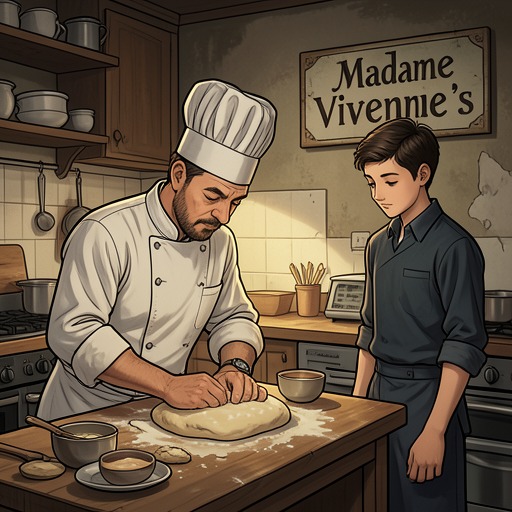
Madame Vivienne's
My Hot Secret: Geheimes Baby mit dem CEO Milliardär - Enemies to Lovers (German Edition)Madame Vivienne's is both a working bakery and the emotional center of Ava and Gabriel's relationship. Ava first enters it while angry, hungry, and unsettled by her humiliating introduction at Harvest Foods International, but the shop's food, atmosphere, and baker gradually turn an accidental stop into a recurring place of nourishment, disclosure, and romantic risk. By the end of the story, the bakery has changed from a site where Gabriel can control the distance between private feeling and public performance into the place where Ava declares her love and demands that he choose a shared life.
Setting and Material Character
Madame Vivienne's stands at the end of the street near Ava's workplace and first attracts her through a blue-and-white facade, ornate gold lettering, and wrought-iron bistro tables and chairs outside. The setting is busy with customers eating sweet and savory pastries, and the late-breakfast bustle makes the shop appear locally established and socially alive. Inside, French-cafe inspiration is combined with a polished modern style: blue-and-white furnishings, antique gold chandeliers, and the smell of bread and pastries create a warm, sensuous environment sharply opposed to the tense corporate office Ava has just left.
The bakery's material details make it more than a decorative romantic setting. Ava joins the line at the bread counter and studies handmade loaves and rolls while a staff member in a white-and-blue striped apron serves customers. The visible labor of baking is part of the shop's identity, but so is its carefully staged presentation: antique lighting, elegant colors, decorated tins, and a menu of carefully made delicacies turn production into an experience. The bakery therefore joins craft with taste and business with hospitality, offering Ava a social world in which competence is expressed through touch, timing, ingredients, and pleasure rather than through corporate authority.
Ava's First Visits and Gabriel's Introduction
Ava's first visit follows a difficult morning at Harvest Foods International. After John dismisses her before she can explain herself, she leaves the office because she has skipped breakfast and needs both food and a few minutes to clear her head. The short walk to Madame Vivienne's reduces some of her anger, and the smell from the bakehouse intensifies her hunger as she enters. The bakery consequently receives her at a moment of professional vulnerability, before she has established herself as the consultant who intends to rescue the company.
At the counter, Ava recognizes Gabriel as the man who stopped to help when her car broke down by the roadside. Their second meeting turns the bakery into the first place where their connection can develop through repeated recognition rather than a single roadside encounter. Gabriel offers her Brioche, describing it as light, fluffy, slightly sweet bread made with milk and eggs, and emphasizes that the last batch has just come from the oven. His enthusiasm for the craft is infectious; Ava is persuaded not merely by the food but by the pleasure with which he explains and handles it. He gives her the final piece and introduces himself, establishing Brioche as the bakery's first edible token of intimacy.
A later visit makes the bakery's romantic charge explicit. Ava returns after lunch because she has time before John and his colleagues decide what to do with her proposal, and seeing Gabriel behind the counter revives memories of their night together. She remembers his focused attention to her pleasure, his physical closeness, and the sense of safety she felt in his arms afterward. Although she tells herself that she is returning to assess Gabriel's suitability as a father rather than simply to pursue desire, the bakery becomes the place where that rational explanation is repeatedly tested by bodily memory and attraction.
The Bakery as Gabriel's Identity and Family Inheritance
The bakery's most important revelation is that Gabriel is not merely an employee. When Ava worries that his boss might object to her being in the kitchen, Gabriel tells her that he is the boss and explains that Madame Vivienne's is his bakery. Ava had read his casual generosity, flexible breaks, and informal manner as evidence of an irresponsible worker; the discovery forces her to revise her understanding of him. The bakery exposes the inadequacy of her first impression and reveals a person who possesses authority without displaying it in the corporate style familiar to her.
Gabriel gives Ava access to the kitchen after hours, when the doors are closed and the lights are off. He greets her from the kitchen in work clothes: an apron over a white T-shirt and worn but well-kept light-blue jeans. In this back-of-house setting he appears especially at ease. Ava notices that he works with relaxed confidence and that the ease she might have expected to resent instead draws her toward his world. The kitchen resembles a blue, white, and gold version of a workshop from a storybook, with a gray marble counter, modern and wood-fired ovens, and ornate antique tins filled with ingredients. It is a private workspace, but it is also a carefully offered invitation into Gabriel's life.
The baking lesson turns the bakery into a place of shared labor. Gabriel explains that Brioche is an enriched dough: unlike ordinary bread made from flour, yeast, and water, it includes milk, butter, and eggs, producing a richer taste. He measures flour, prepares the ingredients, gives Ava a matching apron, and teaches her to knead. The lesson lets Ava encounter his expertise through action rather than résumé or status. It also makes food relational: Brioche is not simply something Gabriel sells or gives her, but something they begin to make together.
The kitchen carries a family history as well. When Ava asks how Gabriel came to baking, his mood changes and he becomes tense and sad before answering that his mother founded the bakery. He confirms that she is Vivienne and explains that she established it before meeting his father there; the parents met in the bakery, married soon afterward, and then Gabriel was born. Madame Vivienne's is therefore a business, a maternal inheritance, and the origin point of Gabriel's family story. Gabriel's sadness shows that the shop preserves loss as well as continuity, while his continued work there keeps his mother's presence active through recipes, equipment, and daily practice.
A Space of Rest, Disclosure, and Relationship Testing
Madame Vivienne's repeatedly contrasts with Ava's work-centered life. During the weekend in Napa Valley, Ava realizes that she has not thought about work even once, admitting that work had been her only real purpose and literally everything she had. The bakery helps make that admission possible because it offers an alternative model of value: a life organized around making, sharing, and inhabiting the present rather than solving the next institutional crisis. Gabriel's confidence in the shop and his willingness to let Ava enter its routines show her that care and competence need not appear as pressure or control.
The bakery also becomes the place where Ava tests Gabriel's capacity for responsibility. She has decided to keep the baby and secretly evaluate whether Gabriel could be present as a father, while maintaining an emotional boundary that protects her from another devastating loss. His work at Madame Vivienne's complicates her initial image of him as a pleasure-seeking man without commitment. The bakery demonstrates sustained skill, ownership, and inherited obligation, even as Gabriel's personal rules resist serious romantic attachment. Ava's attraction grows partly because the shop allows her to see that his apparent lightness coexists with discipline and responsibility.
The place is consequently both a refuge and a stage. Behind the counter, Gabriel can appear as a genial baker who gives away warm Brioche; in the kitchen, he can reveal family history and invite Ava into a private world; before customers, however, the bakery remains a public business where emotional exposure carries an audience. This tension reaches its climax when Ava makes her declaration there. She tells Gabriel that she still loves him, believes that he loves her, wants to be on his team, and is willing to risk being hurt rather than accept a life without love. Her language of joining a team transforms the bakery's practical cooperation into a model for intimate partnership.
Public Confrontation and Lasting Significance
The bakery's final emotional function is to remove the protective distance that Gabriel has maintained. During Ava's declaration, everyone in the bakery falls silent and waits for Gabriel's response. His body reveals the pressure of the moment: he is visibly tense and swallows hard. The counter, previously a workplace barrier and a position of control, separates them until Gabriel slowly comes out from behind it. That movement gives physical form to the story's central question of whether he will remain protected by his role or cross into a shared emotional life.
The shop's recurring food imagery extends beyond romance. Brioche first brings Ava and Gabriel together, the shared preparation of Brioche allows Gabriel to disclose his family history, and food remains associated with care and pregnancy. Later, Gabriel gives Ava a Croissant in the park, where she bites into it and discovers something hard and shining inside. Although that later scene occurs outside the bakery, the pastry carries Madame Vivienne's most important pattern with it: baked food is never merely nourishment. It can hold memory, labor, inheritance, surprise, and a consequential promise.
Madame Vivienne's therefore functions as a domestic counterworld to the corporate offices where Ava fights to prove herself and where Trevor's authority distorts care into control. The bakery makes Gabriel legible through his hands, his family, and his willingness to share a craft. It gives Ava a place to move from hunger and anger toward pleasure, from observation toward participation, and from guarded assessment toward an openly chosen relationship. Its significance lies in that conversion: what begins as a neighborhood bakery becomes the narrative's most durable image of a life built through work that can feed people, inheritance that can be acknowledged, and love that must finally be spoken in public.