Vivienne
My Hot Secret: Geheimes Baby mit dem CEO Milliardär - Enemies to Lovers (German Edition)Vivienne is chiefly present through what she leaves behind: Madame Vivienne's, the bakery she founded, and the brioche recipe that Gabriel treats as one of the finest inheritances of his childhood. Though she does not appear directly in the supplied scenes, her work and memory organize Gabriel’s professional identity and connect food, maternal loss, family history, and the possibility of transforming an inherited wound into a chosen future.
Founder of Madame Vivienne's
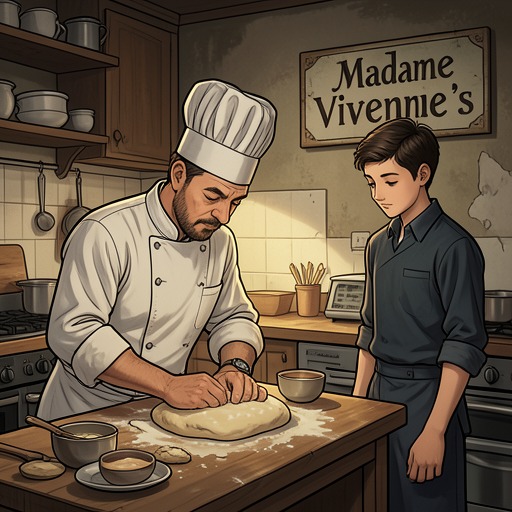
Vivienne founded Madame Vivienne's before she met Gabriel’s father. The bakery’s blue-and-white facade, gold lettering, wrought-iron bistro furniture, French-cafe styling, antique gold chandeliers, and shelves of handmade breads establish it as more than a workplace: it is a carefully cultivated environment carrying its founder’s name and aesthetic. When Ava Brenner enters after a difficult first day at Harvest Foods International, the bakery’s warm, abundant atmosphere offers an immediate contrast to the hostility and judgment she has encountered at HFI.
The bakery also preserves Vivienne’s presence through labor. Gabriel works behind the counter, explains ingredients and technique, and moves through the kitchen with confidence, suggesting that the skills associated with the business have passed from mother to son. The kitchen continues the shop’s blue, white, and gold palette, with a gray marble counter, modern and wood-fired ovens, and elaborately decorated antique tins holding ingredients. Its design makes the bakery feel like a material family archive, in which Vivienne’s taste survives in objects, colors, recipes, and repeated acts of making.
Mother, Memory, and Loss
Gabriel identifies Vivienne as his mother when Ava asks how he came to baking. His manner changes immediately: he becomes tense, his eyes turn sad, and he needs a moment before answering. He explains that Vivienne founded the bakery and that she met his father there. Their meeting led to a passionate romance, a marriage soon afterward, and eventually Gabriel’s birth. The bakery is therefore also the setting of the family’s origin story, joining Vivienne’s entrepreneurial life to the beginning of Gabriel’s family.
Gabriel speaks of Vivienne in the past tense and confirms her identity with a sad smile. The supplied evidence does not specify the circumstances or date of her death, but it makes the emotional consequence clear: remembering her causes deep grief, and he deliberately interrupts the memory rather than allowing himself to dwell in the past. His instinct to return to the present becomes part of his broader refusal to remain trapped by painful history. Vivienne’s absence is thus not an incidental biographical detail; it is one of the sources of Gabriel’s emotional guardedness and his resistance to commitment and responsibility.
The Brioche Inheritance
Vivienne’s strongest recurring legacy is her brioche recipe. Gabriel tells himself that no one can resist the delicacy of his mother’s recipe and calls it one of the best things she left him. The recipe first mediates his renewed contact with Ava: after previously behaving badly toward her, he gives her brioche as an attempt to repair the impression he made. Its warmth and sweetness make the encounter less defensive, while Gabriel’s pride in the recipe reveals how closely his craft remains tied to maternal memory.
Later, when Gabriel invites Ava into the bakery kitchen, he chooses brioche as the first thing they will make because she enjoyed it so much. He explains that brioche is an enriched dough: unlike ordinary bread made from flour, yeast, and water, it includes milk, butter, and eggs, producing a richer taste. The explanation turns Vivienne’s inheritance into an embodied practice. Gabriel does not merely remember his mother; he weighs ingredients, prepares the dough, teaches the method, and shares the work with Ava. Food becomes a language through which family history can be disclosed without being reduced to abstract confession.
The recipe also connects Vivienne’s legacy to Ava’s changing body and circumstances. During the later pregnancy, Gabriel gives Ava a croissant in the park, and she discovers something hard and gleaming inside it: the food has been used to conceal a ring. Although the croissant is not identified as Vivienne’s recipe, the gesture extends the bakery’s inherited language of pastry into Gabriel’s proposal. A maternal craft that once represented loss becomes part of a new family decision.
Legacy and Gabriel’s Reorientation
Vivienne’s influence reaches beyond Gabriel’s identity as a baker. After Ava reveals that she loves him and that she is carrying their child, Gabriel decides that he no longer wants to be the man who avoids responsibility. He says he does not want to teach their child to run away from problems and intends to regain control of HFI, transforming it from a symbol of his father’s abandonment into something positive. The evidence does not present Vivienne as responsible for HFI or for Gabriel’s conflict with his father; rather, her bakery supplies the constructive model against which that damaged inheritance can be measured.
The contrast is decisive. Gabriel’s father is associated with abandonment and with the negative meaning attached to HFI, while Vivienne is remembered through founding, making, nourishment, and a business that bears her name. Gabriel’s eventual resolve does not erase his grief or the family history that produced it. Instead, it redirects the inheritance: the son who once used the present to avoid painful memory begins to build a future in which his own child can receive care rather than inherited flight.
Narrative and Thematic Significance
Vivienne functions as an absent center of the narrative. She is never required to dominate a scene because the bakery, its visual identity, and its food repeatedly speak in her place. Madame Vivienne's gives Gabriel a public role and a private refuge; the brioche gives him a tangible connection to his mother; and the memory of her death exposes the vulnerability beneath his controlled, present-focused persona.
Her legacy also makes the bakery a counterpoint to the corporate world of Harvest Foods International. HFI is marked by financial crisis, power struggles, and the threat of misappropriation, whereas Vivienne’s establishment is presented through craftsmanship, hospitality, and continuity. Gabriel’s movement toward reclaiming HFI therefore carries an implicit demand that an inherited institution be remade according to a more sustaining model. Vivienne’s importance lies in that standard of making: she gives the story a maternal inheritance that is concrete enough to taste, work with, and pass forward, even as her absence continues to shape the people who remain.