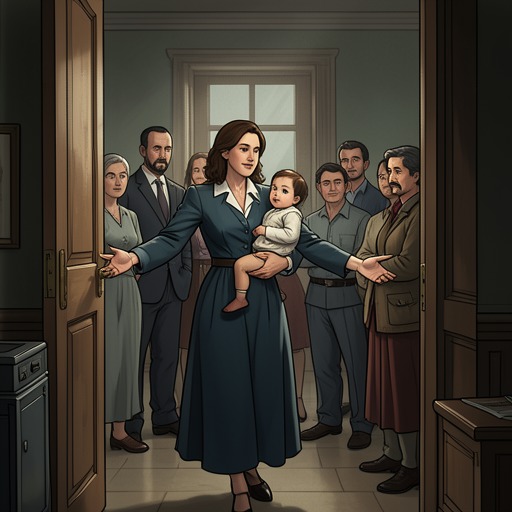
Ava Brenner
My Hot Secret: Geheimes Baby mit dem CEO Milliardär - Enemies to Lovers (German Edition)Ava Brenner is the central protagonist of the narrative and the point through which its conflicts between independence, intimacy, work, and family are experienced. Introduced while preparing to leave with barely enough time to eat a croissant before taking a taxi to the airport, she is already defined by motion, pressure, and emotional withdrawal. Her relationship with Nick has effectively ended because she no longer feels anything for him, and the story’s later developments force her to confront the limits of treating both love and life as problems that can be managed from a safe distance.
Identity and Introduction
Ava begins as a highly mobile professional whose career requires travel and whose immediate instinct is to keep moving. Her separation from Nick is not presented as a dramatic mutual quarrel. Nick explains why their relationship no longer works, while Ava responds with a shrug because he wants an emotional commitment she can no longer give. Her numbness is connected to an earlier bereavement: after the death of her fiancé, she had learned to protect herself by refusing renewed emotional exposure. Yet the apparent indifference is not the same as an absence of feeling. It is a defensive structure that the plot steadily undermines.
Her professional identity is established when she arrives at Harvest Foods International as a new corporate consultant. Before entering John’s office, she pauses to collect herself, smooths her wrinkled blouse, and tucks her hair behind her ear. The gesture reveals how carefully she manages her visible self before entering a workplace where she will be evaluated. John’s office is spacious and formal, dominated by a large dark-wood desk, and his restrained handshake and abrupt manner make the encounter a test of status as much as an introduction. Ava presents herself directly as the company’s new consultant, while John immediately signals that he expects business to take precedence over ceremony.
The tension between competence and vulnerability becomes sharper when Ava arrives late to a meeting with John and Trevor. In the elevator she straightens her clothes and concentrates on the strength of her presentation, trying to appear calmer than she feels. John and Trevor are waiting in a conference room and are visibly displeased, while Trevor greets her with pointed sarcasm. Ava admits that she overslept, but the scene emphasizes that lateness does not erase her professional authority: she enters under pressure and still attempts to defend the value of her work.
Pregnancy and the Decision to Act
Ava’s life changes when a home pregnancy test shows a positive result. She sits on the closed toilet seat with her face hidden in her hands as her thoughts race in many directions. The discovery is frightening precisely because it cannot be absorbed into her previous routines. Travel, employment, housing, financial security, and the child’s future all become practical questions, while the pregnancy also reopens emotional capacities she believed had disappeared with her fiancé’s death.
Beverly is the person to whom Ava can admit her uncertainty. Rather than directing Ava toward one outcome, Beverly tells her that keeping the baby would be wonderful but that abortion would also be acceptable, because the decision belongs to Ava. This response gives Ava room to choose without moral coercion. Ava considers how a child would make travel difficult and transform her entire life, but she also recognizes that her encounter with Gabriel awakened a desire for genuine connection. She finally tells Beverly that she believes she wants to keep the baby, and Beverly responds with confidence that Ava will be a good mother.
The decision immediately becomes an ethical and strategic problem. Ava develops a plan to get to know Gabriel without telling him about the pregnancy. Because there is still time before the child is born, she intends to determine whether he has the qualities of a good father. If he proves capable of accepting that role, she will disclose the truth; if not, she will disappear from his life and raise the child without him. She regards the pregnancy as her responsibility because she forgot her pill and told Gabriel not to use a condom, and she would rather raise the baby alone than force an unwilling father into a life that could make everyone miserable.
This plan is also tied to Ava’s professional ambition. She resolves to work harder than ever and hopes that proving herself at Harvest Foods International will eventually allow her to establish a permanent home and attract further corporate opportunities. She wants the child to have the best possible future and believes she can provide it with or without anyone else’s participation. Her independence is therefore both a resource and a burden: it gives her confidence that she can survive alone, but it also makes concealment appear safer than trust.
Boundaries, Work, and Public Self-Presentation
When Gabriel invites her to dinner after sensing her desire for distance, Ava accepts only on the condition that they go as friends. She states the boundary to Gabriel and to herself, revealing that the rule is less a casual description than a form of self-discipline. Friendship gives her a controlled space in which to assess him while resisting the attraction she still feels. Her emotional life is thus organized through explicit limits, delayed disclosure, and the possibility of withdrawal.
Ava’s assumptions about Gabriel are repeatedly unsettled by the gap between his apparent social position and his actual work. At his bakery, she assumes that he must answer to a chef, only to learn that he is the chef and that the bakery belongs to him. The revelation complicates her reading of him: he is not merely a wealthy or detached man who can move through the world without ordinary obligations, but also a working proprietor whose identity is connected to production, food, and responsibility. The bakery becomes a setting in which the polished professional identities displayed in offices give way to a more intimate and practical form of authority.
Money is another point at which Ava and Gabriel initially differ. Gabriel explains that he does not see the point of hoarding money when it can be used to make the present more pleasant. Ava finds it difficult not to regard this outlook as selfish because her own next paycheck is never secure as she moves from company to company, whereas Gabriel’s thriving bakery gives him greater stability. Her hesitation is not simply romantic caution; it reflects a material difference in how each understands risk. Gabriel can treat spending as an expression of living in the present, while Ava must calculate future security for herself and, increasingly, for her unborn child.
Ava remains committed to a life shaped by independence and career rather than domestic dependence. She has never imagined herself as a permanently cared-for housewife and has always understood that she wanted her own path and professional future. Even when Gabriel’s conduct suggests that care can be offered without erasing autonomy, Ava does not abandon her ambitions. Her central challenge is to discover whether intimacy can become a partnership rather than a replacement for self-determination.
Relationship with Gabriel
Ava’s relationship with Gabriel develops through a repeated tension between attraction and guardedness. She wants the connection she once fled from, yet she continues to test whether allowing Gabriel closer will expose her to another devastating loss. Her pregnancy intensifies this conflict because Gabriel is not only a possible lover but also the potential father of her child. Every gesture therefore carries two meanings: it matters to the romance, and it becomes evidence in Ava’s private assessment of his character.
Gabriel’s care gradually complicates Ava’s suspicion. Before a hike, she eats very little at breakfast, and Gabriel notices. He asks whether everything is all right and offers snacks from his backpack in case she becomes hungry during the walk. Later, on the Napa Valley Wine Train, he refuses champagne because he does not want the smell to make her feel sick again. He does not know why she is avoiding alcohol or why the smell troubles her, and he neither questions nor pressures her. Ava is deeply affected by this unasked-for accommodation: Gabriel attends to her needs as though doing so were ordinary.
These moments matter because they give Ava precisely the evidence her concealed plan seeks. She is not looking only for passion or generosity in spectacular form. She is observing whether Gabriel notices discomfort, respects a boundary, and changes his own behavior without demanding an explanation or reward. Care becomes a practical test of fatherhood and partnership. At the same time, the test exposes the cost of keeping him ignorant, since Gabriel can respond thoughtfully without knowing the full reason his choices matter so much.
The relationship eventually reaches a public emotional crisis in the bakery. Ava tells Gabriel that she still loves him and believes that he loves her, and she asks to be on his team rather than remain outside the life he is trying to protect. She frames love as a risk she is consciously willing to take, not as a guarantee against pain. After making the declaration, she feels strong and free because she has finally chosen exposure over evasion. The public setting turns her confession into the opposite of her earlier secrecy: what began as a private test becomes an openly stated commitment.
Responsibility, Change, and Narrative Role
Ava’s most important transformation is the movement from emotional isolation to deliberate participation. At the beginning, she cannot give Nick the feeling he wants and assumes that withdrawal is preferable to conflict. After meeting Gabriel, however, she recognizes that she wants love again and does not want to run away from it. Keeping the baby becomes part of the same movement. Motherhood is not chosen because it is easy or because it preserves her previous life; it is chosen despite the fact that it will alter travel, work, and personal freedom.
Her concealment of the pregnancy remains morally complicated. Ava believes she is protecting Gabriel from an unwanted responsibility and protecting the child from an unreliable father. She also preserves her own ability to leave if he fails the test. The arrangement gives her control, but it places the relationship inside an uneven exchange: Gabriel is being evaluated on information he does not possess, while Ava withholds the fact that would most radically change his choices. The narrative does not reduce her decision to deception alone. It presents it as the survival strategy of a woman who has learned that love can be lost and that independence may be the only security she can guarantee.
The eventual disclosure changes Gabriel’s understanding of responsibility, but it also confirms the importance of Ava’s standards. Gabriel says that he no longer wants to be the kind of man who avoids responsibility or teaches their child to run from problems. He also decides to regain control of Harvest Foods International and transform the company from a symbol of his father’s abandonment into something positive. Ava welcomes this decision partly because many good employees would lose their jobs if the company went bankrupt. Her concern extends beyond her romance: she measures Gabriel’s commitment by whether he will accept obligations to their child, to his family history, and to the workers whose livelihoods depend on the company.
Ava therefore functions as the story’s testing consciousness and its principal agent of change. She begins by treating emotional distance, mobility, and work as forms of protection. She ends by accepting that a secure future cannot be built solely through solitary effort. Her pregnancy, her boundary-setting with Gabriel, her continued professional purpose, and her willingness to confess love all belong to one larger decision: to exchange controlled isolation for a risky but active form of shared life.