Brioche
My Hot Secret: Geheimes Baby mit dem CEO Milliardär - Enemies to Lovers (German Edition)Brioche is the bread through which Gabriel first repairs his damaged impression, reveals the depth of his identity as a baker, and repeatedly converts food into a language of care. Light, rich, slightly sweet, and made with milk and eggs, it carries the story from an improvised apology at the bakery to a shared domestic ritual and finally to the hidden engagement ring that changes its meaning from taste and memory into commitment.
Appearance and Recipe
Brioche is introduced as more than ordinary bread. Gabriel insists that it is “the best bread,” describing it as light and fluffy, enriched with milk and eggs, and slightly sweet. His explanation gives the food a precise material identity while also displaying his confidence in his craft. The bread is not presented as a neutral item from a shop counter; it is the product of knowledge, timing, and personal pride.
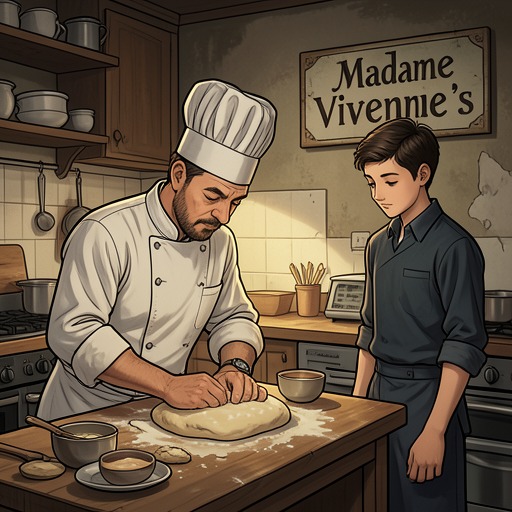
Gabriel’s technical account becomes more detailed when Ava visits the bakery kitchen. He explains that brioche is an enriched dough rather than ordinary bread dough: flour, yeast, and water are joined by milk, butter, and eggs, producing a richer taste. Sugar is added as well, and Gabriel explains that it interacts with the yeast, whose fermentation generates more carbon dioxide and helps the bread rise. The ingredients therefore establish a contrast between basic sustenance and deliberate abundance. Brioche requires additional fat, sweetness, and labor, and its richness reflects the care Gabriel invests in making it.
The process is visible rather than merely described. Gabriel weighs flour, gathers the ingredients, and mixes flour, yeast, milk, eggs, butter, and sugar into a sticky dough. Ava knows almost nothing about bread-making, but she watches Gabriel work with confidence and ease. The recipe becomes a practical demonstration of his expertise, while her unfamiliarity allows the scene to move from instruction toward participation.
First Encounter and Apology
Brioche first connects Ava and Gabriel after their difficult roadside encounter. Gabriel asks whether she has ever eaten it, and the name itself fascinates her before she has tasted it. He tells her that the last batch is coming from the oven at exactly the right moment, emphasizing the warmth and freshness of the bread. His enthusiasm is persuasive because it combines sensory description with unmistakable passion for his work.
Ava accepts the invitation to try it, and Gabriel disappears into the back room before returning with a tray of brioche still steaming from the oven. He uses tongs to place the pieces in a paper bag, then identifies himself as Gabriel while handing over the final piece. When Ava reaches for her wallet, he stops her and gives her the bag for free, explaining that it is the least he can do after the way he behaved that morning. The bread is therefore an apology made tangible: instead of offering only words, Gabriel gives away something produced by his own labor.
The exchange also establishes a boundary between commercial transaction and personal gesture. Ava offers to pay, especially after his persuasive presentation, but Gabriel refuses her refusal and insists that she accept it. His grin keeps the moment playful, yet the gift carries real moral weight because it acknowledges his earlier failure. Ava leaves for the office reluctantly, with part of her wanting to linger, and Gabriel sends her off with the expectation that they will see each other again.
Back at her desk, Ava realizes that she has thought about Gabriel throughout the journey. She takes a bite of the still-warm brioche, closes her eyes, and finds that he was right: it is among the best things she has ever eaten. She finishes the entire portion before beginning work with less hunger and more energy. The bread thus alters both her physical condition and her emotional attention. It nourishes her, but it also keeps Gabriel present after she has returned to the professional world.
Craft, Ownership, and Maternal Inheritance
Gabriel’s attachment to brioche is inseparable from his bakery and from the identity he performs through skilled work. When Ava worries that his boss might object to her being in the kitchen, Gabriel reveals that he is the boss and that the bakery belongs to him. The discovery corrects her assumption about his position and enlarges the meaning of the bread: what seemed like a simple product offered by a helpful baker is also an expression of ownership, authority, and a business built around his expertise.
The bread also opens a path to Gabriel’s family history. While thinking about Ava’s reaction to the gift, Gabriel recalls that the recipe is his mother’s old recipe and describes it as one of the best things she left him. He interrupts the memory because he does not want to dwell on the past and redirects himself toward the present. Brioche consequently carries an inheritance that Gabriel both values and resists. It preserves his mother’s presence through taste and technique, while his attempt to cut off the memory shows how closely pleasure is tied to unresolved loss.
This inheritance gives the bread a double function. It is an object Gabriel can control through professional mastery, but it also contains a part of his past that cannot be reduced to business. Every batch embodies a recipe received from his mother, and every act of sharing it allows that legacy to enter a new relationship. Gabriel’s gift to Ava is therefore personal even before either character openly names the intimacy developing between them.
Shared Labor and Emotional Intimacy
When Gabriel invites Ava to bake with him, he begins with brioche because she enjoyed it so much during their first meeting. The bakery kitchen is spacious, colorful, and fully equipped, with blue, white, and gold details, a gray marble counter, modern and wood-fired ovens, and decorated antique tins on the windowsill. Within this setting, brioche becomes the first project of their shared labor. Gabriel gives Ava an apron matching his own, asks her to help knead the dough, and turns the food that first attracted her into an activity they perform together.
The scene changes the relation between consumer and maker. Ava is no longer simply receiving a warm product across a counter; she is invited behind the scenes to touch the work, follow the stages, and participate in the labor. Gabriel teaches her without withholding his enthusiasm, while Ava admits that she cannot follow all the baking details because she knows so little about the process. Their difference in knowledge does not exclude her. Instead, it creates a structure in which his expertise and her willingness to learn can coexist.
The bread-making appointment also works against Ava’s habit of defining herself through work. During their later time together, she acknowledges that she has not thought about work once during the trip and that work had long been her only purpose, literally all she had. Brioche belongs to the alternative life taking shape around her: a life of food, touch, leisure, and attention shared with Gabriel. The bread is still labor, but it is not the corporate labor that has confined her. It is creative work that produces pleasure and invites companionship.
Recurrence and Final Transformation
Brioche’s significance grows through repetition. At first it is an unexpected gift made in the aftermath of Gabriel’s mistake. Then it becomes the reason he chooses the baking activity for Ava, allowing the remembered taste to become a shared ritual. Its recurring presence links the beginning of their attraction to the period in which they learn to work beside one another and disclose more of their histories.
The final food-related recurrence gives the object its most consequential form. While Gabriel and Ava eat together in a park during winter, Gabriel hands her a croissant. On her first bite, her teeth strike something hard. When she separates the loose layers, she discovers something shining inside. The unexpected object hidden in pastry converts Gabriel’s established vocabulary of baking into a proposal. The gesture recalls the earlier paper bag of warm bread but reverses its terms: the first baked gift repaired a past offense, whereas the concealed object asks Ava to enter a shared future.
Brioche therefore operates as a material thread joining appetite, memory, work, apology, and commitment. Its richness reflects Gabriel’s craft and his mother’s legacy; its warmth marks the beginning of Ava’s attraction; its preparation creates a backstage space where intimacy can develop; and its recurrence prepares the reader for food to carry a promise larger than itself. What begins as bread offered freely becomes part of the story’s argument that care is made through repeated, concrete acts rather than declarations alone.