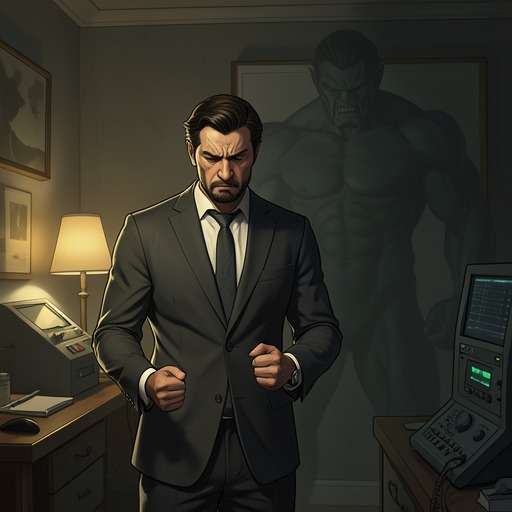
Gabriel's disengagement from HFI
My Hot Secret: Geheimes Baby mit dem CEO Milliardär - Enemies to Lovers (German Edition)Gabriel's disengagement from HFI is both a personal creed and a structural failure. Although he owns the company his father left him and holds its inherited CEO position, he treats HFI as an unwanted burden rather than an active responsibility. His refusal to engage is rooted in the memory of a father who sacrificed intimacy for wealth, but it leaves the company exposed to losses, information control, and Trevor's attempt to seize it from within.
Inheritance and Refusal
Gabriel's distance from HFI is established through inheritance rather than choice. His father died two years earlier and left him the company, while Gabriel also inherited substantial wealth beyond what he could spend in a lifetime. The scale of that inheritance makes ordinary financial necessity irrelevant to him; he does not need HFI to survive, and therefore experiences its demands as an intrusion into the life he wants instead of as an obligation that gives his position meaning.
The inheritance is inseparable from emotional injury. Gabriel remembers his father as a man consumed by success and money, unavailable when his son needed him most. In Gabriel's understanding, HFI is the material form of that abandonment: his father has handed him the enterprise he loved more than his child. Gabriel consequently rejects the company not because it lacks value in the abstract, but because it represents the cost of the life his father chose.
A Philosophy of Life Against Work
Gabriel turns disengagement into a philosophy. He wants experience, freedom, pleasure, and a life not narrowed by a job or a boardroom. He regards work that consumes the self as spiritually destructive, and he does not want to reach the end of his life with nothing except professional achievement. His attachment to Madame Vivienne's bakery offers the acceptable alternative: baking is a passion inherited through his mother, and preserving the bakery allows him to remain connected to her without repeating his father's model of existence.
This distinction explains why Gabriel can care about work in one form while rejecting it in another. The bakery is intimate, creative, and tied to family memory; HFI is associated with corporate control, paternal absence, and the cold authority of a board. He wants the former because it keeps a maternal bond alive, while he avoids the latter because it threatens to reproduce the paternal life he believes destroyed both family and self.
Gabriel's disengagement is also enacted through habit. After spending time with Ava, he can forget the bakery's demands only briefly, but he deliberately refuses to think about the emails from HFI and the requests that he attend board meetings. He has attended only one meeting, shortly after his father's death, and does not want to repeat the experience. Instead, he runs on the beach before sunrise, works with the ovens at the bakery, and returns himself to the present through physical movement and immediate activity. The contrast is precise: the beach and bakery restore his sense of aliveness, while HFI pulls him toward the history he is trying to escape.
The Cost of Absence
Gabriel's refusal does not dissolve his responsibility. He retains the CEO position and ownership, even while leaving day-to-day management to Trevor because he cannot stand dealing with the company. He dislikes Trevor, recognizing him as a manipulative and unpleasant figure, yet treats him as the only person qualified to run operations. This is the central contradiction of Gabriel's disengagement: he does not trust the person exercising practical power, but his desire to remain uninvolved is stronger than his distrust.
The consequences become visible when HFI's finances deteriorate. John tells Ava that the international company has been losing money for more than a year and faces urgent loan obligations; without rapid restructuring, it risks bankruptcy. The crisis is especially alarming because HFI had generated billions in profit in earlier years and held interests in widely known food brands across many countries. Gabriel's absence is not presented as the sole cause of the collapse, but it creates the conditions in which the collapse can proceed without effective owner oversight.
Ava's work exposes the difference between apparent weakness and actual capacity. Her investigation shows that HFI is in better condition than superficial figures suggest and that its profits could be increased through practical measures. The issue is not simply that the company has failed commercially. Money is missing, and the financial records have been manipulated or obscured. Gabriel's refusal to look closely has allowed the corporate structure to become a field of hidden decisions in which someone else controls the information reaching the nominal owner.
Trevor's Exploitation of the Vacuum
Trevor uses Gabriel's withdrawal as an opportunity. When Ava presents evidence that money is missing, Trevor dismisses her accusation as dangerous language that investors will not welcome. His response treats the discovery as a reputational problem rather than a crime, revealing how corporate vocabulary can conceal material harm. Ava is pressured to rely on figures, reports, and approved explanations, while the person controlling daily operations attempts to prevent scrutiny.
The concealed accounts eventually reveal that money has been transferred for years into several secret bank accounts held in Trevor's name. The records show more than personal theft: the timing and scale of the transfers indicate a planned effort to devalue HFI. Gabriel then connects the scheme to an earlier proposal Trevor made after his father's death, when Trevor asked to be appointed CEO in a move that would effectively have handed him the company. Gabriel rejected that proposal, but his subsequent disengagement gave Trevor another route toward the same objective.
John's testimony confirms the takeover plan. He overheard Trevor telling investors that he intended to dismantle the company from inside and buy it back at a bargain price. John had remained silent because Trevor threatened to fire him and prevent him from finding work elsewhere. The episode shows how Gabriel's absence affects not only ownership but also the labor relations inside HFI: the operational manager controls information, employees depend on him for their livelihoods, and fear suppresses disclosure until the evidence becomes impossible to ignore.
Re-engagement and Significance
Gabriel's disengagement changes when Ava forces the hidden structure into view. Their discovery of the accounts gives him a reason to act that is different from ordinary corporate ambition. He may still resent HFI as his father's legacy, but he can no longer treat it as a private burden detached from other people's lives. Employees, investors, and the company's future are caught inside the consequences of his refusal to supervise what he owns.
The state is therefore a major hinge between Gabriel's emotional history and the larger plot. His belief that work destroys life is understandable because it grows from paternal neglect, yet his attempt to escape that history reproduces another form of neglect. He leaves the company to a man he distrusts, accepts ignorance as a form of freedom, and discovers that freedom without oversight can become an opening for exploitation. HFI's crisis ultimately compels him to face the inheritance he wanted to abandon and to recognize that refusing his father's world does not release him from the effects of possessing it.
Gabriel's disengagement also sharpens the book's contrast between immediate pleasure and durable responsibility. His beach runs, baking, and pursuit of experience embody his insistence on living in the present; HFI embodies deferred duties, institutional memory, and the damage that accumulates when the future is left to someone else. The narrative does not erase the legitimacy of Gabriel's rebellion against his father's workaholism. Instead, it tests the limits of that rebellion, showing that a life organized only around escape can leave others vulnerable to the very structures from which the escapee has withdrawn.