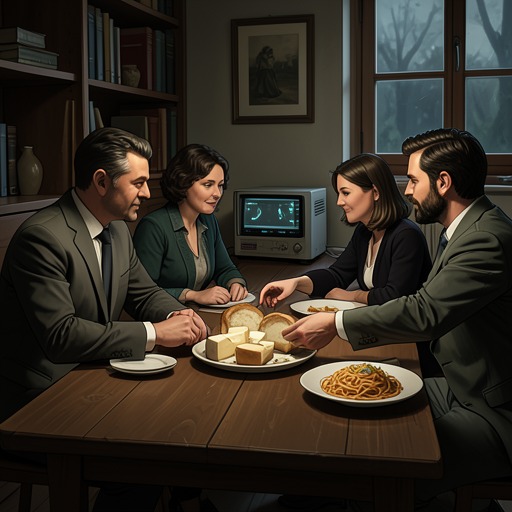
Marco's
My Hot Secret: Geheimes Baby mit dem CEO Milliardär - Enemies to Lovers (German Edition)Marco's is a long-established Italian restaurant that gives Gabriel and Ava's relationship one of its clearest early settings. Gabriel chooses it over more prestigious venues because its food is made with love rather than purchased glamour, while Ava initially expects little from its unpretentious appearance. The evening ultimately changes her judgment: Marco's becomes evidence that Gabriel's pleasure-seeking exterior can coexist with loyalty, care, craftsmanship, and a genuine understanding of family.
Setting and Character
Marco's is presented as a modest, middle-priced neighborhood restaurant rather than an exclusive destination. Ava sees exposed red-brick walls, dark wooden furniture, and checked tablecloths, the familiar visual language of a small Italian establishment. The room is not designed to impress through luxury, and it seems out of step with the extraordinary restaurants Ava has previously been fortunate enough to visit. Gabriel nevertheless considers it his favorite restaurant and has returned for years, a choice that immediately distinguishes personal attachment from status consumption.
Gabriel's connection to the restaurant is visible before the meal begins. He greets the servers as old friends, knows each of them by name, and asks sincerely how they are doing. This behavior makes the restaurant feel less like a service venue than a community in which Gabriel has a place. The contrast matters to Ava because Gabriel is more extroverted than she is, yet his sociability here is not merely performance. His familiarity is attentive and reciprocal, and it gives her an early view of the caring side beneath his easy confidence.
Marco and Valentina
The restaurant's owners, Marco and Valentina, embody the familial world Gabriel values. Marco comes from the back of the restaurant with a broad smile and welcomes Gabriel warmly; the two men greet one another like old friends, exchanging shoulder pats across the room. When Marco asks whom Gabriel has brought, he assumes that the woman invited there must be someone special. The question briefly exposes the emotional stakes of the dinner, because Ava waits for Gabriel's answer while feeling her face grow hot.
Gabriel introduces Ava as a friend. Valentina responds by embracing her rather than accepting a formal handshake and tells her that every friend of Gabriel's is also a friend of theirs. Marco teasingly challenges the word “friend,” but Valentina silences him with a look before drawing him away to leave the pair alone. Her affectionate insistence that Gabriel visit more often so they can feed him reveals a relationship built on habitual care, not transactional hospitality. Valentina's gesture also allows Ava to witness a form of family intimacy that prompts her to wonder what Gabriel's own family is like, even though she is not yet ready to ask directly.
Gabriel explicitly recognizes what Marco and Valentina represent: they understand what family means. That observation gives the restaurant significance beyond its décor and menu. Marco's offers Ava a living model of belonging, sustained through repeated visits, work shared across generations, affectionate teasing, and food made for people rather than merely sold to them.
Food, Labor, and Taste
Food is the restaurant's central language of value. Marco personally brings out the dishes, presenting them with the same enthusiasm Gabriel had shown while recommending them. His love of cooking is unmistakable, and the meal makes audible the labor and pride behind the menu. Gabriel urges Ava to try the gnocchi, explaining that Marco fries them rather than simply boiling them, then combines them with garlic, butter, herbs, and a blue-cheese sauce whose recipe remains a family secret. Ava's amused resistance gives way to curiosity because Gabriel's delight makes the dish difficult to refuse.
The meal becomes a playful contest over taste. Marco asks whether they enjoyed it, and Gabriel challenges Ava to decide whether it is the best food she has ever eaten. She had initially doubted that an ordinary-looking restaurant could compete with the celebrated establishments she knew, but she eventually admits that she was wrong. Gabriel enjoys the victory without dwelling on it, and the evening continues with shared plates, stolen bites, and a tiramisu Ava deliberately savors for as long as possible. The restaurant therefore converts skepticism into embodied knowledge: Ava does not merely revise an opinion about Gabriel's favorite place; she experiences the quality he had defended.
Gabriel's defense of Marco's is also tied to his history and his judgment about class. He has eaten in some of the world's finest restaurants but believes that money, spectacle, and exclusivity do not make food delicious. Marco's occupies a middle price range, and the family has owned it for decades. In his view, earning the loyalty of people who must spend hard-earned money is more difficult than persuading wealthy customers to pay for prestige. The restaurant's durability is consequently treated as proof of quality and devotion. Gabriel respects Marco and Valentina because they practice their craft with the same kind of love he puts into baking, and because their work resists the empty pursuit of exclusivity associated with his father's obsession with money.
Role in Ava and Gabriel's Relationship
Marco's functions as a test of Gabriel's suitability, although Ava does not initially frame the dinner simply as a date. She is still evaluating him as a possible father and remains uncertain whether his enjoyment of life signals selfishness or a refusal to commit. At the restaurant, however, his conduct repeatedly complicates that suspicion. He knows the workers, treats Marco and Valentina as trusted friends, speaks passionately about food, and gives Ava space rather than forcing intimacy. The dinner shows her that pleasure can involve attention and responsibility rather than escape alone.
The setting also lets Ava participate without surrendering control. She chooses the gnocchi after hearing Gabriel's recommendation, questions his confidence, and finally concedes the meal's excellence on her own terms. Their teasing and the occasional exchange of food create closeness without erasing the boundary she is trying to maintain. When the evening ends, Gabriel pays the bill and they leave after a warm farewell from Marco and Valentina; outside, beneath trees decorated with strings of lights, he places a hand around Ava's and asks her to spend the night with him. The invitation follows an evening in which attraction has been grounded in observation, shared pleasure, and social trust.
Narrative Significance
Marco's stands against the city spaces governed by work, reputation, and display. It is intimate, familiar, and visibly shaped by people who have devoted decades to a craft. Its middle-priced status does not diminish it; instead, the restaurant's value lies in the loyalty it has earned and the care that can be tasted in its food. This makes it a counterpoint to both elite consumption and Gabriel's inherited association with wealth.
For Ava, the restaurant is a place where an abstract question becomes concrete. She is asking whether Gabriel can be more than a charming man who lives for immediate pleasure, and Marco's answers through his relationships: Gabriel is known, welcomed, teased, and expected to return. The family atmosphere does not prove that he can become a father, but it gives her a credible first sign that he understands attachment as something enacted through presence and care. By the end of the meal, her doubts remain, yet she no longer wants the evening to end. Marco's thus marks an important shift in her perception, turning a supposedly casual dinner into one of the settings where Gabriel's capacity for connection becomes visible.